TJ-144
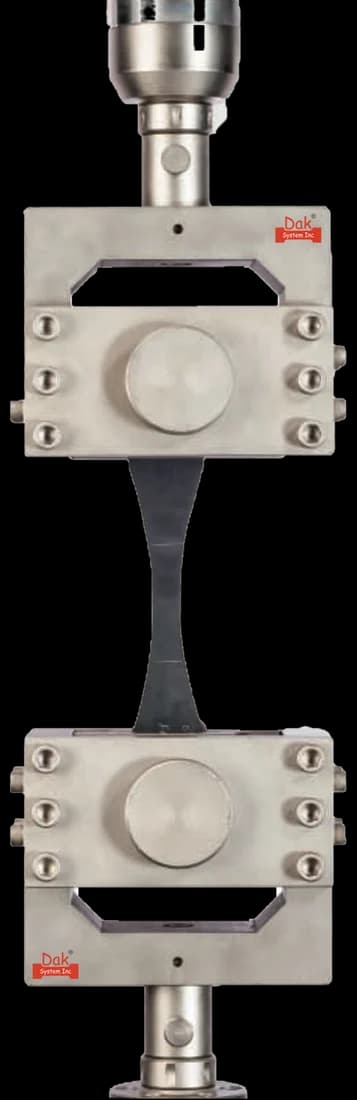
Heavy Duty Hydraulic Grips
Heavy duty hydraulic wedge grips with serrated inserts bite into a ribbed bar and hold as it necks, which is where mechanical wedges tend to let go.
Specifications
Testing standard
Steel for the reinforcement and prestressing of concrete — Test methods — Part 1: Reinforcing bars, rods and wire
Written and technically reviewed by Dak System Inc. engineeringLast reviewed
ISO 15630-1 is the ISO test method collection for reinforcing bars, rods and wire — tensile, bend, rebend and fatigue. Its most consequential rule is that stresses are calculated on the nominal cross-sectional area derived from the bar's mass per metre, never on the measured area of a ribbed section.
From the test method to your testing system
Explore the DAK machines already listed for ISO 15630-1, then review the grips, measurement and setup requirements below.
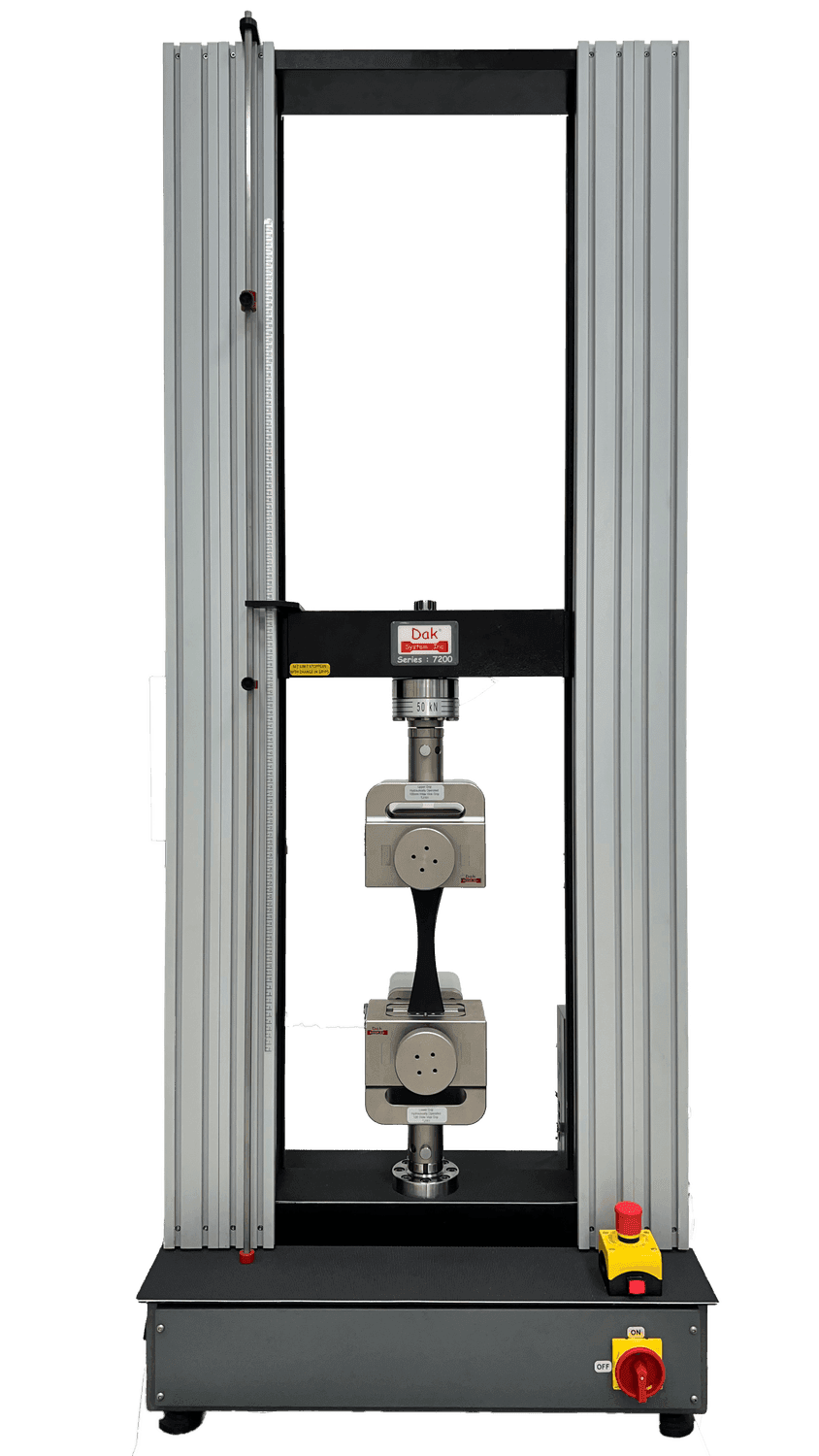 Universal Testing MachineSeries 7200Explore the machine →
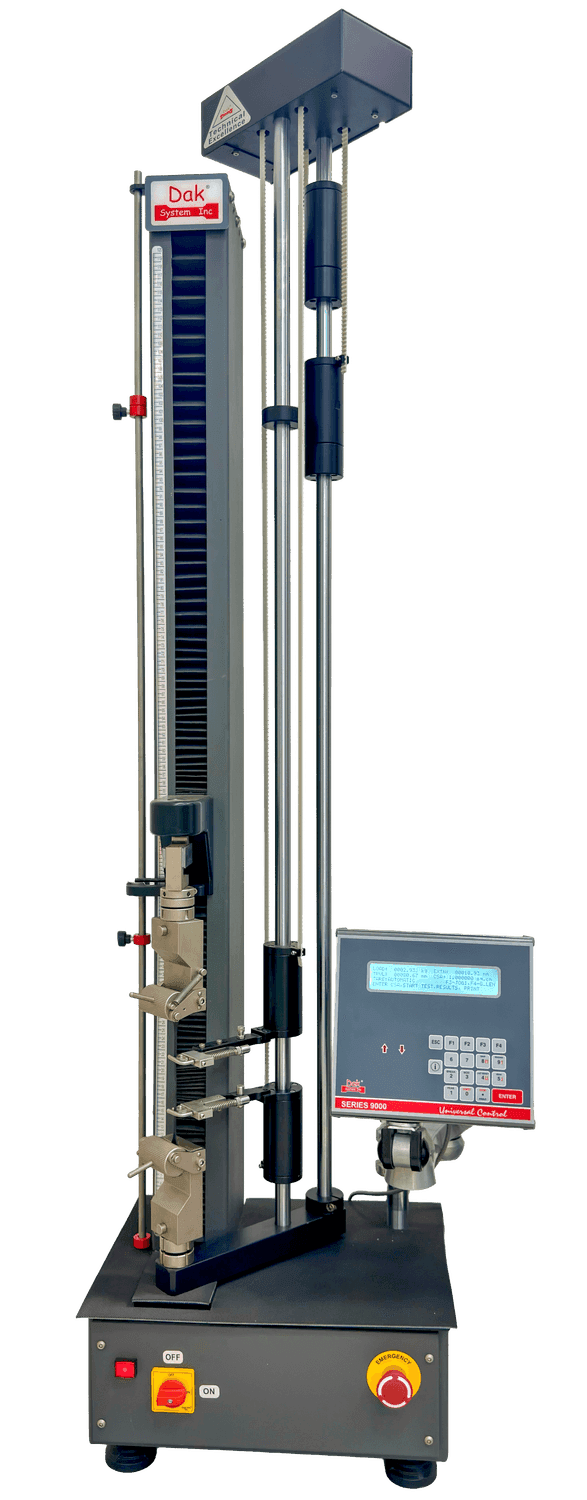 Universal Testing MachineSeries 9000Explore the machine →
01Understand the method
This is a collection of methods rather than a single test. The tensile method grips a full bar section in serrated wedges and pulls it at the rates ISO 6892-1 sets, reporting yield strength, tensile strength, their ratio and elongation. The bend method takes the bar over a mandrel of specified diameter and examines the outer surface. The rebend method bends it, holds it at an elevated temperature for a specified time, and then bends it back. An axial fatigue method completes the set. The values these are judged against come from a product standard such as ISO 6935, not from here.
Strength, ductility and resistance to strain ageing, all on the bar as a product rather than on the steel as a material. The distinguishing convention is the cross-sectional area: it is calculated from the mass of a measured length divided by the density of steel, never measured with callipers. A ribbed bar has no single measurable section — the answer depends on whether the jaws land on a rib — and stresses can shift by several per cent for the same bar. Every specification's strength value assumes the mass-derived nominal area, so departing from it invalidates the comparison. At the mill, where every heat and every rolled size is verified against the product standard before despatch, and at the receiving end, where a contractor or a third-party laboratory tests bar as delivered to site. Reinforcement is one of the few construction materials that is routinely retested after purchase, because the consequence of an under-strength bar is buried in concrete and unrecoverable. The fatigue method is used less often but matters for bridge decks and any structure carrying repeated live load, where the bar sees millions of cycles rather than a single design load.
02Prepare the specimen and test settings
A ribbed bar has no meaningful measurable cross-section. The nominal area comes from the mass per metre and the density of steel, and every stress in the report rests on it.
Rebar is tested as the product, ribs and all. That is the difference between this and a general metals tensile standard, and it is why the nominal area convention exists.
ISO 15630-1 does not set rates of its own: clause 5.3 requires the tensile test to be performed in accordance with ISO 6892-1, so that document's two control modes and their figures apply.
03Build the test setup on a DAK machine
Considerable force — a 32 mm bar in a 600 MPa grade needs well over five hundred kilonewtons, and larger diameters proportionally more. Hydraulic wedge grips with serrated inserts sized for the diameter are effectively required, because the clamping force must hold as the bar necks and mechanical wedges tend to release at exactly the load being recorded.
The tensile test is run in accordance with ISO 6892-1, so its rates are the ones to set. Stress-rate control gives 6 to 60 MPa/s in the elastic range — on a 16 mm bar, mass-derived nominal area 201 mm², a force rate of 1.2 to 12 kN/s; on a 32 mm bar, 804 mm², of 4.8 to 48 kN/s. The preferred strain-rate control gives 0.00025 s⁻¹ ±20 % through the yield or proof strength, then 0.0067 s⁻¹ to fracture, which without closed-loop control is the strain rate multiplied by the free length between the grips: about 5 and 130 mm/min on a 300 mm free length. A rebend jig with mandrels of the specified diameters, and a conditioning oven for the ageing step, complete the requirement.
Heavy duty hydraulic wedge grips with serrated inserts bite into a ribbed bar and hold as it necks, which is where mechanical wedges tend to let go.
SpecificationsDak verifies against whichever standard the method names, and where a class applies our frames sit a class tighter than it asks.
| The method asks for | Dak supplies | |
|---|---|---|
| Capacity | High — a 32 mm bar in a 600 MPa grade needs well over 500 kN | Load cells from 1 kg to 60 ton on the Series 7200, and 0.5 to 100 kN on the Series 9000 |
| Force accuracy | ISO 7500-1 Class 1 over the working range | ISO 7500-1 Class 0.5 — a class tighter than the method asks |
| Strain measurement | An extensometer of the class the method specifies | Certified to ISO 9513 Class 1 and ASTM E83 — non-contact video, clip-on and high-elongation |
| Gripping | Serrated wedge grips sized for the bar diameter, plus a rebend jig for the bend and rebend tests | Our self-tightening serrated wedge grips, with V-jaws for round specimens, built to the specimen |
| Environment | 23 ± 2 °C standard laboratory atmosphere | 3009 series chambers, −150 °C to +400 °C — temperature only |
04Run the test
05Calculate, report and interpret
Sn = m / (ρ × L)
This, not a calliper measurement, is the area every reported stress is divided by.
Rm / Re
A required figure for seismic grades, because a bar that yields and then immediately fails cannot redistribute load in a frame.
Measuring the section instead of weighing the bar is the error that quietly shifts every stress in the report. Gripping too close to the expected fracture voids the test and reads low. Reporting tensile strength without yield strength makes the tensile-to-yield ratio uncomputable, which matters because seismic grades specify a minimum for it — a bar that yields and immediately fails cannot redistribute load through a frame. And treating the rebend as a second bend, without the ageing hold, removes the only thing it was measuring.
06Compare methods and find answers
| ISO 15630-1 | ASTM A370 | |
|---|---|---|
| Scope | Reinforcing bar, rod and wire specifically | Steel products generally, with a rebar annex |
| Area | Nominal, from mass per metre | Nominal, from mass per metre |
| Includes | Tensile, bend, rebend, fatigue | Tensile, bend, hardness, impact |
| Paired with | ISO 6935 product standards | ASTM A615 and A706 |
Both use the mass-derived nominal area, which is the convention that matters most. The difference is scope: ISO 15630-1 is written for reinforcement alone and carries the rebend and fatigue methods with it.
It is the ISO collection of test methods for steel reinforcing bars, rods and wire — tensile, bend, rebend and axial fatigue. It supplies the methods; the acceptance values come from the product standards such as ISO 6935 or a national specification.
Because a ribbed bar has no meaningful measurable cross-section. Callipers give a different answer depending on whether they land on a rib, between ribs, or across the longitudinal rib, and the resulting stress can vary by several per cent for the same bar. Weighing a measured length and dividing by the density of steel gives a nominal area that is repeatable and is what every specification's strength values assume.
No, and this is a deliberate difference from general metals tensile testing. The bar is tested at full section with its ribs intact, because the product being qualified is the bar as it will be cast into concrete. Machining a smooth gauge section would test the steel rather than the reinforcement, and would remove the rib geometry that governs both bond and where cracks start.
Strain ageing. The bar is bent over a mandrel, held at an elevated temperature for a specified time, and then bent back. The ageing step is the whole point — some steels become brittle after being strained and then aged, which is exactly what happens to a bar that is bent on site and later loaded. A plain bend test cannot reveal that.
Because it describes what happens after first yield. A bar that yields and then fails almost immediately cannot redistribute load, so a frame designed to shed energy through plastic hinging has nowhere to shed it. Seismic grades therefore specify a minimum ratio, which means both the yield and the tensile figure must be reported, not the strength alone.
The test is void. A fracture in the jaws reflects the damage the serrations did to the surface, not the strength of the bar, and it almost always reads low. Gripping well clear of the intended fracture region, with inserts matched to the bar diameter, is what prevents it — and checking the fracture position is part of validating the result, not an afterthought.
Considerable force. A 32 mm bar in a 600 MPa grade needs well over five hundred kilonewtons, and larger diameters more. It also needs hydraulic grips that hold their clamping force as the bar necks, since mechanical wedges tend to release at exactly the point where the maximum load is being recorded.
Discuss your specimen, test requirements and reporting needs with DAK engineering.
This page describes the method as practised. The governing text is the current edition from the issuing body. Tell us what you are testing and we will answer with the machine, the fixture and a quotation.