Flexible cellular polymeric materials — Determination of tensile strength and elongation at break
Written and technically reviewed by Dak System Inc. engineering·Last reviewed
ISO 1798 measures the tensile strength and elongation at break of flexible cellular materials — foams. A dumbbell specimen is pulled at 500 mm/min until it breaks. Strength is calculated on the original cross-section and elongation from grip separation, because a clip-on extensometer would load the foam enough to change the answer.
A dumbbell specimen is cut from flexible foam with a sharp die, typically 10 ± 1 mm thick and with a 50 mm gauge length, and clamped in wide flat grips closed at the lowest pressure that will hold it. The crosshead separates at 500 ± 50 mm/min and the specimen is pulled until it breaks. Force is recorded against grip separation throughout. Tensile strength is calculated from the force at break and the original cross-sectional area; elongation at break is calculated from the change in grip separation. No extensometer is used, because a contacting gauge would indent a flexible foam enough to alter the result.
What it measures, and why it matters
The method reports two numbers: tensile strength, in kilopascals, and elongation at break, as a percentage. Neither describes how a cushion will feel — that is governed by the compression properties — but both describe what the foam has to survive. Upholstery foam is stretched over frames, mattress cores are handled and compressed into packaging, technical foams are die-cut and pulled through assembly. A foam with adequate compression behaviour and poor tensile strength tears during fabrication. Both figures are also sensitive indicators of cell structure and cure state, which makes them useful production controls: a change in tensile strength usually shows before anything appears in density.
Specimen
Foam is cut, not machined, and how it is cut decides the result more than anything else in the method.
Form
Dumbbell, cut with a sharp die
Thickness
10 ± 1 mmCut from the interior of the block wherever possible.
Gauge length
50 mm
Remove the skin
Always, unless the skin is the subjectThe moulded skin is denser than the core and carries a disproportionate share of the load, so a specimen with skin on one face reads high and breaks unevenly.
Conditioning
At least 16 h at 23 ± 2 °C, 50 ± 5 % RH
Cut with a fresh blade
Every sessionDakA blunt die crushes cell walls at the edge and creates the notch the specimen then breaks from. Edge quality is the largest source of scatter in foam tensile testing.
Let cut specimens rest
Before testingDakCutting deforms the cells locally and they take time to recover.
A specimen that breaks at or inside the jaw has not measured the material. Foam crushes under clamping pressure, so the jaw line is a stress concentration by default — the grip pressure has to come down until breaks move into the gauge length.
Test speed
Crosshead speed
500 ± 50 mm/minFast by the standards of rigid materials, and appropriate to a material that reaches very high elongation.
Elongation source
Grip separationA contacting extensometer would indent the foam and change the very thing it is measuring.
Set the lowest grip pressure that holds
Then check where breaks occurDakPressure is tuned by result, not by feel: raise it until slipping stops, then stop raising it.
Calculations
Tensile strengthσt
σt = F / A₀
F
force at break, N
A₀
original cross-sectional area, mm²
Original area, measured on the uncompressed specimen. Foam necks heavily before break and none of that reduction enters the figure.
Elongation at breakεb
εb = (L − L₀) / L₀ × 100
L
grip separation at break, mm
L₀
initial gauge length, mm
Taken from grip separation, so any slippage is counted as elongation. This is the reason slipping has to be eliminated rather than tolerated.
How the test runs
01Cut dumbbells with a sharp die from the interior of the block, avoiding the skin.
02Check thickness at several points and record the mean cross-section.
03Condition at least 16 h at 23 ± 2 °C and 50 ± 5 % RH.
04Fit wide flat grip faces and set the lowest clamping pressure that will hold.
05Mount the specimen square, with no pre-tension and no sag.
06Set the initial grip separation to the gauge length.
07Pull at 500 mm/min, recording force against grip separation.
08Continue to break.
09Discard and re-run any specimen that broke at or inside the jaws.
10Calculate strength on the original area and elongation from grip separation.
The fixture this method needs
HJ-42
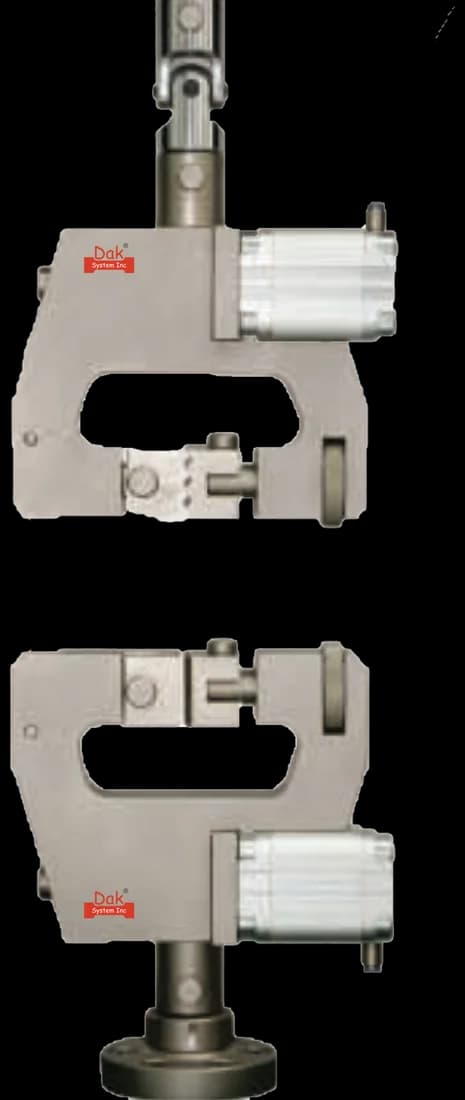
Light Duty Pneumatic Grip
Light duty pneumatic grips. The requirement here is the opposite of most tensile work — the useful property is a clamping force low enough not to crush the cell structure at the jaw line, with faces wide enough to spread what force there is.
Tensile strength and elongation at break for each specimen
Mean and standard deviation
Number of specimens discarded for jaw breaks
What the machine must be capable of
Very little force and a great deal of travel. Most flexible foams break below 100 N and many below 30 N, so the load cell has to be small enough that these forces sit comfortably inside its accurate range — a cell sized for metals will report foam as noise. Accuracy to ISO 7500-1 Class 1 is needed over the working range rather than at full scale. The crosshead must hold 500 mm/min and have enough stroke for elongations that commonly exceed 100 %. The grips matter more than the frame: wide flat faces, and a clamping force low enough not to crush the cell structure at the jaw line.
What goes wrong in practice
Almost every problem in foam tensile testing is a grip problem or a cutting problem. Grips closed at the pressure a laboratory uses for plastics will crush the foam, creating a band of collapsed cells at the jaw line from which the specimen then breaks — the result describes the clamping, not the material. Because elongation is taken from grip separation, slippage in the other direction is equally damaging and is silently counted as extra elongation. On the cutting side, a blunt die is the commonest single cause of scatter, and specimens taken too near the block surface carry skin that reads high. A fourth error is using a load cell far too large for the forces involved, which buries a 20 N break in the noise of a 5 kN channel.
ISO 1798 or ASTM D3574 Test E
ISO 1798
ASTM D3574 Test E
Speed
500 ± 50 mm/min
500 mm/min
Elongation from
Grip separation
Grip separation
Specimen
Dumbbell, 10 ± 1 mm thick
Dumbbell, comparable proportions
Conditioning
16 h at 23 °C / 50 % RH
Per D3574 conditioning requirements
These two are close in intent and often quoted interchangeably, and for many foams they agree. They are still separate documents with their own dimensional details, so a certificate should name the one actually run rather than the one the customer asked about.
Questions we are asked about this test
What is ISO 1798?+
It is the ISO method for the tensile strength and elongation at break of flexible cellular materials — foams. A dumbbell specimen is pulled at 500 mm/min until it breaks. Tensile strength is calculated on the original cross-section and elongation is taken from grip separation.
Why not use an extensometer?+
Because a contacting extensometer has to grip or rest on the specimen, and a flexible foam deforms under the weight and clamping of the gauge itself. The instrument would change the thing it was measuring. Grip separation is the accepted compromise, and it is why eliminating slippage matters so much — any slip is counted as elongation.
My specimens keep breaking at the grips. What do I change?+
The clamping pressure, first. Foam crushes under ordinary grip force, and a crushed band at the jaw line is a built-in notch. Reduce the pressure to the lowest that will hold the specimen, and use wide flat faces to spread it. If breaks still occur at the jaws, check the die — a blunt blade leaves crushed cell walls along the cut edge that behave the same way.
Does the skin have to come off?+
Unless the skin itself is what you are characterising, yes. Moulded skin is considerably denser than the foam core and carries a disproportionate share of the load, so a specimen with skin on one face reads high and tears unevenly. Cutting specimens from the interior of the block is the normal practice.
Why does foam tensile strength scatter so much?+
Mostly because of the cut. Foam has a cellular structure with a length scale you can see, so an edge with crushed or torn cells is a real defect rather than a surface finish issue. A fresh sharp die, specimens cut from the block interior, and a rest period after cutting remove most of the scatter that operators usually attribute to the material.
Is tensile strength a useful property for foam?+
It is useful for what foam has to survive rather than what it has to do in service. Cushioning performance is governed by compression properties — indentation hardness and compression stress-strain. Tensile strength matters for handling, cutting, upholstery tension, and resistance to tearing during fabrication and use, and it is a sensitive indicator of cell structure and cure.
How does this relate to ASTM D3574?+
ASTM D3574 is a collection of lettered tests for flexible foam, and its Test E covers tensile strength and elongation in much the same way, at the same 500 mm/min. The two are close enough to agree on most foams, but they are separate documents with their own dimensional details, so the certificate should name the method actually run.
This page describes the method as practised. The governing text is the current edition from the issuing body. Tell us what you are testing and we will answer with the machine, the fixture and a quotation.