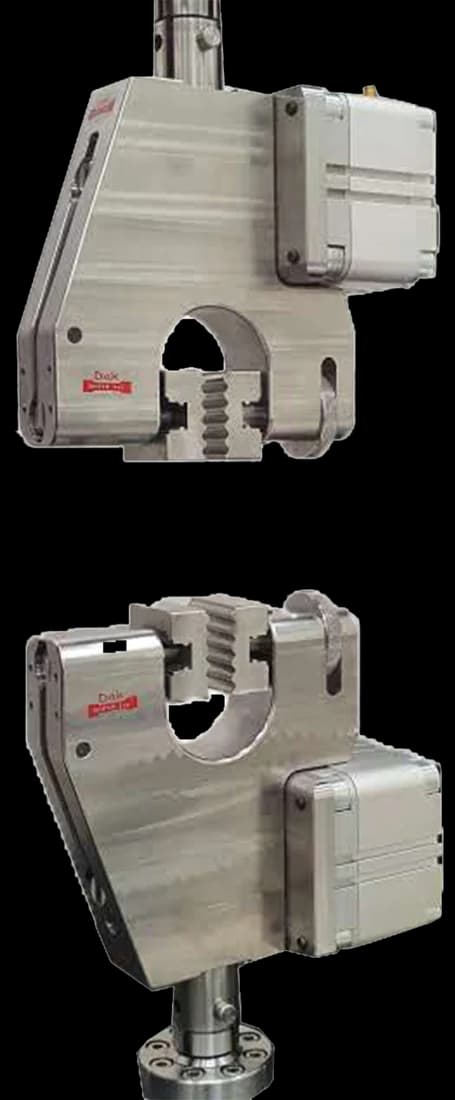
Standard 25 mm
Pneumatic Vice Action Grip
Pneumatic vice action grips clamp the full specimen width at a constant, even pressure — which is what stops one side slipping or tearing before the other.
Specifications
Testing standard
Paper and board — Determination of tensile properties — Part 2: Constant rate of elongation method (20 mm/min)
Written and technically reviewed by Dak System Inc. engineeringLast reviewed
ISO 1924-2 measures the tensile strength, strain at break and tensile energy absorption of paper and board using a constant rate of elongation of 20 mm/min. It also gives the equations for tensile index, TEA index and modulus of elasticity.
From the test method to your testing system
Explore the DAK machines already listed for ISO 1924-2, then review the grips, measurement and setup requirements below.
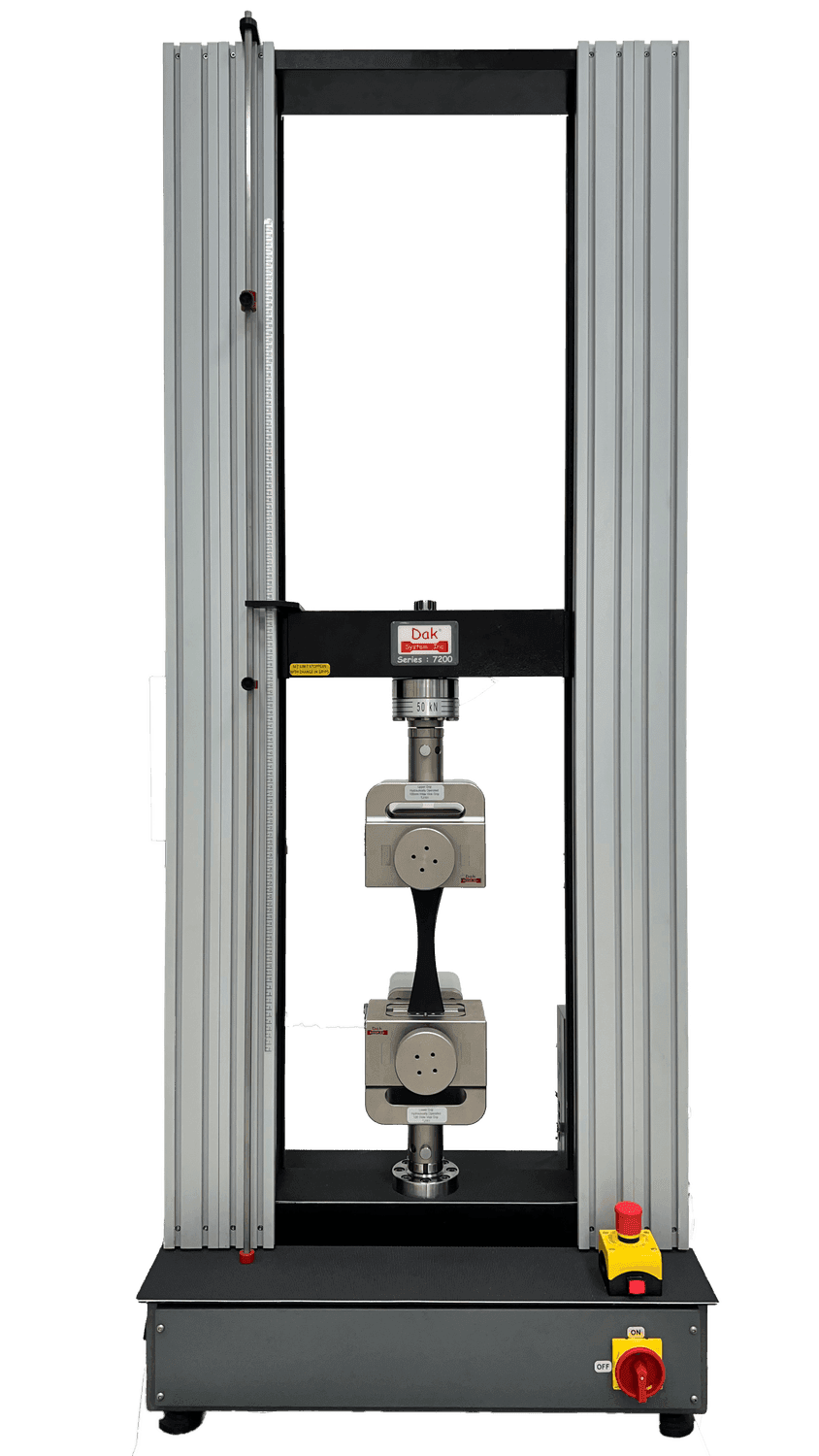 Universal Testing MachineSeries 7200Explore the machine →
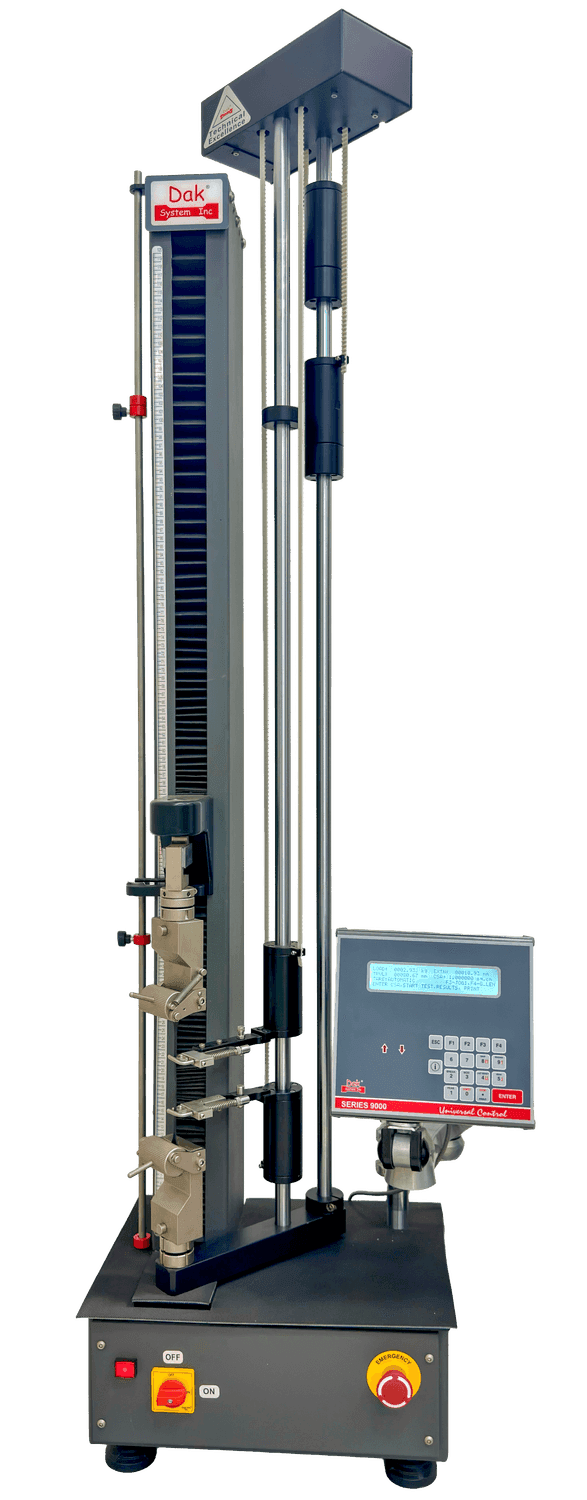 Universal Testing MachineSeries 9000Explore the machine →
01Understand the method
Conditioned strips are cut in the machine and cross directions and pulled at a constant rate of elongation of 20 mm/min until they break, with force and elongation recorded throughout. Three quantities come directly from the run: the tensile strength as maximum force per unit width, the strain at break, and the tensile energy absorption, which is the area under the force-elongation curve. The standard also supplies equations for the tensile index, the TEA index and the modulus of elasticity, all of which normalise by grammage.
How strong the sheet is, how far it stretches, and how much work it absorbs before failing. The third of these is the one most easily overlooked and often the most useful: TEA combines strength and stretch into a toughness figure, and two papers of identical tensile strength can differ markedly in it. The tougher one survives converting, printing and handling better, which is why sack and bag papers are specified on TEA as much as on strength. Everything is normalised by grammage rather than thickness, because a sheet compresses under the gauge and its thickness depends on how hard it was measured.
02Prepare the specimen and test settings
Part 2 runs at 20 mm/min and Part 3 at 100 mm/min. They are the same test at different speeds, and they do not give the same numbers.
Paper is normalised by grammage. Tensile index is strength divided by grammage, and it is the figure that lets a light sheet and a heavy one be compared at all.
03Build the test setup on a DAK machine
Low force, a well-controlled slow rate, and grips that hold a sheet without crushing it. Most papers break between a few newtons and a few hundred, so the load cell is sized for the paper rather than for the frame. The rate matters as much as the force here — 20 mm/min is not a default but a defining parameter, and a machine that cannot hold it accurately is producing Part 3 results under a Part 2 heading. Elongation is normally taken from grip separation, which the method accommodates.
Pneumatic vice action grips clamp the full specimen width at a constant, even pressure — which is what stops one side slipping or tearing before the other.
SpecificationsDak verifies against whichever standard the method names, and where a class applies our frames sit a class tighter than it asks.
| The method asks for | Dak supplies | |
|---|---|---|
| Capacity | Low — most papers break between a few newtons and a few hundred | Load cells from 1 kg to 60 ton on the Series 7200, and 0.5 to 100 kN on the Series 9000 |
| Force accuracy | Class 1 over the working range | ISO 7500-1 Class 0.5, verified to ASTM E4, DIN 51221 and BS 1610 |
| Gripping | Wide flat grips holding the full strip width without cutting or crushing the sheet | Wedge, vice-action, pneumatic and hydraulic grips, built to the specimen |
| Environment | 23 ± 2 °C standard laboratory atmosphere | 3009 series chambers, −150 °C to +400 °C — temperature only |
04Run the test
05Calculate, report and interpret
σ = F / w
Force per unit width, in kN/m. Not a stress — paper thickness is not a usable area.
Tensile strength divided by grammage
The normalisation that makes papers of different substance comparable. It is why paper is specified by index rather than by strength alone.
The area under the force-elongation curve, per unit area of specimen
A toughness measure. Two papers of equal strength can differ greatly in TEA, and the tougher one survives handling better.
Citing ISO 1924 without the part number, which leaves a reader unable to tell whether the result came from 20 or 100 mm/min on a rate-sensitive material. Averaging machine and cross direction. Computing a stress from a measured thickness instead of using the grammage-normalised index. Creased or crushed specimens, which read low and look like material variability. And reporting strength alone where the application is actually governed by toughness, which is what TEA exists to describe. The last one is quiet but common: determining the index values from a nominal grammage taken off the specification rather than from the grammage of the sheet actually tested, which puts an error straight into every normalised figure.
06Compare methods and find answers
| Part 2 | Part 3 | |
|---|---|---|
| Rate | 20 mm/min | 100 mm/min |
| Method | Constant rate of elongation | Constant rate of elongation |
| Results | Not interchangeable | Not interchangeable |
| Cite | Always with the part number | Always with the part number |
Paper is rate-sensitive, so the same sheet gives different numbers at 20 and 100 mm/min. The rate is in each part's title precisely so that citing the part is enough to reproduce the result.
It is the ISO tensile test for paper and board run at a constant rate of elongation of 20 mm/min. It reports tensile strength, strain at break and tensile energy absorption, and gives the equations for tensile index, TEA index and the modulus of elasticity. The current edition is ISO 1924-2:2008, reviewed and confirmed in 2023.
Because it is the distinguishing feature. Part 2 runs at 20 mm/min and Part 3 at 100 mm/min, and they are otherwise the same method. Paper is rate-sensitive enough that the two give different numbers on the same sheet, so putting the rate in the title makes citing the part sufficient to reproduce a result — and makes citing plain ISO 1924 insufficient.
Because paper thickness is not a reliable quantity. A sheet compresses under the pressure used to measure it, so a thickness — and therefore any stress computed from it — depends on how hard the gauge pressed. Grammage, the mass per unit area, is unambiguous. That is why the tensile index, strength divided by grammage, is the figure papers of different substance are compared on.
Toughness. TEA is the area under the force-elongation curve, so it combines strength and stretch into the work the sheet absorbs before it breaks. Two papers of identical tensile strength can differ substantially in TEA, and the tougher one survives converting, printing and handling better — which is why a sack paper or a bag paper is specified on TEA as much as on strength.
Because paper is made on a moving wire and the fibres orient along the direction of travel. Machine direction is routinely twice the cross direction in strength, and the two behave differently in every converting operation. An average would describe neither and would allow a sheet to meet a specification while being weak across the web, which is where most running failures happen.
Usually it is taken from grip separation, which the method accommodates. Paper strains at break are small but the compliance correction is manageable at these gauge lengths and forces. For modulus work the case for a proper extensometer is stronger, since a modulus divides by a small strain and any error in it passes through undiminished.
Usually because the jaw crushed the sheet or because the strip was creased during handling. Paper has no yarns to redistribute load around damage, so a crushed edge or a fold line is simply a weak section, and the specimen breaks there. Handling strips by their ends and setting grip pressure high enough to hold but no higher removes most of these.
Discuss your specimen, test requirements and reporting needs with DAK engineering.
This page describes the method as practised. The governing text is the current edition from the issuing body. Tell us what you are testing and we will answer with the machine, the fixture and a quotation.