
Testing standard
ISO 3108 Steel Wire Rope Breaking Force Testing
Steel wire ropes — Test method — Determination of measured breaking force
Written and technically reviewed by Dak System Inc. engineeringLast reviewed
ISO 3108 specifies a tensile test to destruction for determining the measured breaking force of steel wire ropes. The rope is terminated in poured sockets at both ends rather than gripped, and the result is the force at which it actually broke — distinct from the calculated minimum breaking force.
At a glance
- Test type
- Tensile — the specimen is pulled apart
- Published by
- ISO
- Edition
- ISO 3108:2017
- Material
- Wire, cable & electrical
- Runs on
- Series 7200 and Series 9000
From the test method to your testing system
Explore DAK equipment for ISO 3108, then review the specimen and setup requirements below.
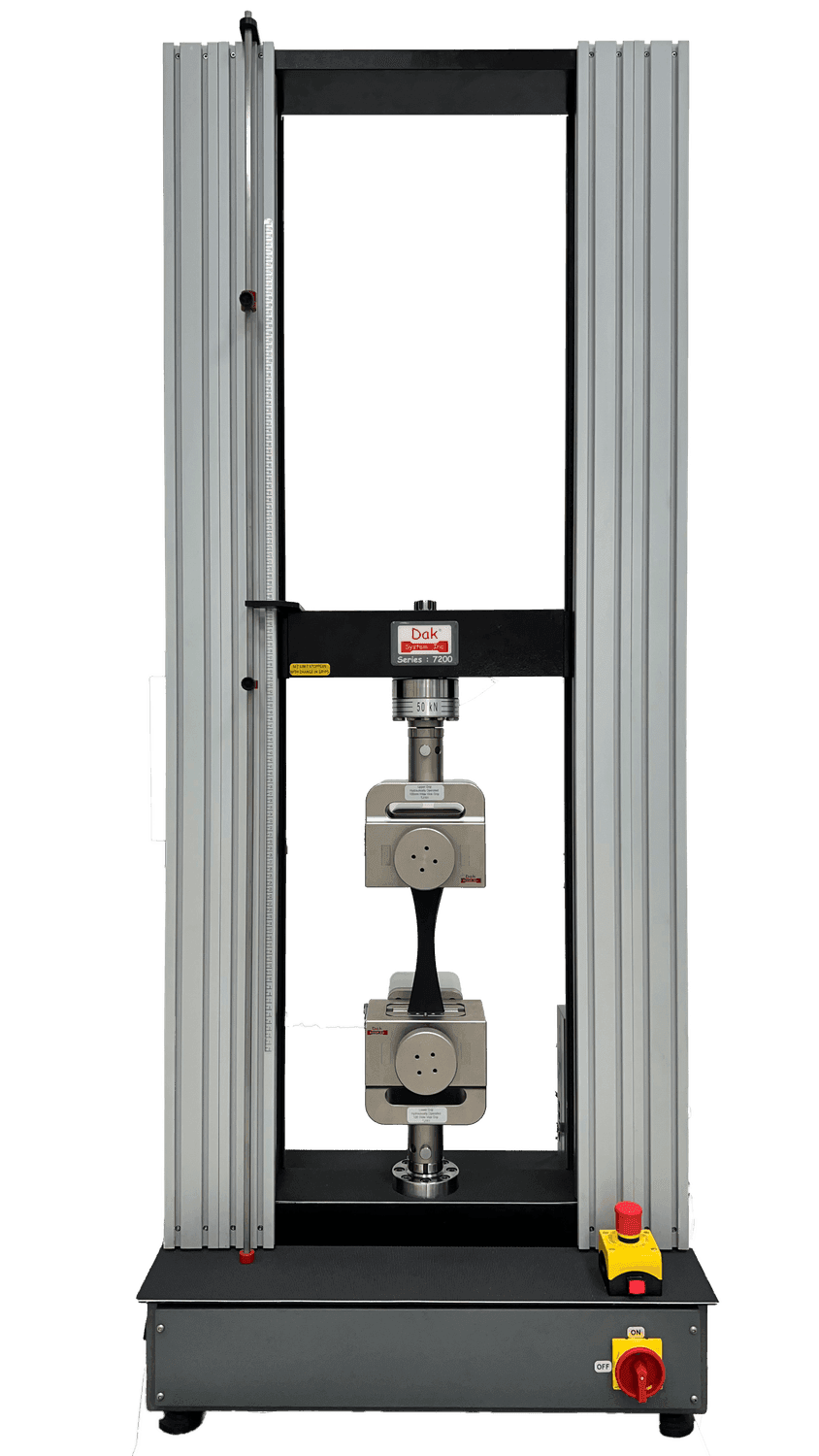 Universal Testing MachineSeries 7200Explore the machine →
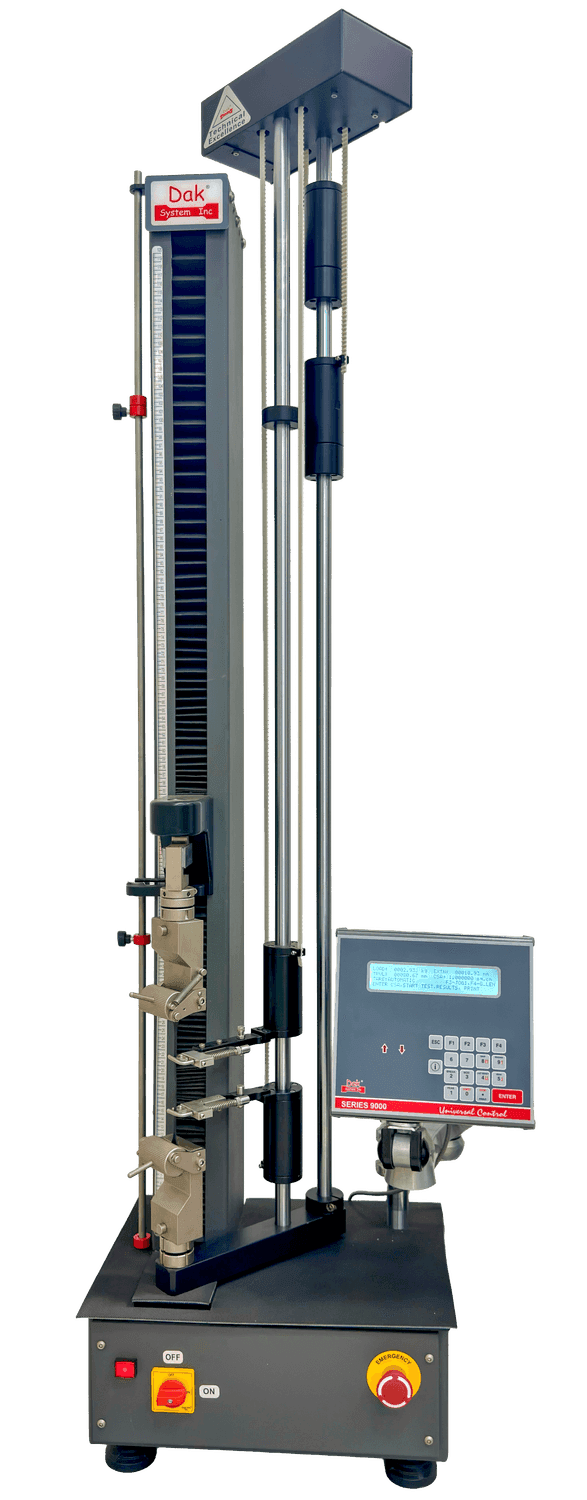 Universal Testing MachineSeries 9000Explore the machine →
Jump to a specific section
01Understand the method
What the test does
A sample of specified test length is cut, with extra for terminations. The ends are seized so they cannot unlay, the wires inside each socket are broomed and cleaned, and resin or white metal is poured and left to cure fully. The test length is then measured between the sockets, the sockets are pinned into the machine so the rope hangs axially, and the rope is loaded to destruction. The rate is set as a fraction of the rope's own strength rather than in millimetres per minute: force may be applied quickly up to 80 % of the minimum breaking force, and above that must not rise faster than 0,5 % of that force per second. The maximum force reached is the measured breaking force, and the position of the break is recorded.
What it measures, and why it matters
The force at which this particular rope actually broke — one of three breaking forces in rope documentation and the only one that comes from a test. The minimum breaking force is a requirement set by the product standard, the floor the rope must clear. The calculated breaking force is arithmetic, derived from construction and wire grade. Confusing them is the commonest error in rope paperwork, and the 2017 edition's renaming of the result from *actual breaking load* to *measured breaking force* was aimed at that confusion.
02Prepare the specimen and test settings
Measured, minimum, calculated
Three different breaking forces appear in rope documentation and only one of them comes from this test.
- Measured breaking force
- What this test producesThe force at which the rope actually broke, on the day, on that sample.
- Minimum breaking force
- A specified requirement from ISO 2408The floor the rope must clear. It is a specification value, not a measurement.
- Calculated breaking force
- Derived from the rope's construction and wire gradeAn arithmetic figure. Confusing it with the measured value is the commonest error in rope paperwork.
- Termination
- Sockets filled with resin or white metalA rope cannot be gripped: wedges crush it, it unlays, and it breaks at the jaw.
- Test length
- Specified, and measured between the sockets
- Let the socket resin cure fully before testing
- DakA socket pulled before the resin has developed strength fails at the socket, and that is not a rope result.
The 2017 edition renamed the quantity from actual breaking load to measured breaking force, aligning it with ISO 2408's vocabulary. Older certificates use the older term for the same thing.
Test speed
- Rate
- Not more than 0,5 % of the minimum breaking force per second, once 80 % of it is reachedBelow 80 % the force may be applied quickly. On a rope of 200 kN minimum breaking force that ceiling is 1 kN/s; on a 500 kN rope, 2,5 kN/s.
- Temperature
- 10 °C to 35 °C; 23 °C ± 5 °C for a strictly controlled test
- Discount the test
- If the rope breaks within six rope diameters of a termination without reaching the minimum breaking force
- Reported
- Measured breaking force
- Also applicable
- To other ropes, unless their own standard excludes it or gives another method
- Record where the rope broke
- Mid-length, or at a socketDakA break at the socket is a termination result and the test should be repeated.
03Build the test setup on a DAK machine
What the machine must be capable of
Force set entirely by the rope, and the range is enormous — a small rope breaks in the tens of kilonewtons while large structural and mooring ropes go far beyond a general-purpose laboratory frame. Because the rule is written against the minimum breaking force, the number to set follows from the rope: at a minimum breaking force of 200 kN the ceiling above 160 kN is 1 kN/s, so the last 40 kN takes at least 40 seconds; at 500 kN it is 2,5 kN/s. Below 80 % the force may be brought up quickly. Force control rather than position control is the sensible arrangement, and testing is done between 10 °C and 35 °C, or at 23 °C ± 5 °C where the test is strictly controlled. The frame also needs the length to accommodate the specified test length plus two sockets, pinned connections that let the rope hang axially without imposing bending, and enough stiffness and guarding that the energy released when a rope parts is contained.
Running ISO 3108 on the Series 7200 and Series 9000
Dak verifies against whichever standard the method names, and where a class applies our frames sit a class tighter than it asks.
| The method asks for | Dak supplies | |
|---|---|---|
| Capacity | Very high and set entirely by the rope — small ropes break in the tens of kilonewtons, large ones far beyond | Load cells from 1 kg to 60 ton on the Series 7200, and 0.5 to 100 kN on the Series 9000 |
| Force accuracy | Class 1 over the working range | ISO 7500-1 Class 0.5, verified to ASTM E4, DIN 51221 and BS 1610 |
| Strain measurement | An extensometer of the class the method specifies | Certified to ISO 9513 Class 1 and ASTM E83 — non-contact video, clip-on and high-elongation |
| Gripping | Sockets at both ends, filled with resin or white metal; the rope is never gripped in jaws | Our a fixture built for this method, built to the specimen |
| Environment | 23 ± 2 °C standard laboratory atmosphere | 3009 series chambers, −150 °C to +400 °C — temperature only |
04Run the test
How the test runs
- Cut a sample of the specified test length, allowing extra for the sockets.
- Seize the rope ends so they cannot unlay before socketing.
- Broom the wires inside each socket and clean them as specified.
- Pour the resin or white metal and allow it to cure fully.
- Measure the test length between the sockets.
- Pin the sockets into the machine so the rope hangs axially.
- Where a modulus is wanted, pre-stress the rope and fit an extensometer on the rope itself.
- Load to destruction — quickly to 80 % of the minimum breaking force, then at not more than 0,5 % of it per second.
- Record the maximum force as the measured breaking force.
- Note where the rope broke, and repeat if it failed at a socket.
- Compare against the minimum breaking force from the product standard.
05Calculate, report and interpret
Calculations
The maximum force reached before the rope fails
A force, not a stress. A rope has no meaningful cross-section — the wires are helical, so the metallic area and the enclosing circle are quite different things.
Measured breaking force must meet or exceed the minimum breaking force from ISO 2408
The acceptance criterion comes from the product standard, not from this test method.
Determined after pre-stressing, because a new rope beds in
The first loading of a rope includes the wires settling into their helical seats, which is construction stretch rather than elastic strain.
What the report has to contain
- Reference to ISO 3108 and the edition
- Rope identification: diameter, construction, grade, core type and finish
- The product standard the rope is supplied to
- Termination method and socketing medium
- Test length between sockets
- Rate of loading
- Measured breaking force
- Position of the break
- The minimum breaking force required, for comparison
- Any sample rejected for failing at a socket
What goes wrong in practice
Testing before the socket medium has fully cured, which fails at the termination and reads low. Reporting a measured breaking force without saying where the rope broke, so a socket failure passes as a rope result. Quoting a calculated or minimum breaking force as though it were measured. And determining a modulus without pre-stressing, which captures the wires bedding into their helical seats — construction stretch — rather than the steel behaving elastically. Sample length is a quieter one: a short sample restrains the rope from twisting as it takes load, so it does not behave as a long rope does in service, which is why the test length is specified rather than left to whatever offcut was to hand.
06Compare methods and find answers
ISO 3108 or ASTM A931
| ISO 3108 | ASTM A931 | |
|---|---|---|
| Reports | Measured breaking force | Measured breaking force, yield, elongation, modulus |
| Scope | Steel wire ropes, and other ropes by extension | Wire ropes and strand |
| Paired with | ISO 2408 for the requirements | The relevant ASTM product specification |
| Termination | Sockets | Sockets or equivalent |
Both destroy a socketed sample and both report the force it actually reached. A931 goes further into the stress-strain behaviour, which matters when a rope is being used as a structural element rather than only as a lifting medium.
Questions we are asked about this test
What is ISO 3108?
It is the ISO tensile test to destruction for steel wire ropes, determining the measured breaking force. It applies to ropes covered by ISO 2408 and, by extension, to other ropes unless their own standard excludes it or gives another method. The current edition is ISO 3108:2017, superseding the 1974 first edition.
Why can't a rope be gripped in wedges?
Because a rope is not a solid bar. Clamping it crushes the outer wires, and as tension rises the strands try to unlay against the grip, so the rope fails at the jaw at a force well below its real capacity. Terminating both ends in a conical socket filled with resin or white metal spreads the load into every wire individually and lets the rope break where it should — in its free length.
What is the difference between measured and minimum breaking force?
Measured breaking force is what this test produces: the force at which that particular sample actually broke. Minimum breaking force is a requirement from the product standard — the floor the rope must clear. There is also a calculated breaking force derived arithmetically from the construction and wire grade. All three appear in rope documentation, and confusing them is the commonest error in rope paperwork.
Why did the standard change its terminology?
The 1974 edition called the result the *actual breaking load*; the 2017 edition calls it the *measured breaking force*, aligning it with the vocabulary ISO 2408 uses for the family of breaking forces. It is the same quantity under a clearer name, but older certificates carry the older term, so a document mentioning actual breaking load is not describing a different test.
Why is a rope's modulus measured after pre-stressing?
Because a new rope beds in. The first time it is loaded, the wires settle into their helical seats and the strands compact against the core, producing an extension that is construction stretch rather than elastic strain. Measuring a modulus through that region would report the geometry settling rather than the steel deforming, so the rope is pre-stressed first.
What if the rope breaks at the socket?
The test should be repeated. A break at or in the socket reports the quality of the termination — brooming, cleanliness, cure — rather than the strength of the rope, and it invariably reads low. Recording the position of the break is therefore part of validating the result rather than an incidental observation.
Is the result a stress?
No, a force. A wire rope has no meaningful cross-sectional area: the wires are laid helically, so the metallic area, the area of the enclosing circle and the effective load-bearing area are all different numbers. Breaking force is reported as a force and compared against a specified minimum breaking force in the same units.
Related
Materials tested to it
The test it standardises
Industries that test to it
Other standards explained
Planning ISO 3108 testing?
Discuss your specimen, test requirements and reporting needs with DAK engineering.
This page describes the method as practised. The governing text is the current edition from the issuing body. Tell us what you are testing and we will answer with the machine, the fixture and a quotation.