Written and technically reviewed by Dak System Inc. engineering·Last reviewed
ISO 2408:2017 is the international requirements standard for steel wire ropes — round strand and compacted strand, uncoated, zinc-coated or Zn-Al coated. It specifies manufacture, dimensions, acceptance and marking, and sets the minimum breaking force a rope must reach. It is not a test method: the pull itself is run to ISO 3108, which terminates a length of rope, loads it quickly to 80 percent of the minimum breaking force and then at no more than 0.5 percent of that force per second until it breaks.
ISO 2408 is a requirements document, not a test method. It specifies manufacture, testing, acceptance, packing, marking and the certificate of quality for round strand and compacted strand ropes, uncoated, zinc-coated or Zn-Al coated. The measurement it calls up is ISO 3108, which determines the measured breaking force and carries no acceptance values of its own. Neither is usable alone.
The scope excludes more than people expect: ropes for mining, aircraft control, aerial ropeways and funiculars, and lifts are all outside it. The 2004 edition also excluded oil and gas and fishing; those exclusions went in 2017.
What it measures, and why it matters
Acceptance turns on one comparison. The measured breaking force must be greater than or equal to the minimum breaking force for that diameter and construction, taken either from the tables in the standard or as stated by the manufacturer.
Rope grade is not wire strength. A rope of grade 1770 is built from wires whose tensile strength grades fall between 1570 and 1960 N/mm², and the tabulated minimum breaking forces are calculated on the rope grade rather than on any individual wire. The 2017 revision raised the upper end of the grade 2160 band to 2360 N/mm².
Dimensional tolerance is one-sided throughout: every diameter tolerance runs from zero upward, so a rope may be oversize but never undersize.
Specimen, cutting and termination
A rope specimen is prepared, not machined, and ISO 3108 is prescriptive about it because a bad termination fails the rope before the rope fails.
Free test length, stranded rope
≥300 mm to 6 mm · ≥600 mm 6 to 20 mm · ≥30d 20 to 60 mm · ≥3000 mm above 60 mmExcluding terminations. d is the nominal diameter.
Free test length, spiral rope
≥500 mm to 6 mm · ≥1000 mm 6 to 20 mm · ≥50d 20 to 60 mm · ≥3000 mm above 60 mm
Total specimen
Test length plus an allowance for gripping
Large diameter
Six rope lay lengths may be neededA note to the table: below that, the rope may not develop its minimum breaking force.
Cutting
Abrasive wheel, percussive or shearingMethods that fuse the rope end shall not be used.
Temporary servings
Used to hold strands and wires during cutting
Permanent serving
Soft wire or strand that preserves the layCopper and brass wires should not be used. If the piece will be socketed with molten metal, the serving must survive that temperature.
Termination 1 — socketing
Molten metal from 6 mm rope or 0.5 mm wire; resin for all ropesPer ISO 17558.
Termination 2 — ferrule pressing
All core typesFor a fibre core, remove the core at the pressing section and replace it with a tapered steel bar of the same diameter.
Termination 3 — direct gripping
Spiral strand and other constructionsWedge grips on the rope itself.
Termination 4 — wrapping
Sheave diameter at least 16 × rope diameter
Test rate
The rate is in two parts, and the second part is where the result is made. It moved out of ISO 2408 into ISO 3108 at the 2017 revision.
Up to 80 % of Fmin
May be applied quickly
Above 80 % of Fmin
Not more than 0.5 % of Fmin per secondSo a rope with a 2000 kN minimum breaking force is loaded at no more than 10 kN per second through the last fifth.
Before 1974 practice
Approximately 10 MPa per secondThe ISO 3108:2017 Foreword records the change explicitly. A procedure written to the old figure runs the critical part of the test on a different basis.
Temperature
10 to 35 °C, or 23 ± 5 °C strictly controlled
Rotation
Prevent itClause 7.5 asks for effective measures; a rope free to unlay reads low.
Calculations
Minimum breaking forceFmin
Fmin = (d² × Rr × K) / 1000
Fmin
minimum breaking force, kN
d
nominal diameter of the rope, mm
Rr
rope grade, N/mm²
K
breaking force factor for the rope class, dimensionless
Stated identically in ISO 3108:2017 clause 3.2 and in the ISO 2408:2004 annex. The factor K depends on construction and core, and the 2017 revision changed that annex — no K value is published here because the current values could not be retrieved.
AcceptanceFm ≥ Fmin
measured breaking force ≥ minimum breaking force
Fm
the force at which the specimen broke, kN
The whole of acceptance, in one comparison.
How the test runs
01Measure the rope diameter first, on a straight portion under no tension or under not more than 5 % of Fmin.
02Take two measurements 90° apart at each of two positions at least 1 m apart, with an instrument spanning at least two adjacent strands; average the four.
03Cut the test length by abrasive wheel, percussion or shearing — never by a method that fuses the end.
04Apply temporary servings before cutting and a permanent serving of soft wire or strand.
05Terminate both ends by socketing, ferrule pressing, direct gripping or sheave wrapping.
06Mount the piece with its centre axis aligned to the grip centreline.
07Fit shielding around the specimen, the operator and observers.
08Load quickly to just over 80 % of the minimum breaking force.
09From there, load at not more than 0.5 % of Fmin per second until the rope breaks.
10Record the measured breaking force and compare it with Fmin.
11Discount the test if the fracture occurred within six rope diameters of a grip or termination and Fmin was not reached.
Uncontained wires during testing can impact and penetrate objects at a great distance. The standard says so itself, and shielding around the specimen as well as around the people is the stated minimum.
The fixture this method needs
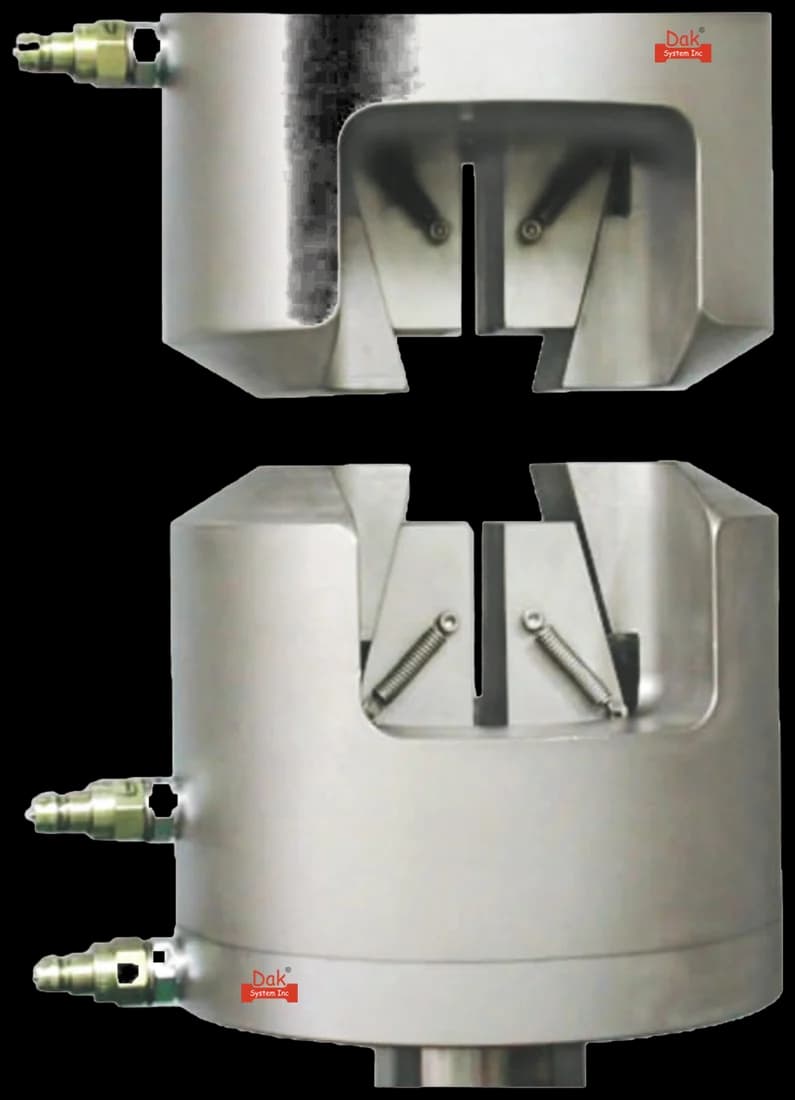
Self-tighteningTJ-135
Heavy Duty Circular Hydraulic Wedge Grips
Direct gripping in wedge jaws is one of the four terminations ISO 3108 permits, and suits spiral strand and smaller ropes. Round capacity to 38 mm and 400 kN covers the lighter end of the range; above that a rope is normally socketed and pulled between pin-mounted sockets rather than gripped.
Nominal diameter and the measured diameter as the average of four readings
Rope grade
Core type and lay direction
Minimum breaking force, and whether it came from the tables or from the manufacturer
Measured breaking force
Termination method used
Test temperature
Any discounted test and the reason
Length supplied, against the length tolerance
What the machine must be capable of
ISO 3108 requires the machine to comply with ISO 7500-1. It names no accuracy class, which is worth stating plainly rather than assuming class 1.
The rate changes partway. Force may be applied quickly until it exceeds eighty percent of the minimum breaking force; after that it must be applied at no more than 0.5 percent of that force per second. The 1974 edition asked for roughly 10 MPa per second, so a laboratory working from an old procedure runs the critical part of the test on the wrong basis entirely.
Testing is done between 10 and 35 °C, or at 23 ± 5 °C for a strictly controlled test. The specimen axis must align with the grip centreline, and the rope must be stopped from rotating during the pull.
Capacity is the real constraint. Minimum breaking force is diameter squared times rope grade times a construction factor, so it climbs with the square of the rope: a 60 mm six-strand rope at grade 1960 needs near 2500 kN. ZwickRoell describe extending a horizontal rope frame from 2500 to 3000 kN for this work.
The standard is unusually direct about safety, and rightly: uncontained wires during testing can impact and penetrate objects at a great distance, so shielding around specimen and operator is a minimum.
What goes wrong in practice
Terminations decide results more than the rope does. The standard says so itself — improper selection, attachment or alignment of a termination will reduce the measured breaking force. A fracture within six rope diameters of the grip is a discountable test rather than a failure, which is the standard admitting how often the termination is the weak point.
Diameter is measured wrongly more often than it is measured well. It must be taken on a straight portion under no tension, at two positions a metre apart, twice at each position ninety degrees apart, with an instrument spanning at least two adjacent strands to catch the circumscribed circle. Measuring across a single strand reads low and fails a rope that conforms.
The rest are quieter: fusing the end when cutting, brass servings, and letting the rope spin.
Rope grades and wire strength
Table 1. The rope grade is not the strength of any wire in it — the tabulated breaking forces are calculated on the rope grade rather than on individual wires.
Rope grade
Range of wire tensile strength grades (N/mm²)
1570
1370 to 1770
1770
1570 to 1960
1960
1770 to 2160
2160
1960 to 2360
The upper bound for grade 2160 was 2160 N/mm² in the 2004 edition and was raised to 2360 in 2017. Other grades may be supplied by agreement, referencing ISO 10425.
Diameter tolerance — oversize only
Table 2, as a percentage of nominal diameter. Every lower bound is zero: a rope may be over nominal, never under.
Rope type
Nominal diameter d (mm)
Wire or solid polymer centres
Fibre centres
Round steel wire rope
2 ≤ d < 4
+8 / 0
—
4 ≤ d < 6
+7 / 0
+9 / 0
6 ≤ d < 8
+6 / 0
+8 / 0
8 ≤ d < 60
+5 / 0
+7 / 0
d ≥ 60
+5 / 0
—
Compacted strand rope
d ≥ 10
+5 / 0
—
A separate table limits the difference between any two of the four diameter readings — 4 percent of nominal for ropes from 8 mm with wire centres, more for smaller ropes and for fibre centres. An out-of-round rope can meet the diameter tolerance and still fail that one.
ISO 2408 or ISO 3108
ISO 2408:2017
ISO 3108:2017
What it is
Requirements and acceptance
Test method
Contains breaking force values
Yes, in the annex tables
No
Contains a procedure
No
Yes
Sets the test rate
No, since 2017
Yes — ≤0.5 % Fmin/s above 80 %
Sets the free test length
No, since 2017
Yes, by diameter and rope type
The 2004 edition of ISO 2408 DID carry the free-length rule of "600 mm or 30 × d, whichever is greater" and the rate rule in its own clause 5.4.1. Both were deleted in 2017 and now live only in ISO 3108, whose table is more detailed. Anyone quoting that free-length sentence as an ISO 2408 requirement is quoting a withdrawn edition.
Questions we are asked about this test
What is ISO 2408?+
It is the international standard specifying requirements for steel wire ropes — their manufacture, testing, acceptance, packing, marking and certificate of quality — for round strand and compacted strand ropes that are uncoated, zinc-coated or Zn-Al coated. The current edition is ISO 2408:2017, the fourth, confirmed in 2022.
Is the title still "steel wire ropes for general purposes"?+
No. The 2017 revision deleted both "general purposes" and "minimum" from the title, which is now simply "Steel wire ropes — Requirements". Anyone citing the longer title is citing ISO 2408:2004, which is withdrawn.
Does ISO 2408 tell me how to run the test?+
No, and this catches people out. ISO 2408 tabulates minimum breaking forces and manufacturing rules but contains no test procedure. ISO 3108 is the procedure and contains no acceptance values. You need both. Until 2017 ISO 2408 did carry the free test length and the loading rate in its own clause 5.4.1; those were deleted and now live only in ISO 3108.
What ropes are outside ISO 2408?+
Ropes for mining, for aircraft control, for aerial ropeways and funiculars, and for lifts. Each has its own standard. The 2004 edition also excluded oil and gas and fishing, and those two exclusions were removed in 2017.
How is minimum breaking force calculated?+
The nominal diameter squared, times the rope grade, times a breaking force factor for that rope class, divided by a thousand, giving kilonewtons. The factor depends on construction and core. It sits in an annex that the 2017 revision changed, and the current values are not published openly, so no factor is quoted here — take it from your copy of the standard.
What speed does ISO 3108 require?+
Two speeds. The force may be applied quickly until it exceeds eighty percent of the minimum breaking force. After that it must be applied at no more than 0.5 percent of the minimum breaking force per second. On a rope with a 2000 kN minimum that is 10 kN per second through the last fifth of the test. The 1974 edition asked for roughly 10 MPa per second, so an old procedure is running the decisive part of the test on a different basis.
My rope broke near the socket. Does the test count?+
Not necessarily. ISO 3108 allows a test to be discounted where the fracture occurs within six rope diameters of the base of the grip or termination and the minimum breaking force was not reached. The standard also states plainly that improper selection, attachment or alignment of a termination reduces the measured breaking force — so a run of grip-end failures is a termination problem, not a rope problem.
How do I measure rope diameter correctly?+
On a straight portion, under no tension or under not more than five percent of the minimum breaking force, at two positions at least a metre apart, taking two readings ninety degrees apart at each. The average of the four is the measured diameter. Critically, the measuring instrument must extend over at least two adjacent strands, because the figure wanted is the circumscribed circle. A caliper closed across a single strand reads low and fails a rope that conforms.
What capacity machine do I need for wire rope?+
It rises with the square of the diameter, so the answer is set by the largest rope you test. A 60 mm six-strand rope at grade 1960 needs something near 2500 kN, which is why rope houses run long horizontal frames — ZwickRoell describe one extended from 2500 to 3000 kN for this work. Small ropes up to about 16 mm sit comfortably within ordinary laboratory capacity. Shielding is not optional at any size.
Related and equivalent standards
ISO 3108 is the test method and carries no acceptance values. ISO 17893 supplies the vocabulary, designation and classification ISO 2408 defers to entirely. ISO 2232 covers the wire, ISO 4345 fibre main cores, ISO 4346 lubricants. ISO 6892-1 and ISO 7800 are the wire tensile and torsion methods, ISO 7500-1 the machine verification, ISO 17558 the socketing procedures. EN 12385-1 is the European wire rope family, used alongside ISO 2408 in practice.
Dak verifies against whichever standard the method names, and where a class applies our frames sit a class tighter than it asks.
The method asks for
Dak supplies
Capacity
Rises with the square of the diameter. A 60 mm six-strand rope at grade 1960 reaches roughly 2500 kN, which is why rope houses run horizontal frames of that order. Small ropes to about 16 mm sit within ordinary laboratory capacity.
Load cells from 1 kg to 60 ton on the Series 7200, and 0.5 to 100 kN on the Series 9000
Force accuracy
unknown — ISO 3108 requires compliance with ISO 7500-1 but names no accuracy class, and none is asserted here
ISO 7500-1 Class 0.5 — the method sets no class of its own
Gripping
One of four terminations per ISO 3108: molten metal or resin socketing, ferrule pressing, direct gripping in wedge jaws, or wrapping around a sheave of at least sixteen times the rope diameter. Shielding around specimen and operator is required.
This page describes the method as practised. The governing text is the current edition from the issuing body. Tell us what you are testing and we will answer with the machine, the fixture and a quotation.