5 to 400 kNTJ-125
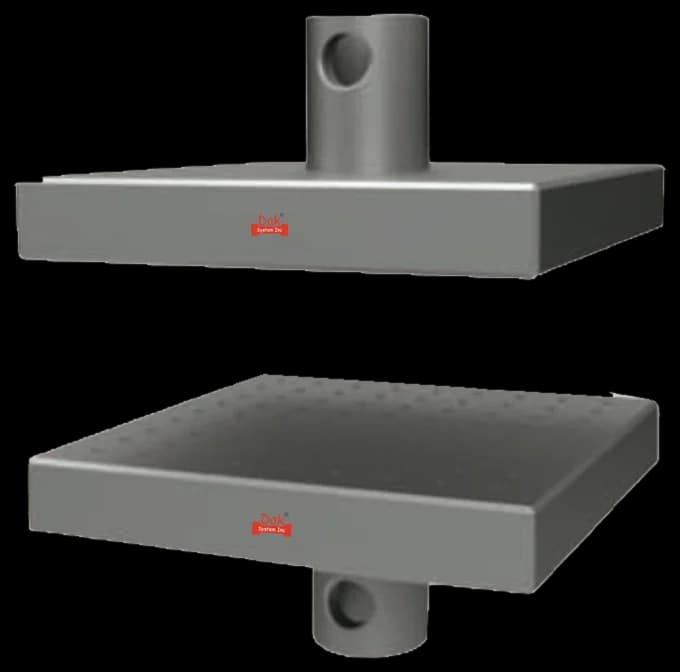
Direct Compression Fixture
Flat, parallel platens large enough to cover the whole specimen. Flat crush is a whole-area test: any platen tilt loads one side of the board first and the flutes there collapse early.
Specifications
Testing standard
Corrugated fibreboard — Determination of flat crush resistance
Written and technically reviewed by Dak System Inc. engineeringLast reviewed
ISO 3035 determines the flat crush resistance of corrugated fibreboard: a specimen is compressed between flat parallel platens perpendicular to its surface until the flutes collapse, and the maximum force is reported. It is a measure of the fluting medium and how well it was formed, not of the liners.
From the test method to your testing system
Explore the DAK machines already listed for ISO 3035, then review the grips, measurement and setup requirements below.
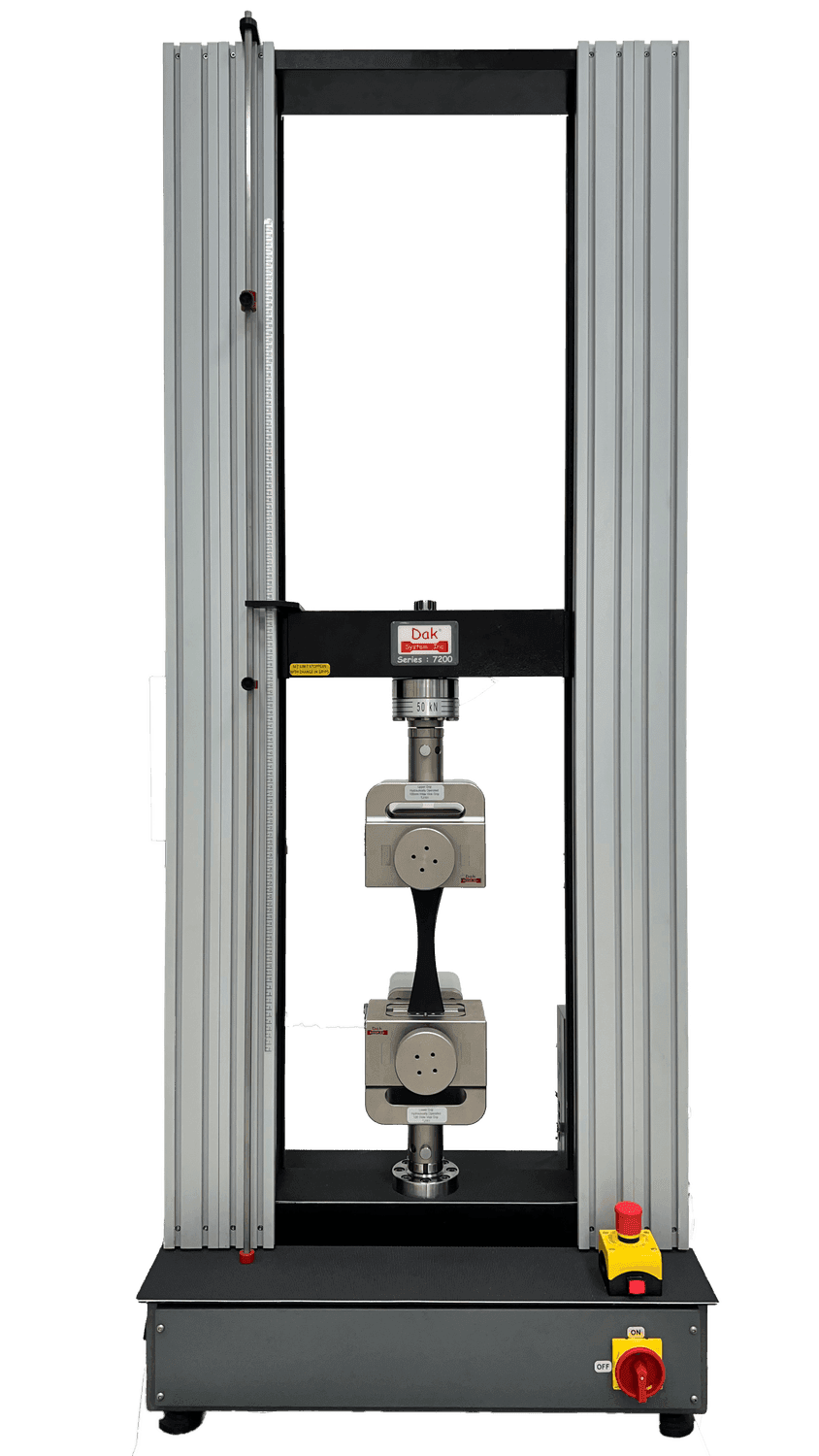 Universal Testing MachineSeries 7200Explore the machine →
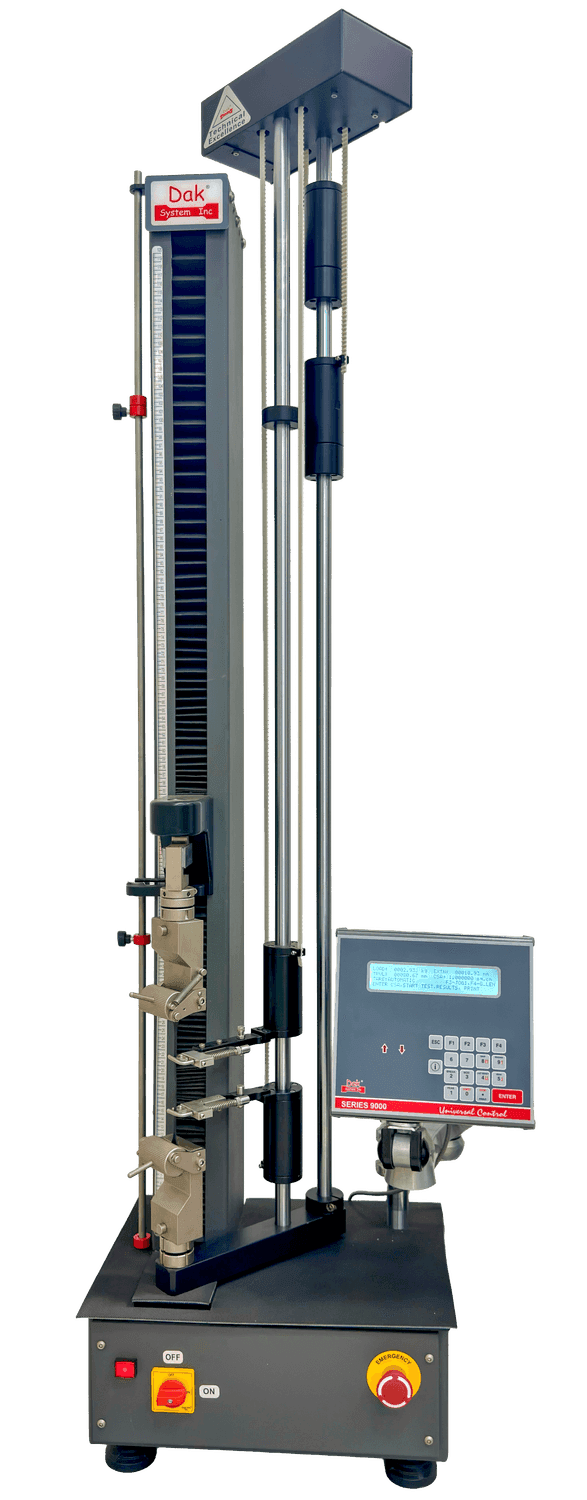 Universal Testing MachineSeries 9000Explore the machine →
01Understand the method
A specimen of corrugated fibreboard is cut to a specified area, conditioned in the standard atmosphere for paper and board, and placed centrally between two flat, parallel platens. The platens close at a nominal 12,5 mm/min (0.49 in./min), compressing the board perpendicular to its surface, and the force is recorded until the flute structure buckles and collapses. The maximum force reached is divided by the specimen area and reported as flat crush resistance. The peak is the whole result: once the flutes have folded the trace falls away, and nothing after that point describes how the board will behave in a stack.
The standing strength of the flutes themselves. In this direction the load is carried almost entirely by the fluting medium and by the geometry the corrugator gave it, with the liners contributing very little — which is what makes flat crush one of the most direct process checks available in a corrugated plant. A low result points at the medium, the corrugating rolls, or the heat and moisture at the corrugator, and it does so before the board becomes boxes. It is also the property most obviously damaged in converting: board crushed passing through a printer or a die-cutter loses flat crush first, and measuring it on finished blanks rather than on the sheet is one way of finding out whether the conversion line is doing that.
02Prepare the specimen and test settings
The specimen is the board itself, and the one thing that ruins it is the thing that happens most easily — being crushed before it reaches the platens.
Flat crush is destroyed by handling more easily than any other board property. A specimen that has been leaned on, stacked, or carried flat under a stack of others has already given up part of the result before the platens touch it.
03Build the test setup on a DAK machine
Low force, well resolved, between platens that stay parallel and close at a controlled 12,5 mm/min. Flat crush on single-wall board is commonly a few hundred newtons, so the load cell has to be chosen for the specimen rather than for the frame; a cell sized for a heavy compression machine simply cannot resolve the peak. The feed rate matters as much as the cell: ISO 13820, the compression-tester standard this method now calls up, requires the platen to hold within 0,25 mm/min of the nominal speed and requires that nominal speed to be reported with the result — because rates of 10,0 mm/min are used in some markets and a different rate gives a different number on the same board. The platens must be flat, clean and large enough to cover the whole specimen, and their parallelism decides whether the flutes collapse together or one edge goes first and takes the peak down with it.
Flat, parallel platens large enough to cover the whole specimen. Flat crush is a whole-area test: any platen tilt loads one side of the board first and the flutes there collapse early.
SpecificationsA low-range load cell. Flat crush resistance on single-wall board is measured in a few hundred newtons, and a cell sized for the frame rather than the specimen throws away the resolution the test needs.
SpecificationsDak verifies against whichever standard the method names, and where a class applies our frames sit a class tighter than it asks.
| The method asks for | Dak supplies | |
|---|---|---|
| Capacity | Low — flat crush on single-wall board is commonly under 1 kN | Load cells from 1 kg to 60 ton on the Series 7200, and 0.5 to 100 kN on the Series 9000 |
| Force accuracy | ISO 7500-1 Class 1 | ISO 7500-1 Class 0.5 — a class tighter than the method asks |
| Gripping | Flat, parallel compression platens covering the whole specimen area | Our compression anvils, built to the specimen |
| Environment | Standard atmosphere for conditioning and testing paper and board | 3009 series chambers, −150 °C to +400 °C — temperature only |
04Run the test
05Calculate, report and interpret
Maximum force divided by the specimen area
Reported as a pressure, so a result from one specimen area is comparable with another.
The point at which the flute structure buckles
After the peak the trace falls away as the flutes fold. The falling part carries no information about the board's performance in a stack.
The flutes carry the load in this direction
Flat crush is dominated by the fluting medium and by how well the corrugator formed it. A heavy liner does not rescue a poorly formed flute.
Pre-crushed specimens, which is the dominant failure and almost never looks like one. Closing the platens onto the board to find the force zero, which applies a small crush of precisely the kind being measured. Testing unconditioned board, which puts the store room's humidity into the result. Reading a peak from the falling part of the trace after the flutes have folded. And quoting a flat crush figure where the specification asked for edge crush, which is a different loading direction answering a different question.
06Compare methods and find answers
| Flat crush (ISO 3035) | Edge crush (ISO 3037) | Box compression (ISO 12048) | |
|---|---|---|---|
| Loaded | Perpendicular to the board face | On the board edge, along the flutes | The finished box, top to bottom |
| Tells you about | The fluting medium and how it was formed | The board's stacking capability | The whole box, closures included |
| Specimen | A piece of board | A piece of board | A made-up box |
| Damaged by handling | Very easily | Easily, at the loaded edges | Less so |
These three answer different questions and are not substitutes. Flat crush says whether the corrugator formed good flutes; edge crush predicts stacking strength; box compression measures the actual box. A specification that names one is not satisfied by another.
ISO 3035 is the international method for the flat crush resistance of corrugated fibreboard. A specimen is compressed between flat parallel platens perpendicular to its surface until the flutes collapse, and the maximum force is reported as a force per unit area. The current edition is ISO 3035:2025, which supersedes the withdrawn 2011 edition.
Because the collapse is not a clearly observable end point on those constructions. On single-faced and single-wall board the flutes buckle together and the trace shows an unambiguous peak. Where two flute layers of different heights are stacked, or where the flutes are very fine, the load transfers between structures rather than peaking cleanly, and there is no single force that means what flat crush resistance is defined to mean.
How well the fluting medium was formed and how well the corrugator ran. The flutes carry the load in this direction and the liners contribute very little, so a low flat crush figure points at the medium, the corrugating rolls, or the moisture and heat at the corrugator — not at the liner grammage. It is one of the most useful process checks in a corrugated plant for exactly that reason.
Because the property being measured is the standing structure of the flutes, and a thumb pressed on a specimen, a stack of specimens left on a bench, or a sample carried under something else all crush that structure before the test. The damage rarely looks like damage. Cutting cleanly, handling by the edges and never stacking cut specimens are the difference between a real number and a low one nobody can explain.
They load the board in different directions and answer different questions. Flat crush presses perpendicular to the face and reports on the fluting medium; edge crush, under ISO 3037, loads the board on its edge along the flutes and is the property that correlates with stacking strength. Both are routinely run on the same board, and neither substitutes for the other on a specification.
A compression frame with flat, parallel platens covering the whole specimen, a drive holding 12,5 mm/min to within 0,25 mm/min, and a load cell sized for the specimen rather than the frame — single-wall flat crush is commonly under a kilonewton, so a cell chosen for a heavy frame throws away resolution. Platen parallelism matters more than capacity: any tilt loads one edge first and collapses the flutes there before the rest.
Yes, substantially. Fibreboard is hygroscopic and its stiffness and strength fall as moisture content rises, which is why the method requires conditioning in the standard atmosphere for testing paper and board. A specimen tested straight off a warm machine or out of a damp store measures the environment it came from rather than the board.
Discuss your specimen, test requirements and reporting needs with DAK engineering.
This page describes the method as practised. The governing text is the current edition from the issuing body. Tell us what you are testing and we will answer with the machine, the fixture and a quotation.