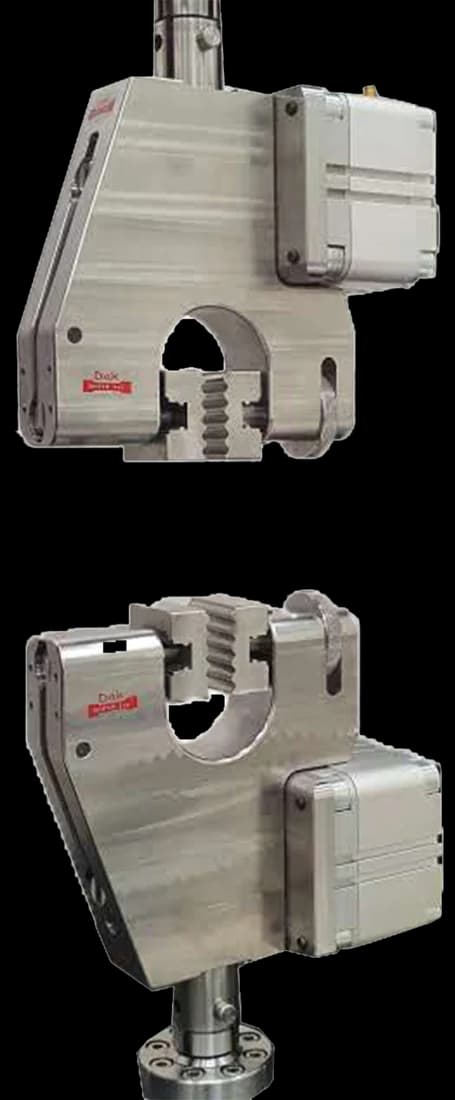
Standard 25 mm
Pneumatic Vice Action Grip
Pneumatic vice action grips clamp the full specimen width at a constant, even pressure — which is what stops one side slipping or tearing before the other.
Specifications
Testing standard
Leather — Physical and mechanical tests — Determination of tensile strength and percentage elongation
Written and technically reviewed by Dak System Inc. engineeringLast reviewed
ISO 3376 determines the tensile strength, elongation at a specified load and elongation at maximum force of leather, and applies to all types of leather. The 2020 edition changed the second of those from elongation at break, which matters when comparing against older data.
From the test method to your testing system
Explore the DAK machines already listed for ISO 3376, then review the grips, measurement and setup requirements below.
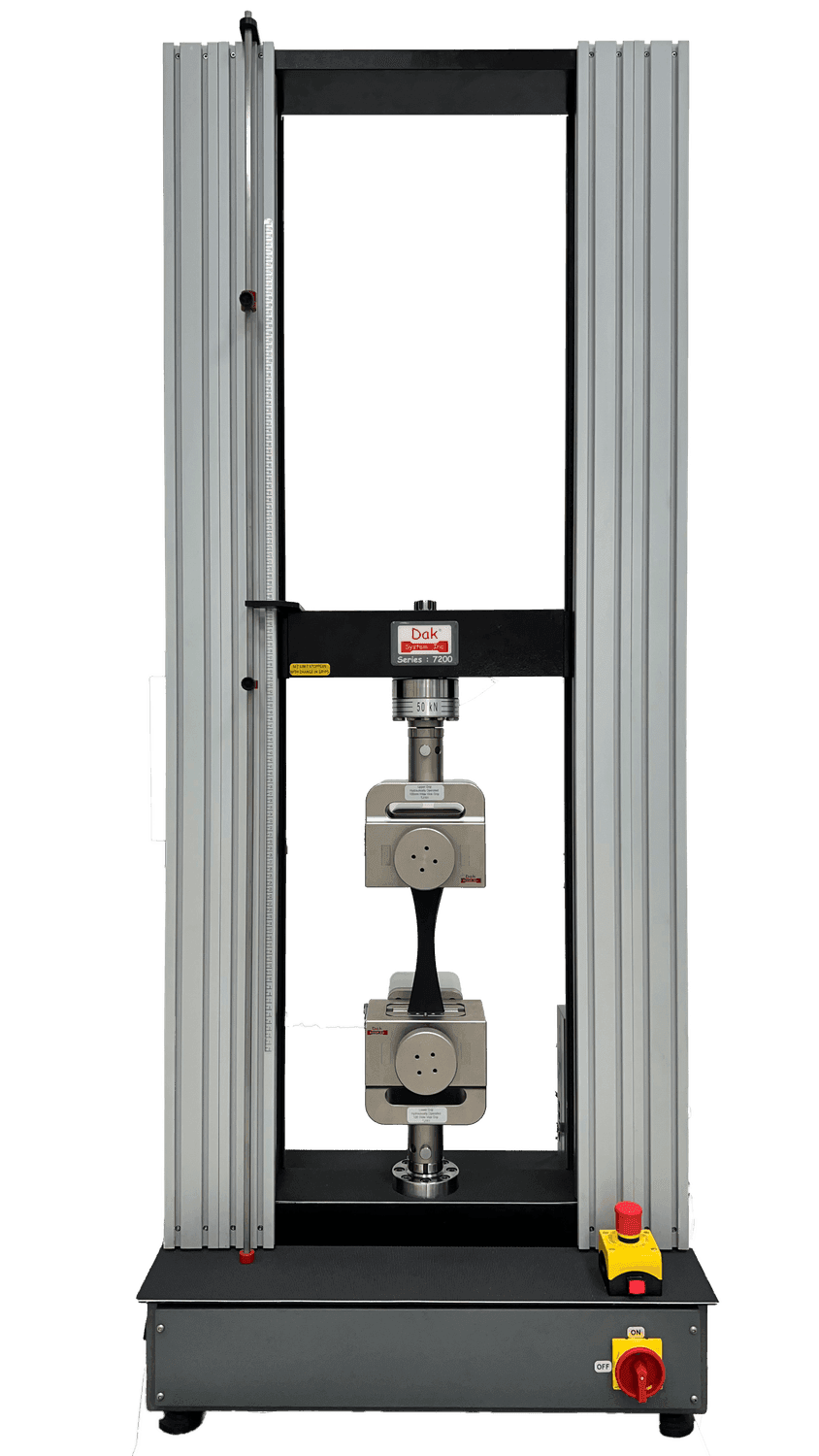 Universal Testing MachineSeries 7200Explore the machine →
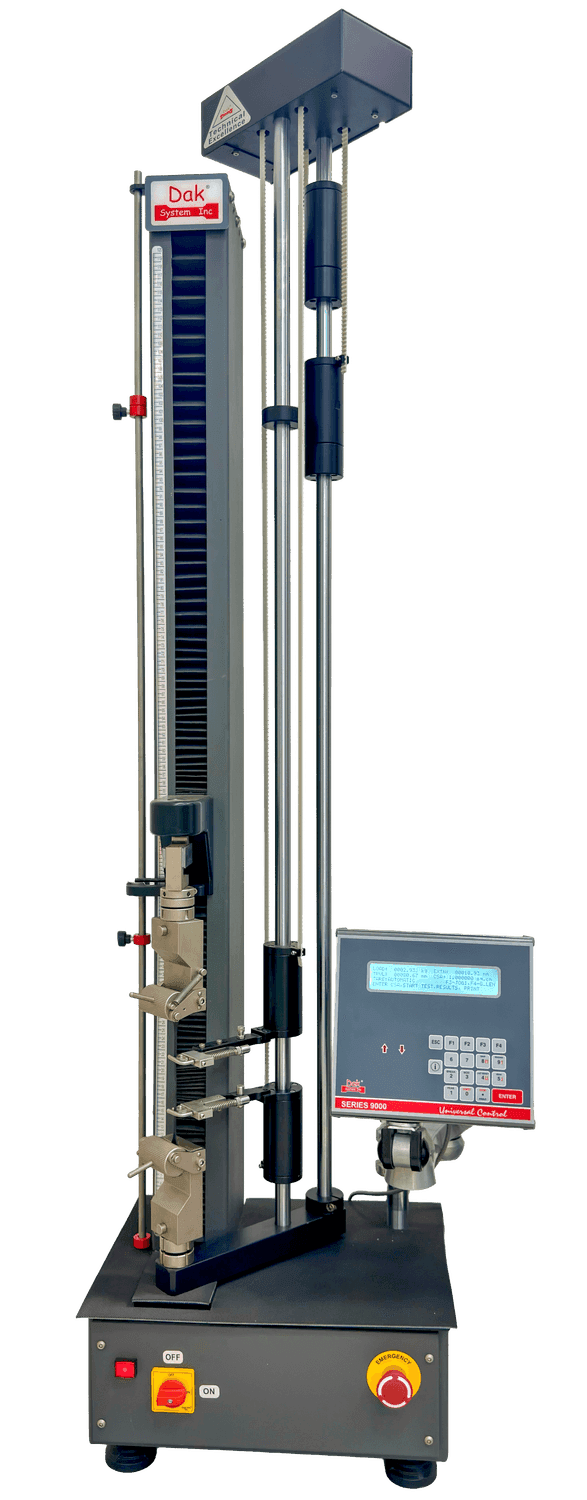 Universal Testing MachineSeries 9000Explore the machine →
01Understand the method
Conditioned leather specimens are cut in recorded directions and positions, their width and thickness measured individually, and pulled apart at a uniform jaw-separation speed of 100 mm/min ± 20 mm/min (3.9 in./min ± 0.8 in./min) until they fail. Three quantities come out: the tensile strength, calculated as the maximum force over the measured original cross-section; the elongation at a load the specification names; and the elongation at maximum force. The method applies to all types of leather, and elongation is normally taken from grip separation rather than from an extensometer.
How strong the leather is, and how much it gives. The second question is usually the commercially important one, because leather in service is almost never loaded near failure — a shoe upper, a bag handle or an upholstery panel works at a small fraction of its breaking load, and what decides whether the product holds its shape is how far it stretches there. That is why an elongation at a stated working load is reported alongside the failure figures. The 2020 edition also changed the second failure quantity from elongation at break to elongation at maximum force, and on leather those are different points on the curve.
02Prepare the specimen and test settings
Two things moved: the word extension became elongation, and elongation at break became elongation at maximum force.
Leather is a natural material and is not uniform. Sampling position and direction are part of the result, not administrative detail.
03Build the test setup on a DAK machine
Modest force — most leathers break between roughly a hundred newtons and a kilonewton — a crosshead holding 100 mm/min ± 20 mm/min, and grips that can hold a soft, compressible, unevenly thick material without damaging it. That single speed is set against two starting jaw separations: 50 mm ± 1 mm for the standard test piece and 100 mm ± 1 mm for the large one, so the same 100 mm/min strains the standard piece at about 200 % per minute and the large piece at about 100 % per minute. Force indication has to reach Class 2 of ISO 7500-1, an error of 2 %. That is the real difficulty. A hard jaw bears heavily on the thick parts of a specimen and lightly on the thin ones, so the pressure needed to stop the thin side slipping is enough to crush the grain on the thick side, and the specimen then fails at the jaw. Pneumatic grips at a controlled pressure, with faces that spread the load, keep failures in the gauge length.
Pneumatic vice action grips clamp the full specimen width at a constant, even pressure — which is what stops one side slipping or tearing before the other.
SpecificationsDak verifies against whichever standard the method names, and where a class applies our frames sit a class tighter than it asks.
| The method asks for | Dak supplies | |
|---|---|---|
| Capacity | Low — most leathers break between about 100 N and 1 kN | Load cells from 1 kg to 60 ton on the Series 7200, and 0.5 to 100 kN on the Series 9000 |
| Force accuracy | Class 1 over the working range | ISO 7500-1 Class 0.5, verified to ASTM E4, DIN 51221 and BS 1610 |
| Gripping | Grips that hold a soft, variable-thickness specimen without cutting it | Wedge, vice-action, pneumatic and hydraulic grips, built to the specimen |
| Environment | 23 ± 2 °C standard laboratory atmosphere | 3009 series chambers, −150 °C to +400 °C — temperature only |
04Run the test
05Calculate, report and interpret
Maximum force divided by the original cross-sectional area
Thickness is measured on the specimen because leather varies across its own area, and a nominal figure will not do.
(extension / original gauge length) × 100
Which of the two is being quoted must be stated. The 2020 edition moved the second from elongation at break, so an unlabelled figure is ambiguous across editions.
Comparing results across editions without checking which one applied, when elongation at break and elongation at maximum force are both called an elongation and both are large numbers. Using a nominal thickness instead of a measured one. Mixing sampling positions within a data set and then attributing the scatter to the material. And accepting jaw breaks, which on leather almost always report the grip rather than the specimen. A quieter one is reporting an elongation without saying which of the two it is — the figure at a working load and the figure at maximum force can differ by a factor of several, and neither is labelled by its magnitude alone.
06Compare methods and find answers
| 2020 edition | 2011 edition | |
|---|---|---|
| Title | percentage elongation | percentage extension |
| Second quantity | Elongation at maximum force | Elongation at break |
| Applies to | All types of leather | All types of leather |
| Comparable data | Only if the edition is stated | — |
An edition change that alters what is measured is easy to miss, because both figures are called an elongation and both are large. Historic leather data should be read with its edition attached.
It is the ISO method for the tensile strength and percentage elongation of leather, applicable to all types. It reports the tensile strength, the elongation at a load the specification names, and the elongation at maximum force. The current edition is ISO 3376:2020, the fourth, which cancels and replaces ISO 3376:2011.
Two things worth knowing. The title moved from *percentage extension* to *percentage elongation*, which is cosmetic. The substantive change is that the 2011 edition reported elongation at **break** while the 2020 edition reports elongation at **maximum force**. On leather those are genuinely different points on the curve, so comparing a new result against historic data without checking the edition can produce a difference that is entirely procedural.
Because leather in service is almost never loaded near its breaking point. A shoe upper, a bag handle or an upholstery panel works at a small fraction of failure, and what matters is how much it stretches there — whether a shoe holds its shape, whether a seam puckers. The elongation at a stated working load describes that, where the elongation at failure does not.
Because leather is a natural material and its thickness varies across a single hide and across a single specimen. Tensile strength is force divided by cross-sectional area, so using a nominal thickness introduces an error straight into the result. Measuring it on the specimen, at the point it will fail if possible, is what makes the strength figure mean anything.
A great deal. Leather is markedly stronger along the backbone than in the belly, and fibre orientation changes across the hide as well. A data set drawn from mixed positions will scatter widely for reasons that have nothing to do with the tannage or the finish being assessed. Recording the position and the direction turns that scatter into information instead of noise.
Usually because the grip crushed the grain rather than because the leather was weak. Leather is compressible and uneven in thickness, so a hard jaw bears heavily on the thick parts and lightly on the thin ones — enough pressure to hold the thin side damages the thick side. Pneumatic grips at a controlled pressure, with faces that spread the load, are what keep the failure in the gauge length.
Normally it is taken from grip separation, which the method accommodates. Leather elongations are large enough that grip take-up is a modest proportion of the total, so the error introduced is small. It is a different judgement from a stiff, low-elongation material, where the same shortcut would dominate the answer.
Discuss your specimen, test requirements and reporting needs with DAK engineering.
This page describes the method as practised. The governing text is the current edition from the issuing body. Tell us what you are testing and we will answer with the machine, the fixture and a quotation.