Standard 25 mm
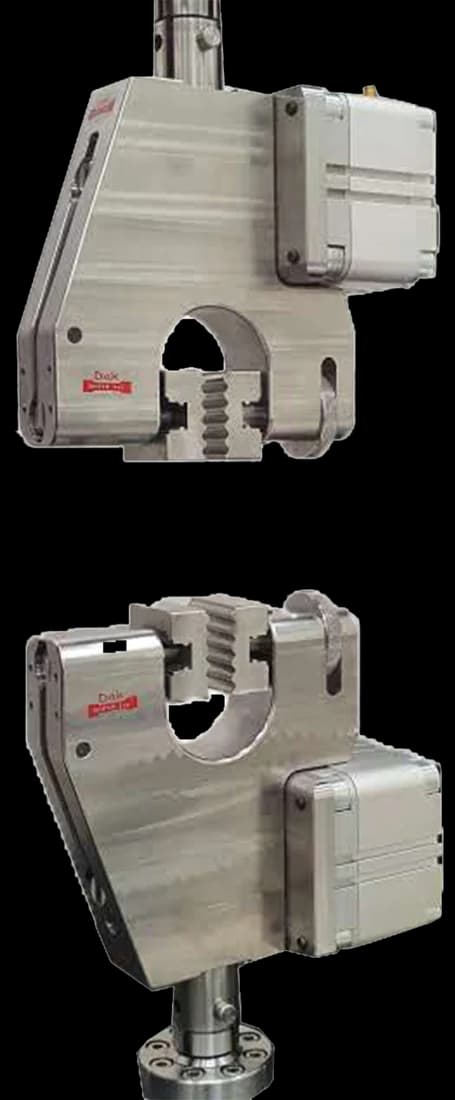
Pneumatic Vice Action Grip
Pneumatic vice action grips clamp the full specimen width at a constant, even pressure — which is what stops one side slipping or tearing before the other.
Specifications
Testing standard
Rubber- or plastics-coated fabrics — Determination of tensile strength and elongation at break
Written and technically reviewed by Dak System Inc. engineeringLast reviewed
ISO 1421 determines the tensile strength of rubber- or plastics-coated fabrics by two methods. Method 1, the strip test, gives tensile strength and elongation at break. Method 2, the grab test, gives tensile strength only. Both pull at 100 mm/min ± 10 mm/min on a constant rate of extension machine, and both cover conditioned and wet specimens.
From the test method to your testing system
Explore the DAK machines already listed for ISO 1421, then review the grips, measurement and setup requirements below.
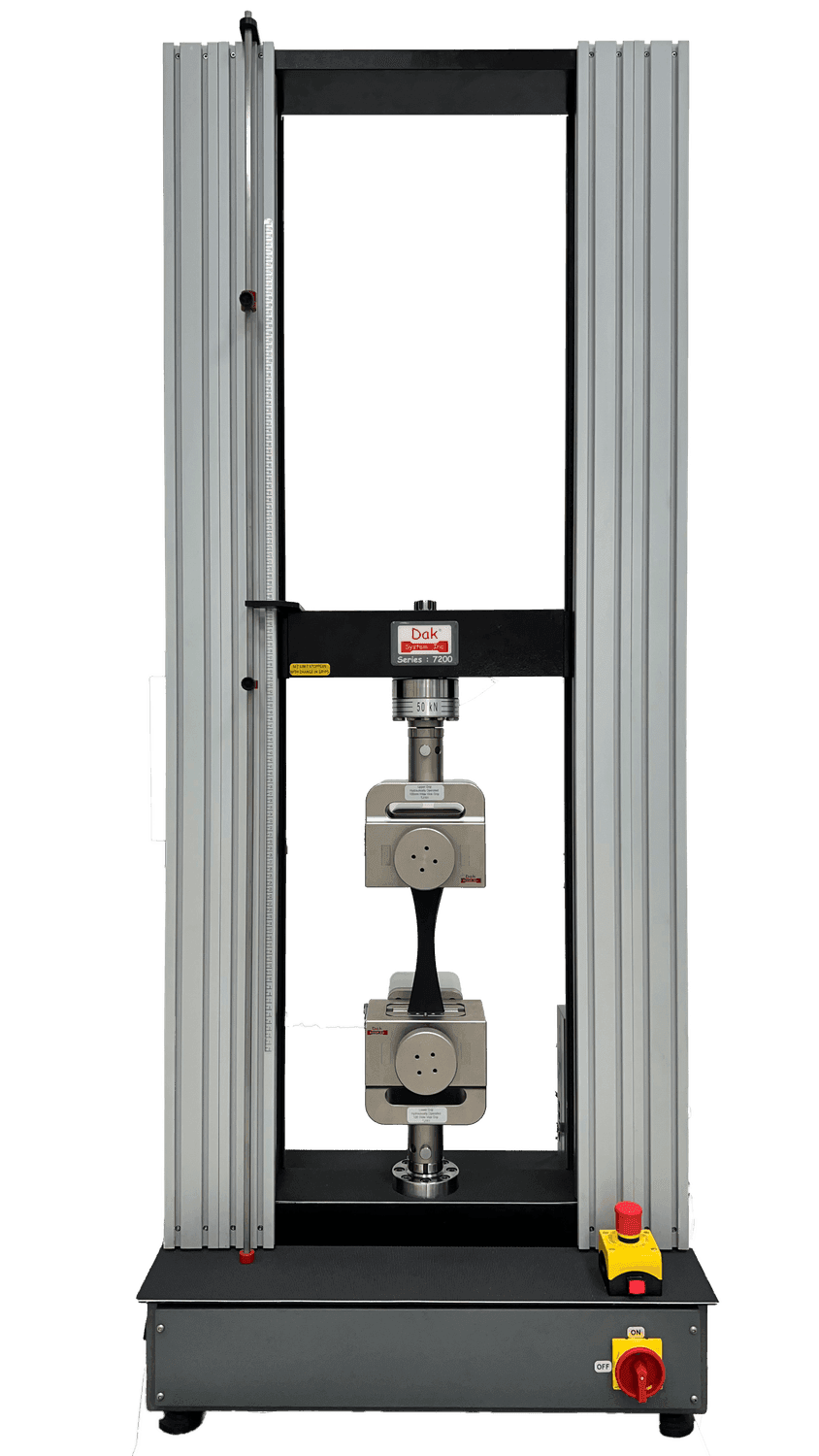 Universal Testing MachineSeries 7200Explore the machine →
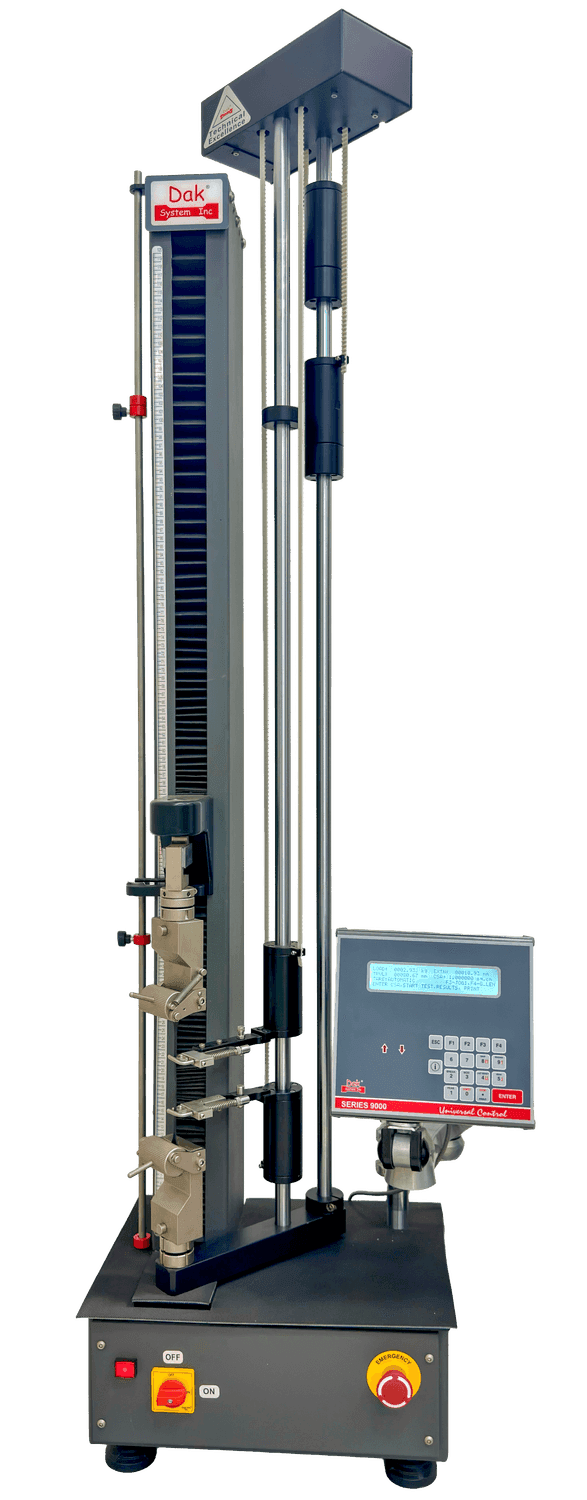 Universal Testing MachineSeries 9000Explore the machine →
01Understand the method
A specimen of coated fabric is conditioned in the standard atmosphere, or prepared wet where the application requires it, and pulled to break in a constant rate of extension machine. Two methods are defined. Method 1, the strip test, clamps the full specimen width so that every yarn carries load, and yields both tensile strength and elongation at break. Method 2, the grab test, clamps only a central portion of the width and yields tensile strength alone. Warp and weft are tested and reported separately, and the method used is part of the result.
The load a coated fabric carries before it breaks, in the direction tested. These materials — architectural membranes, tarpaulins, inflatable structures, protective clothing — are engineered around directional strength, since the woven base has different yarn counts, tensions and crimp in warp and weft. Reporting an average across the two would describe neither and would let a product meet a specification while being weak in one axis. The result is a force rather than a stress, because a coated fabric is a composite whose overall thickness bears no useful relation to the area actually carrying load.
02Prepare the specimen and test settings
Choosing the grab method and then being asked for elongation is a re-test, because that method does not produce it.
A grab result and a strip result on the same fabric are different numbers. The grab method loads a narrower path and the surrounding material shares some of it, so the two are not interchangeable.
03Build the test setup on a DAK machine
A constant rate of extension of 100 mm/min ± 10 mm/min, which is what both methods run at unless the interested parties agree otherwise, held so that after the first two seconds the rate of increase in clamp separation is uniform to within 5 %. The strip method starts with the jaws 200 mm ± 1 mm apart, reduced to 100 mm ± 1 mm where elongation exceeds 75 %; the grab method starts at 100 mm ± 1 mm, or 75 mm ± 1 mm by agreement. Capacity runs from a few hundred newtons to several kilonewtons depending on the product, and grips must be wide enough to hold the full specimen width evenly. Grip pressure is the practical difficulty: coated surfaces are smooth and slip easily, while a serrated face pressed hard enough to hold them cuts through the coating into the substrate. The working pressure lies in a window that differs between products and is found by trial on a spare specimen rather than set from a laboratory default.
Pneumatic vice action grips clamp the full specimen width at a constant, even pressure — which is what stops one side slipping or tearing before the other.
SpecificationsDak verifies against whichever standard the method names, and where a class applies our frames sit a class tighter than it asks.
| The method asks for | Dak supplies | |
|---|---|---|
| Capacity | Low to moderate — coated fabric strengths commonly run from a few hundred newtons to several kilonewtons | Load cells from 1 kg to 60 ton on the Series 7200, and 0.5 to 100 kN on the Series 9000 |
| Force accuracy | ISO 7500-1 Class 1 over the working range | ISO 7500-1 Class 0.5 — a class tighter than the method asks |
| Gripping | Wide grips clamping the full specimen width without cutting the coating | Wedge, vice-action, pneumatic and hydraulic grips, built to the specimen |
| Environment | 23 ± 2 °C standard laboratory atmosphere | 3009 series chambers, −150 °C to +400 °C — temperature only |
04Run the test
05Calculate, report and interpret
The maximum force recorded before break
A force, reported per specimen width for the strip method. Coated fabric thickness is not a usable area, since the coating and the substrate carry load quite differently.
Eb = (ΔL / L₀) × 100
Available from the strip method only. The grab method has no defined gauge across the loaded width.
Running the grab method and then being asked for elongation, which is a complete re-test. Comparing grab and strip figures as though they measured the same thing. Jaw breaks caused by grips cutting the coating, which read low and are often accepted because the specimen looks intact away from the cut. Averaging warp and weft. And testing dry when the product spends its service life wet, in a standard that provides a wet procedure precisely because some substrates lose strength when saturated.
06Compare methods and find answers
| ISO 1421 | ASTM D751 | |
|---|---|---|
| Family | ISO | ASTM |
| Methods | Strip and grab | Grab, strip and other properties |
| Elongation | Strip method only | Depends on the procedure |
| Wet testing | Provided for | Depends on the procedure |
Both serve the coated fabric trade and both distinguish grab from strip. Cite the designation and the method together, because the method matters as much as the standard.
It is the ISO method for the tensile strength of rubber- or plastics-coated fabrics — the materials used for architectural membranes, tarpaulins, inflatable structures and protective clothing. It specifies two procedures: Method 1, the strip test, giving tensile strength and elongation at break, and Method 2, the grab test, giving tensile strength only. The current edition is ISO 1421:2016.
Whichever the specification names — and check before cutting specimens, because the choice cannot be revisited afterwards. If elongation at break is required, it has to be the strip method: the grab test clamps only part of the width, so there is no defined gauge across the loaded region and elongation cannot be attributed to one. Selecting grab and then being asked for elongation means preparing and running the whole set again.
Because they load the fabric differently. In the strip test the full width is clamped and every yarn carries load. In the grab test only a central portion is gripped, and the material either side of the grips shares some of the load through the weave, so the loaded path is effectively wider than the clamped one. The result is a higher force than the clamped width alone would suggest, and it is not convertible to a strip value.
Because coated fabrics are outdoor materials. Architectural membranes, tarpaulins, awnings and covers spend much of their life wet, and some substrates lose strength when saturated while the coating does not. Testing only conditioned specimens reports a property the product often does not have in service, so the method defines how to prepare and test wet specimens alongside dry ones.
Because there is a narrow window. Too little and the coating, which is smooth and often slightly waxy, slips through the jaws. Too much and a serrated face cuts through the coating into the substrate, creating a notch at the jaw line from which the specimen then tears well below its real strength. The pressure has to be found by trial on a spare specimen, and it differs between products rather than being a laboratory constant.
No, as a force. A coated fabric is a composite of a woven substrate and a polymer coating that carry load quite differently, so its overall thickness is not a meaningful area to divide by — most of the strength lives in the yarns, and the coating adds thickness out of proportion to what it carries. Force at break, with the specimen width stated, is the honest quantity.
Because coated fabrics are usually built on a woven base whose warp and weft differ in yarn count, tension and crimp from manufacture. The two directions can differ substantially in both strength and elongation, and a membrane or tarpaulin is engineered around that difference. Reporting an average would describe neither direction and would allow a product to meet a specification while being weak in one axis.
Discuss your specimen, test requirements and reporting needs with DAK engineering.
This page describes the method as practised. The governing text is the current edition from the issuing body. Tell us what you are testing and we will answer with the machine, the fixture and a quotation.