TJ-144
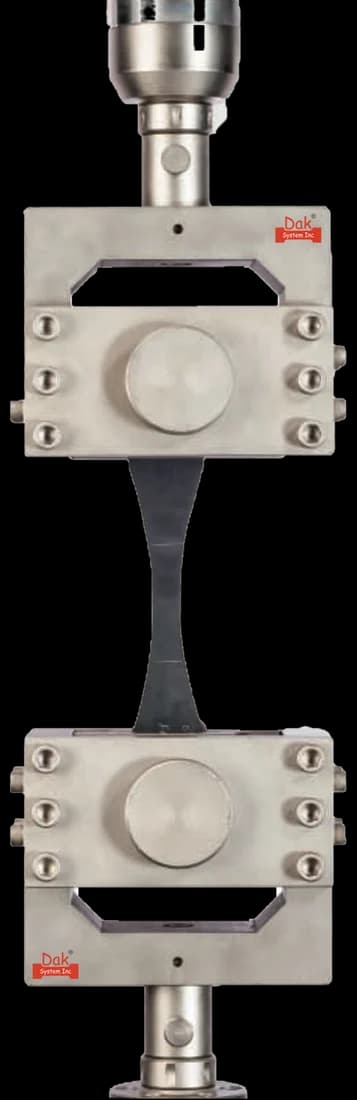
Heavy Duty Hydraulic Grips
Heavy duty hydraulic wedge grips hold a constant clamping force as the coupon thins slightly under load, which mechanical wedges do not always manage at composite failure loads.
Specifications
Testing standard
Plastics — Determination of tensile properties — Part 5: Test conditions for unidirectional fibre-reinforced plastic composites
Written and technically reviewed by Dak System Inc. engineeringLast reviewed
ISO 527-5 gives the tensile test conditions for unidirectional fibre-reinforced composites — the coupon types, the end tabbing, the rate and the strain measurement. Its practical burden is that a result only counts if the coupon failed in the gauge section, and getting it to do so is most of the work.
From the test method to your testing system
Explore the DAK machines already listed for ISO 527-5, then review the grips, measurement and setup requirements below.
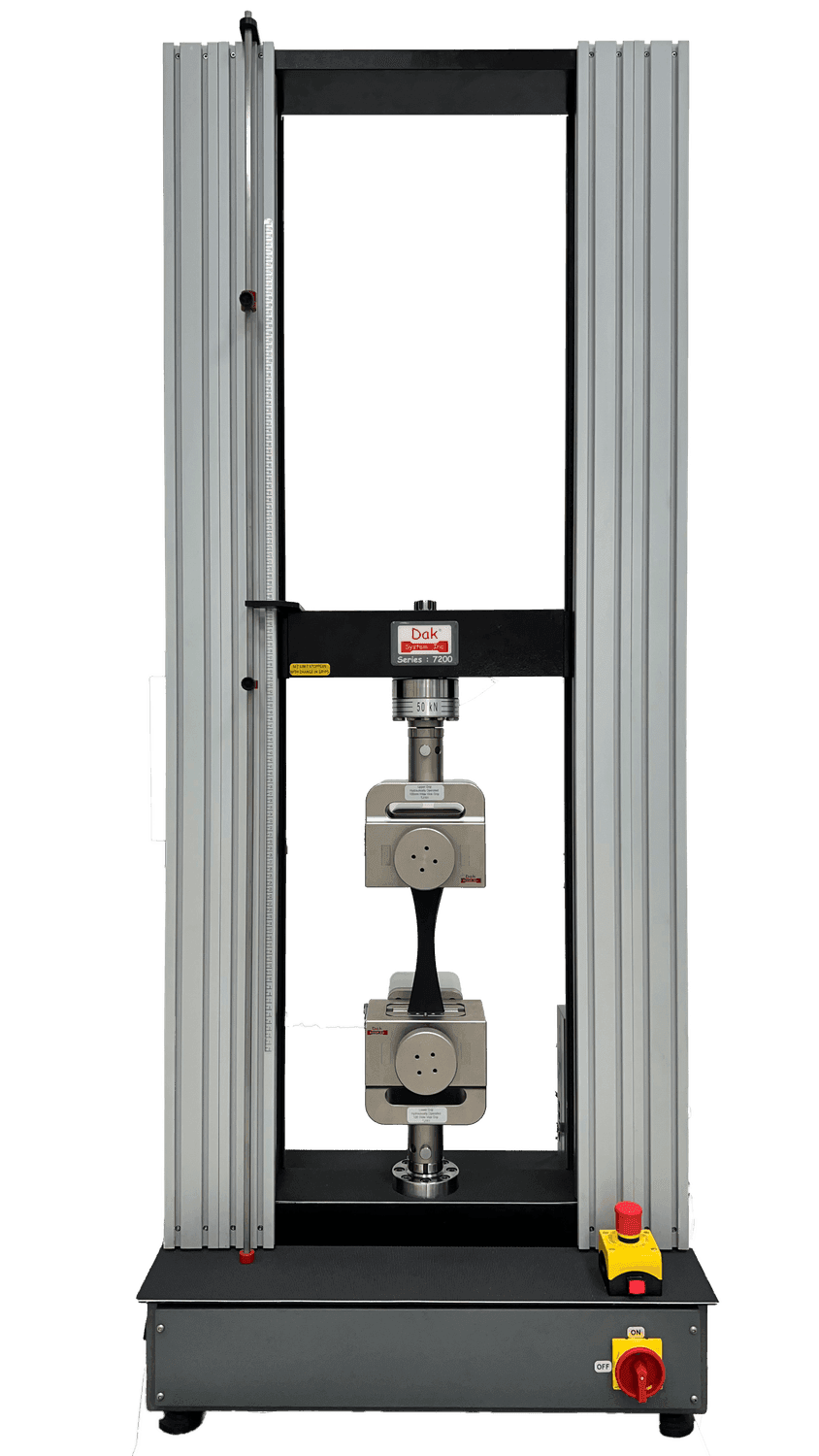 Universal Testing MachineSeries 7200Explore the machine →
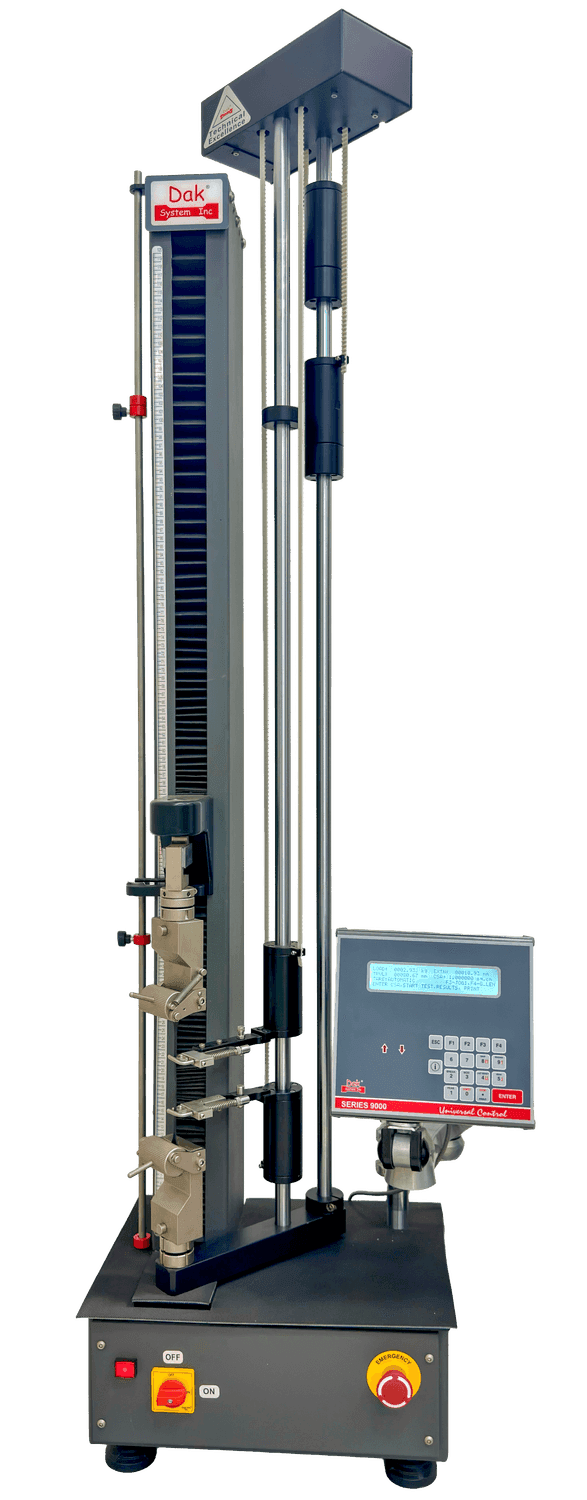 Universal Testing MachineSeries 9000Explore the machine →
01Understand the method
A flat rectangular coupon with bonded end tabs is gripped in wedges and pulled at a constant crosshead rate, commonly 2 mm/min, while force and strain are recorded to failure. Two geometries are defined: Type A, nominally 250 mm by 15 mm by 1 mm, for testing along the fibres, and Type B, nominally 250 mm by 25 mm by 2 mm, for testing across them. Strain is measured with an extensometer or bonded gauges, and where Poisson's ratio is required it is measured in both the axial and transverse directions at once. Tensile strength, a chord modulus over the 0,0005 to 0,0025 strain window, strain at break and Poisson's ratio come out of the run.
The stiffness and strength of a unidirectional laminate in a single, known fibre direction — which is the input every laminate analysis is built from. A structural composite part is a stack of plies at different angles, and its behaviour is predicted from the properties of one ply along and across the fibres. Those two sets of numbers come from Type A and Type B coupons respectively, and they differ by more than an order of magnitude, because one is carried by the fibres and the other by the matrix. Getting them wrong propagates into every prediction made from the laminate model, which is why the method is so specific about geometry and failure location.
02Prepare the specimen and test settings
Type A is the 0° coupon, Type B the 90°. They are different widths and thicknesses because they fail at wildly different loads.
A 0° coupon that failed at or under the tab has reported the tab, not the laminate. The failure mode code is part of the result and a report without it cannot be assessed.
03Build the test setup on a DAK machine
Enough force for a 0° coupon — commonly thirty to a hundred kilonewtons — with wedge grips that clamp the tabbed ends squarely and alignment good enough that the load is genuinely axial, since any bending is concentrated at the tab ends where failure is already most likely. Strain measurement to Class 0,5 is required for modulus, and biaxial capability where Poisson's ratio is wanted. The frame needs the daylight for a 250 mm coupon plus grips, and enough stiffness that the sudden release when a 0° coupon fails does not disturb the load train.
Heavy duty hydraulic wedge grips hold a constant clamping force as the coupon thins slightly under load, which mechanical wedges do not always manage at composite failure loads.
Specifications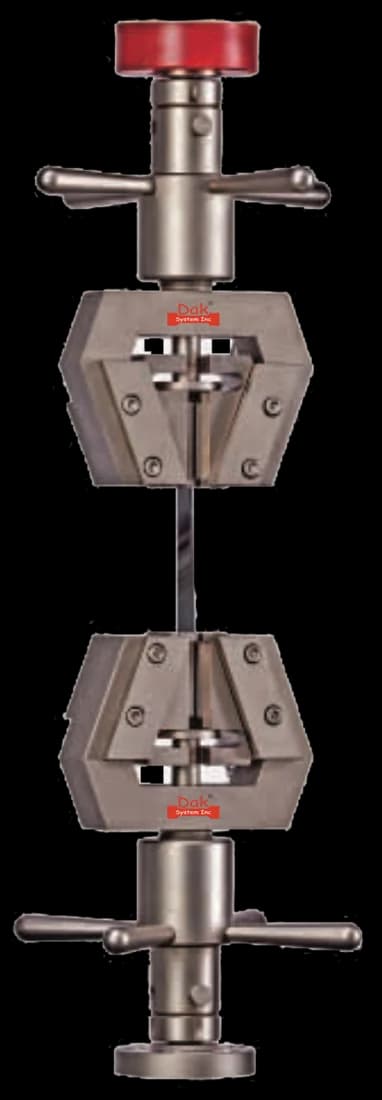
Universal parallel wedge grips where the coupon width and failure load sit within their range.
SpecificationsDak verifies against whichever standard the method names, and where a class applies our frames sit a class tighter than it asks.
| The method asks for | Dak supplies | |
|---|---|---|
| Capacity | Moderate to high — a 0° carbon coupon commonly needs 30 to 100 kN | Load cells from 1 kg to 60 ton on the Series 7200, and 0.5 to 100 kN on the Series 9000 |
| Force accuracy | ISO 7500-1 Class 1 over the working range | ISO 7500-1 Class 0.5 — a class tighter than the method asks |
| Strain measurement | An extensometer of the class the method specifies | Certified to ISO 9513 Class 1 and ASTM E83 — non-contact video, clip-on and high-elongation |
| Gripping | Wedge grips with tabbed coupon ends; the tabs are part of the specimen, not the fixture | Our self-tightening serrated wedge grips, with V-jaws for round specimens, built to the specimen |
| Environment | 23 ± 2 °C standard laboratory atmosphere | 3009 series chambers, −150 °C to +400 °C — temperature only |
04Run the test
05Calculate, report and interpret
σM = F / (b × h)
On the gauge section dimensions, measured on the coupon, not nominal.
Et = (σ₂ − σ₁) / (ε₂ − ε₁)
A chord modulus over a fixed strain window rather than a tangent, so it does not depend on where anyone chose to draw a line.
ν = −εtransverse / εaxial
Requires strain measured in both directions simultaneously, which is why biaxial gauges are common on these coupons.
Coupons failing in or at the tab, which reports the gripping arrangement rather than the laminate and makes the result inadmissible; this is why the failure mode and location are recorded on every specimen and why exclusions are stated. Brittle tab adhesive that peels before the coupon reaches its own limit. Misalignment, which biases every coupon the same way and is therefore invisible in the scatter. And quoting a modulus without naming the method, since ASTM D3039 uses a different strain window and produces a different figure from the same curve.
06Compare methods and find answers
| ISO 527-5 | ASTM D3039/D3039M | |
|---|---|---|
| Scope | Unidirectional composites specifically | Polymer matrix composites generally |
| Coupon | Type A 0°, Type B 90° | Width and thickness by lay-up |
| Modulus | Chord, 0,0005–0,0025 strain | Chord, 0,001–0,003 strain |
| Failure codes | Recorded | Three-character code required |
Close in intent, different in the strain window used for modulus — so moduli from the two are not directly interchangeable even on the same laminate. Specify which method was used whenever a modulus is quoted.
It is Part 5 of the ISO 527 tensile series, giving the test conditions for unidirectional fibre-reinforced composites. Parts 1 and 4 supply the general principles and the conditions for isotropic and orthotropic composites; Part 5 adds the coupon geometries, tabbing and strain measurement that unidirectional laminates specifically need.
Because they fail at completely different loads. A 0° coupon carries load on the fibres and can reach very high stresses, so it is made thin and narrow to keep the force within a sensible frame capacity. A 90° coupon carries load on the matrix across the fibres and fails at a small fraction of that, so it is made wider and thicker to give a measurable load and a coupon robust enough to handle.
Because a serrated grip face bites into the surface and crushes fibres exactly where the load is highest. A bonded tab converts that concentrated clamping into shear transferred gradually along the bond line, moving the peak stress away from the jaws and into the gauge section. Without tabs a 0° coupon fails at the grip almost every time, and that result reports the gripping arrangement rather than the laminate.
Because if the adhesive is more brittle than the laminate matrix, the bond line fails first. The coupon then slips or the tab peels, the test ends before the material has been loaded to its own limit, and the coupon is wasted. Tab debonding is the most common reason a composite tensile coupon is discarded, and it is nearly always a surface preparation or adhesive selection problem rather than anything to do with the material under test.
So that it does not depend on judgement. A tangent modulus depends on where the operator chose to draw the line, and on a composite whose curve has slight initial non-linearity from take-up that choice can move the answer by several per cent. Fixing the window at 0,0005 to 0,0025 strain makes every laboratory compute the same slope from the same two points.
For a 0° coupon, yes. A failure in or immediately at the tab means the stress concentration from the grip caused it, so the recorded strength is a lower bound on the laminate rather than a measurement of it. The failure mode and location are recorded for every coupon precisely so that inadmissible results can be identified and excluded, with the exclusions stated in the report.
Strength usually, modulus not directly. The two methods use different strain windows for the chord modulus — 0,0005 to 0,0025 here against 0,001 to 0,003 in D3039 — so on a laminate with any curvature the two produce different figures for the same material. Whenever a composite modulus is quoted, the method behind it should be quoted with it.
Discuss your specimen, test requirements and reporting needs with DAK engineering.
This page describes the method as practised. The governing text is the current edition from the issuing body. Tell us what you are testing and we will answer with the machine, the fixture and a quotation.