Self-identifying
Load Cells
Pull-out force on a single cord is commonly in the low kilonewtons. A cell sized for the cord rather than for a belting frame is what keeps the initial and aged figures distinguishable from each other.
Specifications
Testing standard
Steel cord conveyor belts — Cord-to-coating bond test — Initial test and after thermal treatment
Written and technically reviewed by Dak System Inc. engineeringLast reviewed
ISO 7623 pulls a single steel cord out of the rubber coating of a conveyor belt at (100 ± 10) mm/min, continuously and with no pauses, and reports the bond strength — first on the belt as made and again after a thermal treatment. It applies to metal-carcass belts only. The current edition is ISO 7623:2022; ISO 7623:2015 is withdrawn, although legacy specifications still name it.
From the test method to your testing system
Explore the DAK machines already listed for ISO 7623, then review the grips, measurement and setup requirements below.
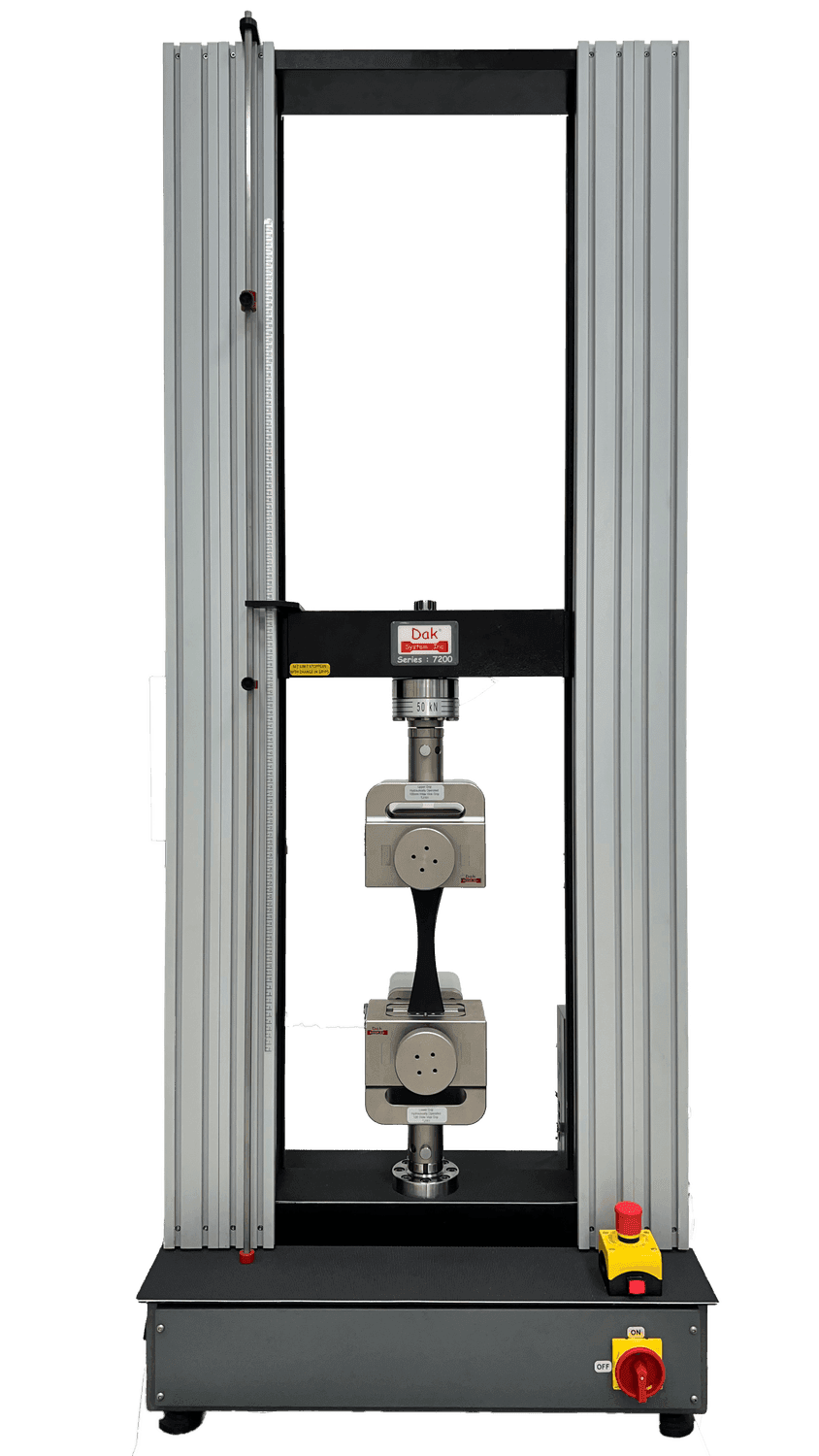 Universal Testing MachineSeries 7200Explore the machine →
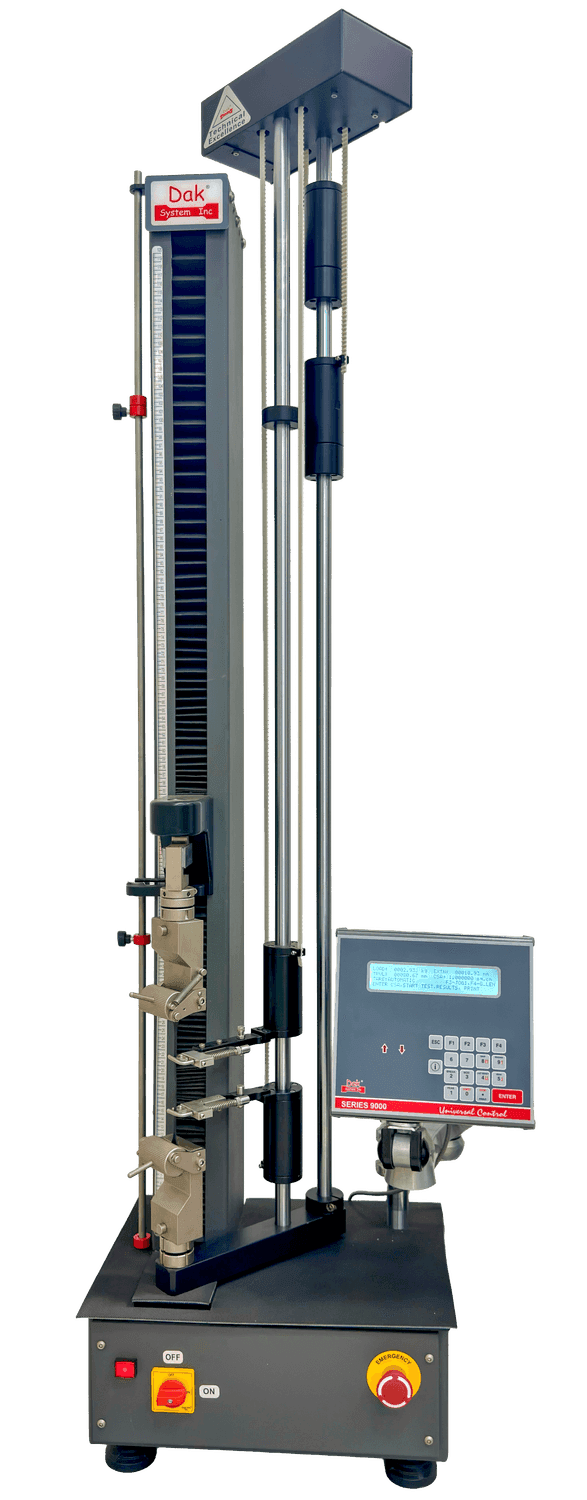 Universal Testing MachineSeries 9000Explore the machine →
01Understand the method
A strip is cut from a steel cord conveyor belt and prepared so only one warp cord bridges a marked test length. It is pulled at (100 ± 10) mm/min, continuously and with no pauses, until that cord tears completely out of its coating; the highest force reached is the tear-out force. The test runs on the belt as made and again after a thermal treatment, comparing the bond before and after heat ageing.
A steel cord belt carries its entire load in the cords. The rubber carries no tension: it holds the cords in place, transfers load into and out of them at the splice, and keeps water off the steel. The bond decides whether it can.
The consequence of a poor bond is a failed splice, not a broken belt. A splice overlaps cords in rubber and relies on the bond along their length to transfer force from one belt end to the other. If it is weak the cords pull through under tension, the splice elongates and separates, and the belt fails at the one place that cannot be repaired quickly.
The after-thermal-treatment result is the more interesting of the two. Heat ageing simulates a hot environment or a hot splice cure, and a compound with an excellent initial bond whose aged bond falls away will disappoint in service. Reporting only the initial figure hides the behaviour the method exists to find.
02Prepare the specimen and test settings
The bond being measured is a few millimetres of interface around one cord. Anything that disturbs it during preparation is invisible in the result and changes it.
03Build the test setup on a DAK machine
A crosshead holding (100 ± 10) mm/min and jaws set 250 mm ± 10 mm apart. The standard borrows its machine wholesale from ISO 7622-2, which fixes the same rate and requires the maximum test load to fall between 15 % and 85 % of capacity. Force on a single cord is modest, commonly low kilonewtons, so 5 to 50 kN is ample. Force accuracy to ISO 7500-1 Class 1 is normal.
Grips are the difficulty: the jaws must hold full-thickness rubber-faced belting without crushing or nicking the cord, because a damaged cord breaks in the grip instead of stripping out. ISO 7622-2 calls for cross-ribbed jaws with self-tightening wedges, and where the belt is too thick part of the cover may be cut away in the grip areas. A heated press is also needed, not an oven: platens at 145 °C ± 5 °C applying 1 to 5 MPa.
Pull-out force on a single cord is commonly in the low kilonewtons. A cell sized for the cord rather than for a belting frame is what keeps the initial and aged figures distinguishable from each other.
SpecificationsDak verifies against whichever standard the method names, and where a class applies our frames sit a class tighter than it asks.
| The method asks for | Dak supplies | |
|---|---|---|
| Capacity | Low — commonly a few kN on a single cord | Load cells from 1 kg to 60 ton on the Series 7200, and 0.5 to 100 kN on the Series 9000 |
| Force accuracy | ISO 7500-1 Class 1 | ISO 7500-1 Class 0.5 — a class tighter than the method asks |
| Gripping | A support plate restraining the rubber block around the cord, with a cord grip matched to the cord diameter | Our a fixture built for this method, built to the specimen |
| Environment | An ageing oven is required for the thermal treatment set, in addition to the testing machine | 3009 series chambers, −150 °C to +400 °C — temperature only |
04Run the test
The test length L is the divisor in the result, so marking it carelessly changes the answer by exactly that proportion. Pausing mid-pull is worse: the procedure forbids it because the interface partly recovers, and the peak that follows is not a bond strength.
05Calculate, report and interpret
The force required to strip one cord from its coating
Reported for the initial condition and again after the thermal treatment.
Aged bond strength compared with initial bond strength
The commercially interesting figure. A compound with an excellent initial bond and poor retention will disappoint in a hot duty or after a hot splice cure.
A steel cord splice transfers force through this bond alone
Weak bond means the cords pull through the rubber under tension: the splice elongates, then separates. It is the one place on a steel cord belt that cannot be repaired quickly.
Cords nicked while paring the cover break instead of stripping. Marking the test length carelessly changes the divisor. Pausing mid-pull, which the procedure forbids, lets the interface recover and inflates the peak. And running only the initial test when the specification asks for both conditions is easy to miss, because the initial figure on its own looks complete.
06Compare methods and find answers
The two constructions fail differently and are tested by different documents. Substituting one method for the other is not possible.
| Steel cord belt | Textile belt | |
|---|---|---|
| Adhesion method | ISO 7623, cord pulled from coating | ISO 252, layers peeled apart |
| Tensile method | ISO 7622-1 and -2 | ISO 283 |
| Joint | Vulcanised splice; requirements in ISO 15236-1 | Splice or mechanical fastener, ISO 1120 |
| Load carried by | The cords alone | The woven carcass |
| Rubber does | Holds cords, transfers splice load, excludes water | Carries part of the structure |
ISO 252 has no meaning on a steel cord belt — there are no plies to separate. Specifications occasionally call for it anyway, and the right answer is to query the specification rather than to improvise a specimen.
ISO 7623 is the international method for the cord-to-coating bond of steel cord conveyor belts. A belt strip is prepared so that one warp cord alone bridges a marked test length, then pulled at (100 ± 10) mm/min until that cord tears completely out of its coating. The highest force reached, divided by the test length, is the bond strength in N/mm. It is measured once on the belt as made and again after a specified thermal treatment, and it applies exclusively to metal-carcass belts.
ISO 7623:2022 is the current edition. ISO 7623:2015 was withdrawn on its publication, and the national adoption that carried the 2015 text, DIN EN ISO 7623:2016-04, has since been withdrawn and replaced by DIN EN ISO 7623:2023-02. Customer specifications written some years ago still name the 2015 text, so it is worth checking what a specification calls up and confirming that the current edition is acceptable before testing.
Because it is the one that predicts service. The thermal treatment stands in for a hot operating environment and for the heat of a splice cure, and a compound whose initial bond is excellent but whose aged bond falls away will fail in exactly the situation it was bought for. A report giving only the initial figure looks complete and has left out the finding.
A failed splice rather than a broken belt. A steel cord splice works by overlapping cords in rubber and relying on the bond along their length to transfer force from one belt end to the other. If that bond is weak the cords pull through the rubber under tension, the splice elongates and then separates. It is the one part of a steel cord belt that cannot be fixed quickly, so the consequence is unplanned downtime.
Because a cord that breaks in the grip has measured the cord, not the bond. This happens when the cord was nicked during specimen preparation or crushed by the grip. It is a rejected specimen, and recording it as a low bond figure corrupts the mean. The report should say how many were rejected and why.
Jaws rather than a bespoke fixture. The specimen is a full-thickness belt strip held at both ends with the jaws 250 mm ± 10 mm apart, and ISO 7622-2 — from which this standard takes its machine — calls for cross-ribbed jaws with self-tightening wedges so a rubber-faced strip cannot slip. The difficulty is holding it without crushing or nicking the cord, since a damaged cord breaks in the grip instead of stripping out. Where the belt is too thick to grip, part of the cover may be cut away in the grip areas.
No. ISO 252 peels apart layers, and a steel cord belt has no plies to separate — it is cords in a rubber matrix. The two methods measure different things on different constructions. Where a specification asks for ISO 252 on a steel cord belt the correct response is to query it, not to invent a specimen that fits the words.
Discuss your specimen, test requirements and reporting needs with DAK engineering.
This page describes the method as practised. The governing text is the current edition from the issuing body. Tell us what you are testing and we will answer with the machine, the fixture and a quotation.