Heavy dutyTJ-531
Twin Side Acting Hydraulic Grips
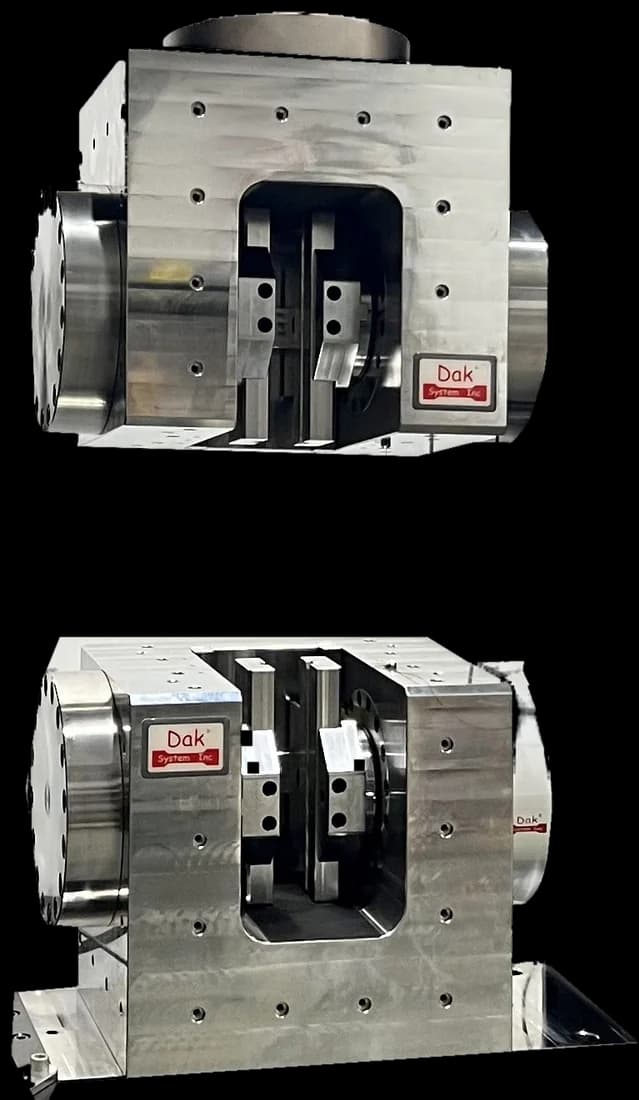
Twin side-acting closure holds a 50 mm full-thickness strip through 200 load cycles without creeping — clamp creep here shows as a step in the elongation record and voids the run.
Specifications
Testing standard
Conveyor belts — Determination of elastic and permanent elongation and calculation of elastic modulus
Written and technically reviewed by Dak System Inc. engineeringLast reviewed
ISO 9856 measures how much a conveyor belt stretches and how much of that stretch it keeps. A full-thickness strip is cycled 200 times between two force levels at 0.1 Hz while elongation is recorded, and the method reports elastic elongation, permanent elongation and elastic modulus. Permanent elongation is the figure that sizes the take-up an installed conveyor needs.
From the test method to your testing system
Explore the DAK machines already listed for ISO 9856, then review the grips, measurement and setup requirements below.
 Universal Testing MachineSeries 7200Explore the machine →
 Universal Testing MachineSeries 9000Explore the machine →
01Understand the method
A 50 mm wide strip cut through the full thickness of a conveyor belt is clamped at both ends, with at least 300 mm of free length between the jaw faces. A clip-on device spans a marked reference length of 100 mm or more on the axis of the strip. The machine then cycles the strip sinusoidally between two force levels — 200 cycles at 0.1 Hz — and records elongation throughout.
Three figures come out: elastic elongation, permanent elongation and elastic modulus in newtons per millimetre of belt width. Permanent elongation sizes the take-up, since the tensioning gear on an installed conveyor has to absorb whatever stretch the belt keeps after running in. Elastic elongation and modulus feed belt-tension, sag and starting-and-braking calculations for the drive, and they separate steel-cord carcases from textile ones at specification stage rather than after commissioning.
02Prepare the specimen and test settings
There is no crosshead speed here in the usual sense. The machine holds a force waveform, and that is the binding requirement.
The requirement is CONTROL, not capacity. Holding an approximately sinusoidal force waveform at 0.1 Hz for 200 consecutive cycles needs closed-loop force control — a frame that can break the belt cannot necessarily cycle it.
03Build the test setup on a DAK machine
Force demand scales with the belt rating, not with the frame's break capacity. The upper reference force is 10 % of nominal tensile strength multiplied by test-piece width and the lower is 2 %, so a 200 N/mm belt on a 50 mm strip cycles between roughly 200 N and 1 kN, a 3150 N/mm textile belt between about 3.2 kN and 15.8 kN, and a heavy steel-cord belt can carry the upper force toward 30–50 kN. An initial force of 0.5 % of nominal tensile strength times width is applied first to take up slack.
The binding capability is control, not capacity: closed-loop force control holding an approximately sinusoidal waveform at 0.1 Hz — six cycles a minute — for 200 consecutive cycles at those loads. Force indication is required to ISO 7500-1 Class 3 or better, with Class 2 given as an example of better, per the 2003 text and not confirmed here for the 2016 edition.
Strain measurement is set by the method itself rather than by an extensometer class: measuring length of at least 100 mm, accurate to 0.1 mm or better. Total strain stays inside about 5 %, so resolution matters far more than travel. Clamps must hold a 50 mm full-thickness strip without creeping over 200 cycles; the face pattern is not prescribed. Conditioning follows ISO 18573 — atmosphere A at 20 °C and 65 % RH, B at 23 °C and 50 % RH, or tropical C at 27 °C and 65 % RH, as the parties agree.
Twin side-acting closure holds a 50 mm full-thickness strip through 200 load cycles without creeping — clamp creep here shows as a step in the elongation record and voids the run.
Specifications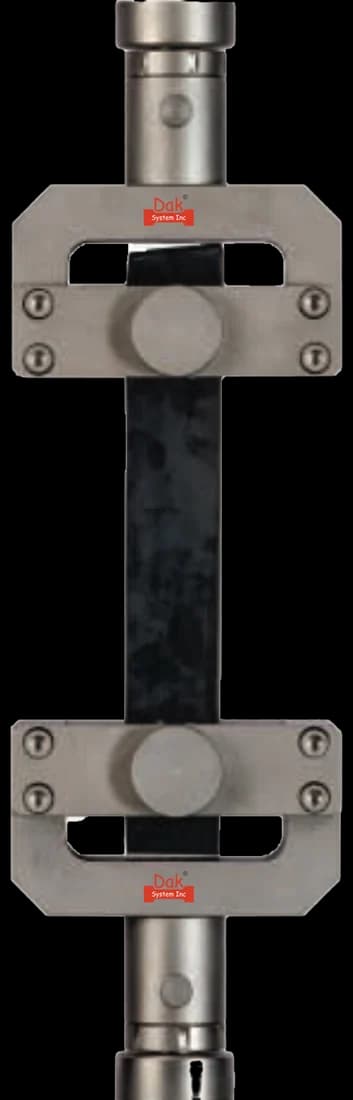
Wide vice-action jaws, for the larger gripped area a heavy steel-cord belt strip needs at the upper reference force.
SpecificationsDak verifies against whichever standard the method names, and where a class applies our frames sit a class tighter than it asks.
| The method asks for | Dak supplies | |
|---|---|---|
| Capacity | Loads are modest but must be applied dynamically: the upper reference force is a tenth of the belt's rating across a 50 mm strip, so a 200 N/mm belt cycles between about 200 N and 1 kN, a 3 150 N/mm textile belt between roughly 3,2 kN and 15,8 kN, and a heavy steel-cord belt can take the upper force toward 30-50 kN. The frame requirement is 0,1 Hz sinusoidal control at those loads, not a high break capacity. | Load cells from 1 kg to 60 ton on the Series 7200, and 0.5 to 100 kN on the Series 9000 |
| Force accuracy | ISO 7500-1 Class 3 or better (Class 2 given as an example of 'better') — per the 2003 edition text; not confirmed for the 2016 edition | ISO 7500-1 Class 0.5 — a class tighter than the method asks |
| Strain measurement | An extensometer to none — the method sets its own device requirement: measuring length at least 100 mm, accurate to 0,1 mm or better, gauge length at least 100 (extensometer reference length); free length between jaw faces at least 300 | Certified to ISO 9513 Class 1 and ASTM E83 — non-contact video, clip-on and high-elongation |
| Gripping | Belt clamps holding a 50 mm strip over at least 300 mm free length, with a clip-on extensometer set to a reference length of 100 mm or more | Our vice-action grips or self-tightening serrated wedge grips, with V-jaws for round specimens, built to the specimen |
| Environment | Conditioning per ISO 18573 — at least 16 h in a controlled-humidity atmosphere; the sample is taken no sooner than five days after belt manufacture | 3009 series chambers, −150 °C to +400 °C — temperature only |
04Run the test
05Calculate, report and interpret
εel = recoverable extension / reference length × 100
The part that comes back. It feeds belt-tension, sag and starting-and-braking calculations for the drive.
εperm = retained extension / reference length × 100
The part that does not come back. It sizes the take-up, because the tensioning gear has to absorb whatever stretch the belt keeps after running in.
E = Δ force per mm width / Δ elastic strain
In newtons per millimetre of belt width, not in MPa — the same convention as the strength figure, and for the same reason: thickness is not a useful quantity for a layered composite.
Grip creep is the dominant error: a strip walking a millimetre through the clamps over 200 cycles is read as permanent elongation the belt does not have. Cutting the sample inside five days, or skipping conditioning, leaves the carcase still relaxing and drifts permanent set high. Extensometer clips walking on soft cover rubber shift the reference length, depressing elastic elongation and inflating modulus. Stopping short of 200 cycles understates permanent elongation, because the belt has not yet settled.
06Compare methods and find answers
| ISO 9856 | ISO 283 | ISO 505 | |
|---|---|---|---|
| Measures | Elastic and permanent elongation, modulus | Full thickness tensile strength | Tear propagation resistance |
| Loading | 200 cycles, below break | Once, to rupture | Tear |
| Answers | How much take-up travel? | Is the belt to its rating? | How does damage spread? |
| Binding requirement | Closed-loop force control at 0.1 Hz | Frame capacity | Low-force resolution |
A belt accepted on ISO 283 strength alone has not been shown to behave acceptably in service. Strength says it will not break; this method says how much the conveyor's tensioning gear will have to absorb, which is a different question and often the one that causes trouble after commissioning.
It is the international standard for measuring elastic and permanent elongation of conveyor belting. A full-thickness strip is cycled 200 times between two force levels at 0.1 Hz while elongation is recorded, and the method reports elastic elongation, permanent elongation and elastic modulus in newtons per millimetre of belt width.
It is the stretch the belt keeps after cycling — the part that does not come back. It matters because the take-up gear on an installed conveyor has to absorb exactly that, so the figure sizes the take-up travel. A belt specified on strength alone can still be wrong for an installation if its permanent elongation exceeds the take-up provided.
They scale with the belt rating rather than being fixed. The upper reference force is 10 % of the nominal tensile strength multiplied by the test piece width and the lower is 2 %, so a 200 N/mm belt on a 50 mm strip cycles between roughly 200 N and 1 kN, while a 3150 N/mm textile belt cycles between about 3.2 kN and 15.8 kN. An initial force of 0.5 % is applied first to take up slack.
One that can control force, not merely apply it. The binding requirement is closed-loop force control holding an approximately sinusoidal waveform at 0.1 Hz for 200 consecutive cycles at the reference loads. A frame with ample capacity to break the belt is not necessarily able to cycle it, and capacity is the easier half of this specification.
Because the carcase is still relaxing after manufacture. Testing sooner measures that relaxation alongside the belt's real elongation behaviour, and the permanent elongation figure comes out higher than the belt will actually show in service.
Cover rubber carries very little of the load but contributes a good deal of thickness variation, so leaving it on adds scatter without adding signal. The method reduces it to between 0.5 and 1 mm so that what is measured is the carcase, which is what actually resists the stretch.
Look at the shape of the elongation record rather than at the final numbers. Clamp creep and a lost extensometer reference both appear as a step in the trace, and both invalidate the run. A curve that looks plausible is not by itself evidence the test was clean — the step is the thing to search for.
Discuss your specimen, test requirements and reporting needs with DAK engineering.
This page describes the method as practised. The governing text is the current edition from the issuing body. Tell us what you are testing and we will answer with the machine, the fixture and a quotation.