Conveyor belts — Determination of strength of mechanical fastenings for textile conveyor belts — Static test method
Written and technically reviewed by Dak System Inc. engineering·Last reviewed
ISO 1120 joins two lengths of textile conveyor belt with the mechanical fastener under test and pulls the joint apart statically until it fails. The standard states its own purpose plainly: to eliminate fastenings of insufficient static strength. It does not cover vulcanised joints, and it is not valid for light conveyor belts. The current edition is ISO 1120:2025.
Two lengths of belt are joined with the mechanical fastener under test, the assembly is clamped in the machine by its two free ends, and it is pulled apart statically until the joint fails. The maximum force is the static strength of that fastening. The method covers both fastener types in common use: those employing a connecting rod through the hinge and those that do not.
It does not cover vulcanised joints, and it is neither applicable nor valid for light conveyor belts as described in ISO 21183-1.
What it measures, and why it matters
A conveyor belt joined with mechanical fasteners is only as strong as the joint, and the joint is always weaker than the belt. Fastener manufacturers publish a holding strength for each series against belt rating, and the plant engineer chooses a fastener from that table. This test is what puts a number behind the table.
The standard is unusually plain about its own purpose: the test exists to eliminate mechanical fastenings of insufficient static strength. It is a screening test, not a service-life prediction. A joint that passes will still fatigue under repeated passage over pulleys, and nothing in a static pull tells you how long it will last — only whether it should be considered at all.
Failure mode is the second half of the result. A joint can fail by the fastener plate tearing, by the rod pulling out of the hinge loops, or by the fastener tearing through the belt carcass. The last of those is a belt problem rather than a fastener problem and points at the wrong fastener series having been chosen for that carcass.
The specimen is a made-up joint
Everything that makes a field joint good or bad is built into the specimen before the machine is switched on. That is the method, and it is also its weak point.
Specimen
Two belt ends joined with the fastener under test
Fastener types covered
With a connecting rod through the hinge, and without
Not covered
Vulcanised joints
Not valid for
Light conveyor belts as described in ISO 21183-1
Preparation
Fastener tool, rivet or bolt pattern and end preparation as specified
Free length
Enough that the grips do not influence the fastened regionPractice
Make the joint the way the field makes it
DakA joint assembled carefully on a clean bench is not the joint a fitter makes underground at three in the morning. Where the test is meant to qualify a fastener for site use, that gap is the whole risk.
Loading, and what comes out
Loading
Static tensile pull to failure
Rate
As specified in the standard; not publicly quotable
Reported
Maximum force, and the failure mode
Static only
The method is a static test. Nothing in it predicts fatigue life under repeated passage over pulleys, which is how fastened joints actually die.
What the number is, and what it is not
Static fastening strength—
The maximum force the joint carried before failure
Compared against the belt rating to see what fraction of the belt strength the fastener returns. It is always a fraction.
The three failure modes—
Plate tears, rod pulls out, or fastener tears through the carcass
plate tears
the fastener itself is the limit
rod pull-out
the hinge loops or the rod are the limit
carcass tear-through
the wrong fastener series for that belt
The third is a selection error rather than a product fault, and it is the one the force alone will not tell you about.
A screening test, not a life prediction—
Pass means fit to consider; it does not mean fit for the duty
The standard says as much: the purpose is to eliminate fastenings of insufficient static strength.
How the test runs
01Cut two belt ends and prepare them as the fastener system requires.
02Fit the fastener with the correct tool and rivet or bolt pattern.
03Check free length either side of the joint is sufficient.
04Condition in the standard atmosphere.
05Clamp the two belt ends in the grips, square to the pull.
06Load statically to failure.
07Record the maximum force.
08Examine the failed joint and classify the failure mode.
09Report force and failure mode together, with the fastener series and the belt rating.
Grips that slip at high load on a compliant belt end do not announce themselves. The trace becomes shallow and rounded rather than showing an obvious jump, and the reported strength is low. Check the belt ends for jaw witness marks after every test.
Grips and fixtures for this method
TJ-144
Heavy Duty Hydraulic Grips
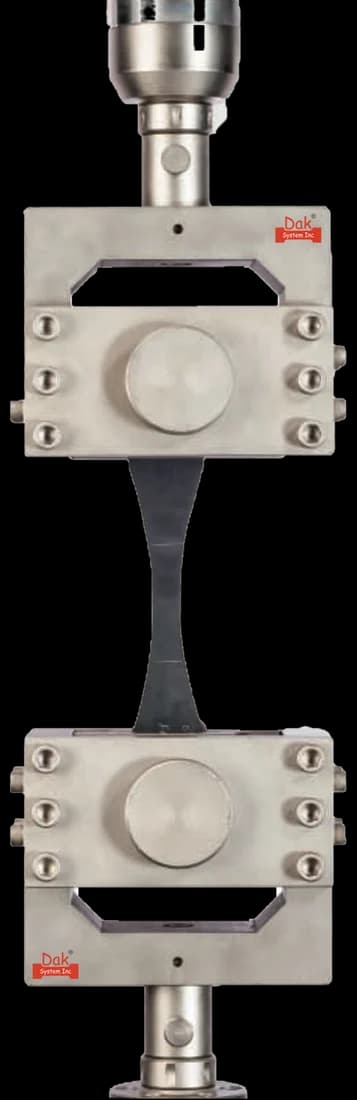
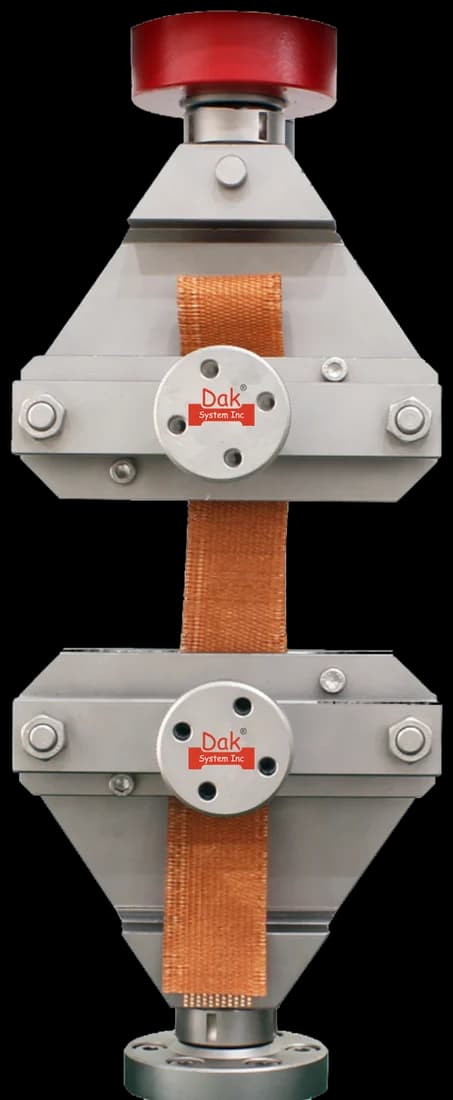
Wide hydraulic jaws with enough clamping force to hold a compliant, rubber-faced belt end at high load. This is the one method in the belting cluster where clamping force, not resolution, is the binding requirement.
For narrower specimens and lower-rated belts, a wide vice-action face takes the full belt end. Check for jaw witness marks after each test — slippage on rubber creeps rather than jumps and does not show in the trace.
Belt construction, ply count, rating and cover thicknesses
Fastener manufacturer designation and series
Fastener type — connecting rod or non-rod
Rivet or bolt pattern and the tool used
Specimen width and free length either side of the joint
Conditioning atmosphere
Maximum force for each specimen
Failure mode for each specimen
Any reduction in specimen width agreed for capacity reasons, and why
What the machine must be capable of
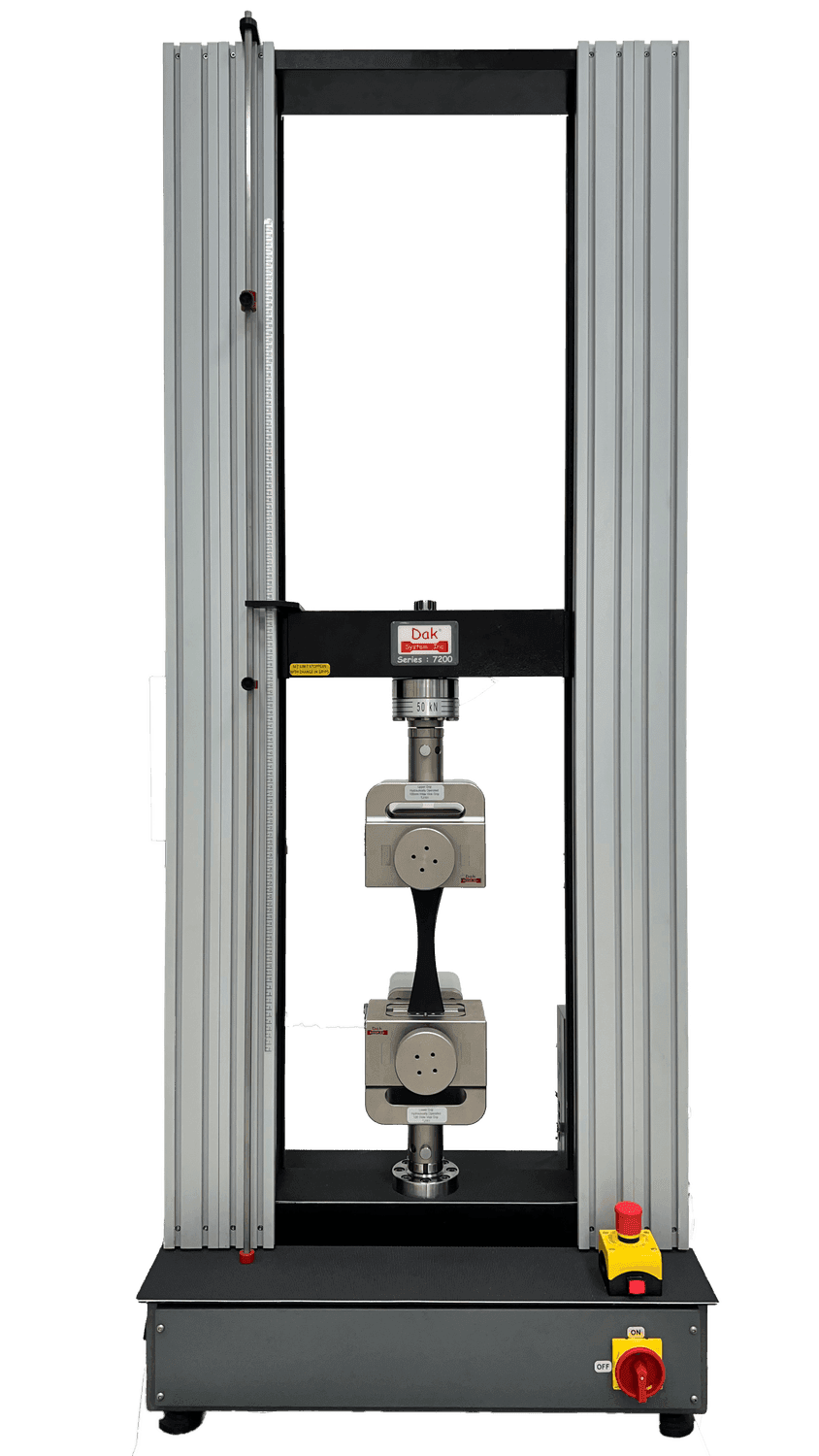
This is the highest-force method in the belting group. A fastened joint on a heavy textile belt can carry tens to low hundreds of kilonewtons, so frame capacity is a real constraint rather than an afterthought, and the specimen is wide. A frame with wide grips and generous daylight is needed — the joint plus free length either side is a long specimen.
Grips have to hold a wide rubber-faced belt end without slipping at high load, which in practice means large hydraulic or heavy vice-action jaws with a gripping face and enough clamping force to hold a compliant material. Force accuracy to ISO 7500-1 Class 1 is the normal requirement. No extensometer is needed; the result is a force.
Where a belt width or fastener series exceeds a standard frame, specimen width can sometimes be reduced by agreement — a decision to record, not to make silently, because a narrowed specimen is not directly comparable.
What goes wrong in practice
Joints made to a different standard of workmanship than the field job dominate. Grips that slip at high load on a compliant belt end are the mechanical fault, and they usually show as a shallow, rounded force trace rather than an obvious slip. Insufficient free length lets the grip constrain the belt near the fastener and stiffen the joint. And a result recorded without the failure mode cannot distinguish a weak fastener from a belt carcass that the fastener was never suited to.
Mechanical fastening against a vulcanised splice
Both join a belt. They are chosen for different reasons and only one of them is covered by this method.
Mechanical fastening
Vulcanised splice
Covered by
ISO 1120
ISO 8094 for steel cord splice adhesion
Strength returned
A fraction of belt rating
Close to belt rating
Fitted
In minutes, on site, with hand tools
In hours, with a press and heat
Repairable
Yes, quickly
Only by re-splicing
Fails by
Plate tear, rod pull-out, carcass tear-through
Cord pull-through, cover separation
A fastener is chosen because a splice cannot be made or cannot be afforded in downtime, not because it is as strong. Comparing the two on strength alone misses the decision that was actually being made.
Questions we are asked about this test
What is ISO 1120?+
ISO 1120 is the international static test method for the strength of a mechanical fastening in a textile conveyor belt. Two belt ends are joined with the fastener under test and pulled apart until the joint fails. It covers fasteners that use a connecting rod through the hinge and those that do not. The current edition is ISO 1120:2025, which narrowed the title to textile conveyor belts; it supersedes ISO 1120:2012.
What is the test actually for?+
The standard states its own purpose unusually plainly: to eliminate mechanical fastenings of insufficient static strength. It is a screening test. A fastener that passes is fit to be considered for a duty; the test says nothing about how long it will last under repeated passage over pulleys, which is how fastened joints normally fail.
Does it cover vulcanised splices?+
No. Vulcanised joints are explicitly outside the scope, and so are light conveyor belts as described in ISO 21183-1. For steel cord belts, which are spliced rather than fastened, ISO 8094 covers splice joint adhesion and ISO 7623 the cord-to-coating bond that the splice depends on.
Why does the failure mode matter?+
Because it says whose problem it is. A fastener plate that tears, or a rod that pulls out of the hinge loops, points at the fastener. A fastener that tears through the belt carcass points at the wrong fastener series having been chosen for that belt — a selection error, not a product fault. The peak force alone cannot distinguish the two, and the report is much less useful without it.
Why is this the highest-force belting method?+
Because the specimen is the belt itself, at full width, and a fastened joint on a heavy textile belt can carry tens to low hundreds of kilonewtons. The other belting methods peel, tear or strip and need only a few hundred newtons to a few kilonewtons. Here frame capacity, grip width and daylight are genuine constraints rather than afterthoughts.
Can specimen width be reduced if the frame will not take it?+
Sometimes, by agreement between the parties — but it is a decision to record in the report, not one to make silently. A narrowed specimen changes how load distributes across the fastener row and is not directly comparable with a full-width result. Where narrowing is not acceptable, the specimen needs a frame sized for it.
What is the commonest way this test misleads?+
A specimen joint made to a higher standard of workmanship than the field job. Every variable that decides whether a fastened joint holds — end squareness, fastener spacing, rivet setting, tool condition — is built into the specimen before the machine is switched on. A laboratory joint assembled unhurriedly on a clean bench can pass comfortably while the same fastener, fitted underground in a hurry, does not.
This page describes the method as practised. The governing text is the current edition from the issuing body. Tell us what you are testing and we will answer with the machine, the fixture and a quotation.