
Testing standard
ASTM C1499 Equibiaxial Flexural Strength Testing of Advanced Ceramics
Standard Test Method for Monotonic Equibiaxial Flexural Strength of Advanced Ceramics at Ambient Temperature
Written and technically reviewed by Dak System Inc. engineeringLast reviewed
ASTM C1499 supports a flat ceramic plate on a ring and loads it through a smaller concentric ring, putting the underside into equal tension in every direction at once. It measures what the standard calls the least flexural strength — the worst flaw is found whatever its orientation, which a bar in uniaxial bending cannot do.
At a glance
- Test type
- Flexure & bend — the specimen is bent
- Published by
- ASTM
- Edition
- C1499-19
- Material
- Wood, concrete & ceramics
- Runs on
- Series 7200 and Series 9000
From the test method to your testing system
Explore DAK equipment for ASTM C1499, then review the specimen and setup requirements below.
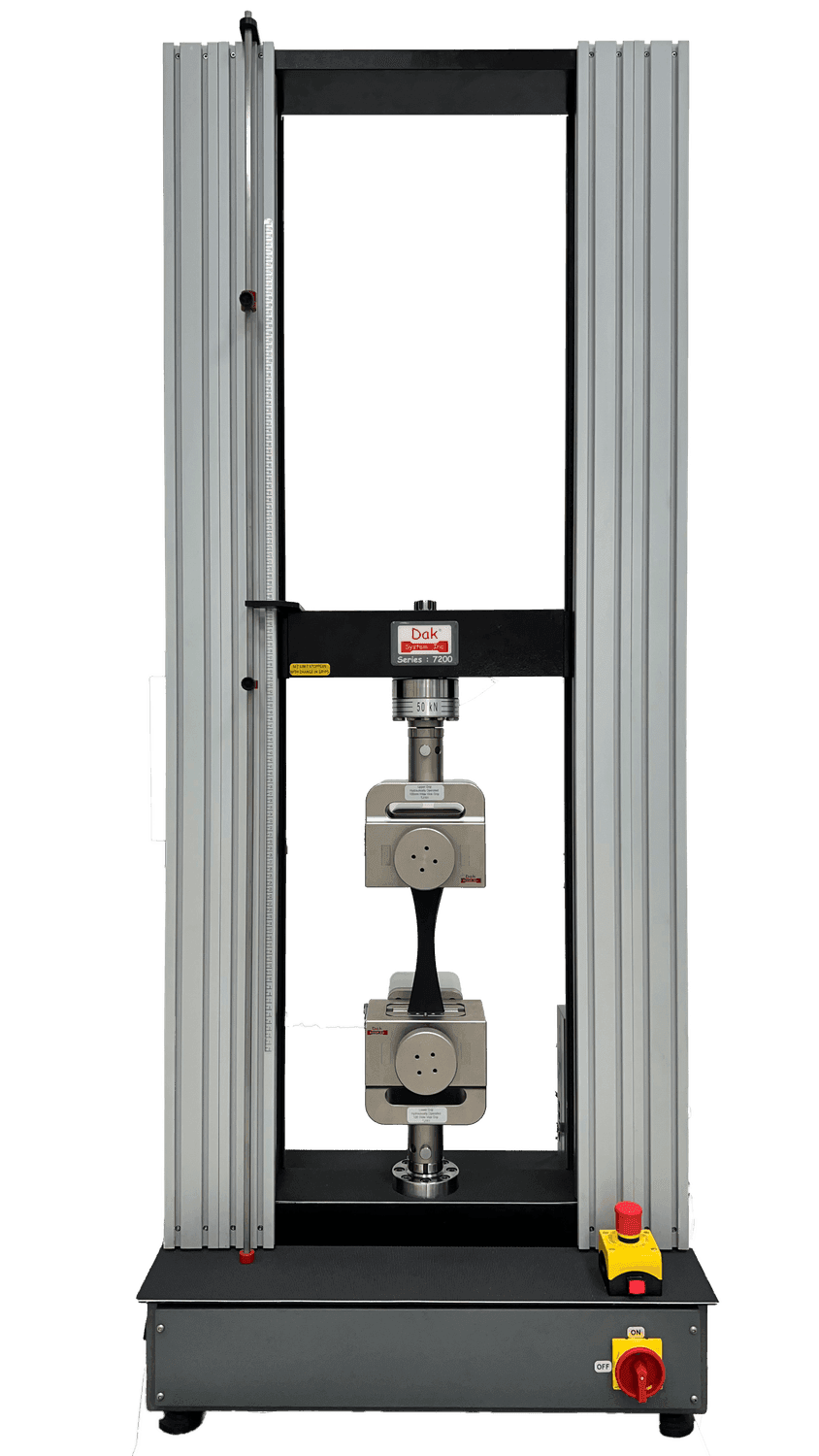 Universal Testing MachineSeries 7200Explore the machine →
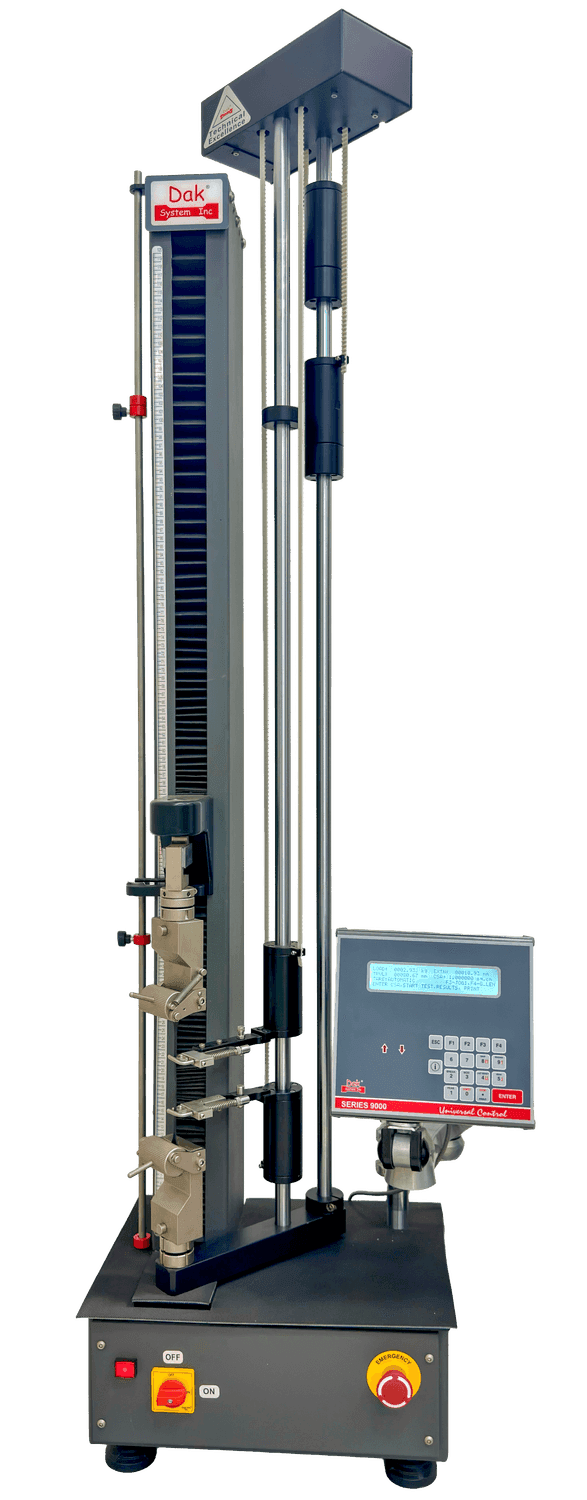 Universal Testing MachineSeries 9000Explore the machine →
Jump to a specific section
01Understand the method
What the test does
A flat ceramic disc or plate is supported on a ring and loaded through a smaller concentric ring, putting the underside into equal tension in every direction at once. Load rises monotonically to fracture, and equibiaxial strength is calculated from the load at break.
The arrangement is called ring-on-ring, and the geometry is the whole idea. A bar in bending is in tension along one axis; a plate loaded through a concentric ring is in tension along two, equally — a far better model of what a ceramic seal face, substrate or window actually sees.
Scope covers machined and as-fired specimens with limited warpage, applied to isotropic and homogeneous materials: monolithic ceramics and some composite ceramics. Continuous fibre composites are excluded, as they are from the uniaxial method.
The fixture is not fixed by a table of dimensions; the ring sizes are defined in relation to the specimen. The loading-to-support ring diameter ratio falls between about 0.2 and 0.5, and the loading ring's contact radius is tied to specimen thickness, between half and one and a half times it. A laboratory testing 1 mm plate and one testing 6 mm plate use different fixtures and both comply.
What it measures, and why it matters
The standard's own significance says why it exists: ceramic applications frequently involve biaxial tensile stresses. A uniaxial figure from a bar is a legitimate property measured in a stress state most ceramic components never see.
The difference is not a correction factor. Under equal tension in two directions a flaw of any orientation is fully loaded, whereas in uniaxial bending a flaw lying along the stress axis is barely loaded at all. Equibiaxial testing finds the worst flaw whatever its orientation, and measures what the standard calls the least flexural strength.
That is why the method is framed probabilistically, on weakest-link theory. A ceramic does not have a strength; it has a distribution of flaws and a probability of failure at a given stress and area. The equibiaxial result is what that distribution needs when the component is loaded in two directions.
There is a practical advantage too: a ring-on-ring specimen has no machined edges inside the stressed region, so edge damage — which dominates so many bar results — is absent. What breaks is the surface and the volume, not the way the specimen was cut.
The stated uses are material development, comparison, quality assurance, characterisation, and verification of design codes or models.
02Prepare the specimen and test settings
Specimen
Flat plates or discs, and flatness is the requirement that decides whether the result means anything.
- Form
- Flat discs or plates, machined or as-firedAs-fired being explicitly in scope matters: a component surface can be characterised as it will be used, without grinding away the condition in question.
- Warpage
- LimitedA warped plate does not sit evenly on the support ring, so load enters at high points and the field is no longer equibiaxial anywhere. The fault is invisible in the result.
- Materials
- Isotropic and homogeneous: monolithic and some composite ceramicsContinuous fibre composites are excluded, as they are from the uniaxial method.
- No machined edges in the stressed region
- By geometryDakEdge damage dominates so many bar results and is simply absent here. What breaks is the surface and the volume, not the way the specimen was cut.
Test speed
Monotonic loading to fracture: the load rises steadily and is neither cycled nor held. The fixture geometry is set by relationships rather than fixed dimensions.
- Loading
- Monotonic, uniaxial, to fractureThe frame applies one load down the axis; the fixture converts it into a biaxial stress field.
- Ring diameter ratio
- Loading to support, about 0.2 to 0.5DakPublished fixture-design guidance for the configuration. The standard sizes the rings against the specimen rather than fixing them.
- Loading ring contact radius
- Between half and one and a half times the plate thicknessDakA sharp ring on a thin plate initiates fracture from the contact rather than from the flaw population, which is a different measurement entirely.
03Build the test setup on a DAK machine
What the machine must be capable of
Monotonic uniaxial loading: the frame applies one load down the axis and the fixture turns it into a biaxial field. Forces are modest, and a load cell matched to the specimen matters far more than frame capacity.
The fixture is the specialised part and must be built to the specimen rather than bought as one size. Both rings must be concentric to a fine tolerance: eccentricity turns an equibiaxial field into something else the calculation still treats as equibiaxial. The loading ring contact radius must suit the plate thickness, per the relationship the standard sets.
Alignment and a self-seating arrangement matter for the same reason they do in bar flexure, with less forgiveness: there is no span to average across.
Running ASTM C1499 on the Series 7200 and Series 9000
Dak verifies against whichever standard the method names, and where a class applies our frames sit a class tighter than it asks.
| The method asks for | Dak supplies | |
|---|---|---|
| Capacity | Low: forces are modest and a load cell matched to the specimen matters far more than frame capacity | Load cells from 1 kg to 60 ton on the Series 7200, and 0.5 to 100 kN on the Series 9000 |
| Force accuracy | unknown — no force-verification class is named in the retrievable ASTM record | ISO 7500-1 Class 0.5 — the method sets no class of its own |
| Gripping | Concentric ring-on-ring, sized to the specimen: loading-to-support diameter ratio about 0.2 to 0.5, loading ring contact radius between half and one and a half times the plate thickness | Our compression anvils, built to the specimen |
| Environment | ambient temperature | 3009 series chambers, −150 °C to +400 °C — temperature only |
04Run the test
How the test runs
- Check the plate for warpage against the standard's limit.
- Select or build rings sized to the plate thickness, per the diameter ratio and contact radius relationships.
- Set both rings concentric to a fine tolerance.
- Seat the plate on the support ring so it bears evenly.
- Load monotonically to fracture.
- Compute the equibiaxial strength from the load at fracture and the ring geometry.
- Characterise a set statistically — the method is framed on weakest-link theory.
05Report and interpret
What travels with a C1499 result
The fixture is specimen-specific, so the geometry is part of the result.
- Both ring diameters, and the loading ring contact radius.
- Plate thickness, and whether the surface was machined or as-fired.
- Measured warpage against the limit.
- The number of specimens and the distribution.
- That the result is equibiaxial — it is not comparable with a uniaxial bar figure.
What goes wrong in practice
A warped specimen is the commonest, and the standard's warpage limit exists precisely because the fault is invisible in the result.
Eccentric rings are the second. The arithmetic assumes concentricity and cannot detect its absence.
A fixture sized for a different plate thickness is the third: the loading ring radius relationship is a requirement, and a sharp ring on a thin plate initiates from the contact rather than the flaw population.
Finally, comparing an equibiaxial figure with a uniaxial one as though they were the same property. The equibiaxial value will generally be lower, and that is the method working, not the material being worse.
06Compare methods and find answers
Equibiaxial or uniaxial
ASTM C1161 is the uniaxial companion. They measure different things about the same material.
| C1499 equibiaxial | C1161 uniaxial | |
|---|---|---|
| Stress state | Equal tension in every in-plane direction | Tension along one axis |
| Which flaws are loaded | All orientations, fully | Flaws along the stress axis barely at all |
| Edge damage | Outside the stressed region | Often governs the result |
| Models | Seal faces, substrates, windows | Beams and bars |
| Typical result | Lower — it finds the worst flaw | Higher |
An equibiaxial figure below a uniaxial one is the method working, not the material being worse. Treating them as the same property is the common error.
Related and equivalent standards
ASTM C1161 is the uniaxial flexure companion, using bars in three- or four-point bending. Product standards for ceramic components frequently call for biaxial strength by a ring-on-ring arrangement. Continuous fibre-reinforced ceramic composites are excluded here and need their own methods.
Questions we are asked about this test
What is ASTM C1499?
It is the ASTM method for monotonic equibiaxial flexural strength of advanced ceramics at ambient temperature, current as C1499-19. A flat plate is supported on a ring and loaded through a smaller concentric ring — the arrangement usually called ring-on-ring.
Why test biaxially rather than in bending?
Because, as the standard's significance puts it, ceramic applications frequently involve biaxial tensile stresses. A bar figure is a legitimate property measured in a stress state most ceramic components never actually see.
What does equibiaxial loading find that a bar does not?
The worst flaw regardless of orientation. Under equal tension in two directions any flaw is fully loaded, whereas in uniaxial bending a flaw lying along the stress axis is barely loaded at all. The standard calls the result the least flexural strength of the material.
What are the ring dimensions?
They are not fixed. The standard sizes the rings against the specimen: the loading-to-support diameter ratio falls in a range of roughly 0.2 to 0.5, and the loading ring's contact radius is tied to plate thickness, between half and one and a half times it. Different plate thicknesses need different fixtures and both comply.
Why does warpage matter?
Because a warped plate does not sit evenly on the support ring. Load enters at the high points and the stress field stops being equibiaxial, while the calculation carries on treating it as though it were. The standard's warpage limit exists precisely because the fault leaves no trace in the result.
Can as-fired surfaces be tested?
Yes, and it is one of the method's real advantages. As-fired specimens are explicitly in scope, so a component surface can be characterised as it will actually be used rather than after grinding away the very condition in question.
Why is the method framed probabilistically?
Because a ceramic does not have a strength — it has a distribution of flaws and a probability of failure at a given stress over a given area. The method rests on weakest-link failure theory, so a set of specimens characterised statistically is the output, not a single number.
Can Dak supply a ring-on-ring setup?
Yes. Tell us the plate thickness and diameter and the expected strength, and we will answer with the frame, a load cell matched to the specimen, rings built to your plate and a quotation.
Related
Materials tested to it
The test it standardises
Industries that test to it
Other standards explained
Planning ASTM C1499 testing?
Discuss your specimen, test requirements and reporting needs with DAK engineering.
This page describes the method as practised. The governing text is the current edition from the issuing body. Tell us what you are testing and we will answer with the machine, the fixture and a quotation.