Self-identifying
Load Cells
A low-range cell. Rigid foam in tension fails at a small fraction of what a solid plastic of the same section carries, so resolution at the bottom of the range decides whether the result is usable.
Specifications
Testing standard
Standard Test Method for Tensile and Tensile Adhesion Properties of Rigid Cellular Plastics
Written and technically reviewed by Dak System Inc. engineeringLast reviewed
ASTM D1623 pulls rigid cellular plastic apart in tension. Load is introduced through the specimen's end faces rather than by gripping its sides, because foam cannot be clamped without being crushed. The method reports the tensile strength of the foam itself and, using a different specimen, the tensile adhesion strength of the foam to a substrate. The current edition is D1623-17(2023).
From the test method to your testing system
Explore the DAK machines already listed for ASTM D1623, then review the grips, measurement and setup requirements below.
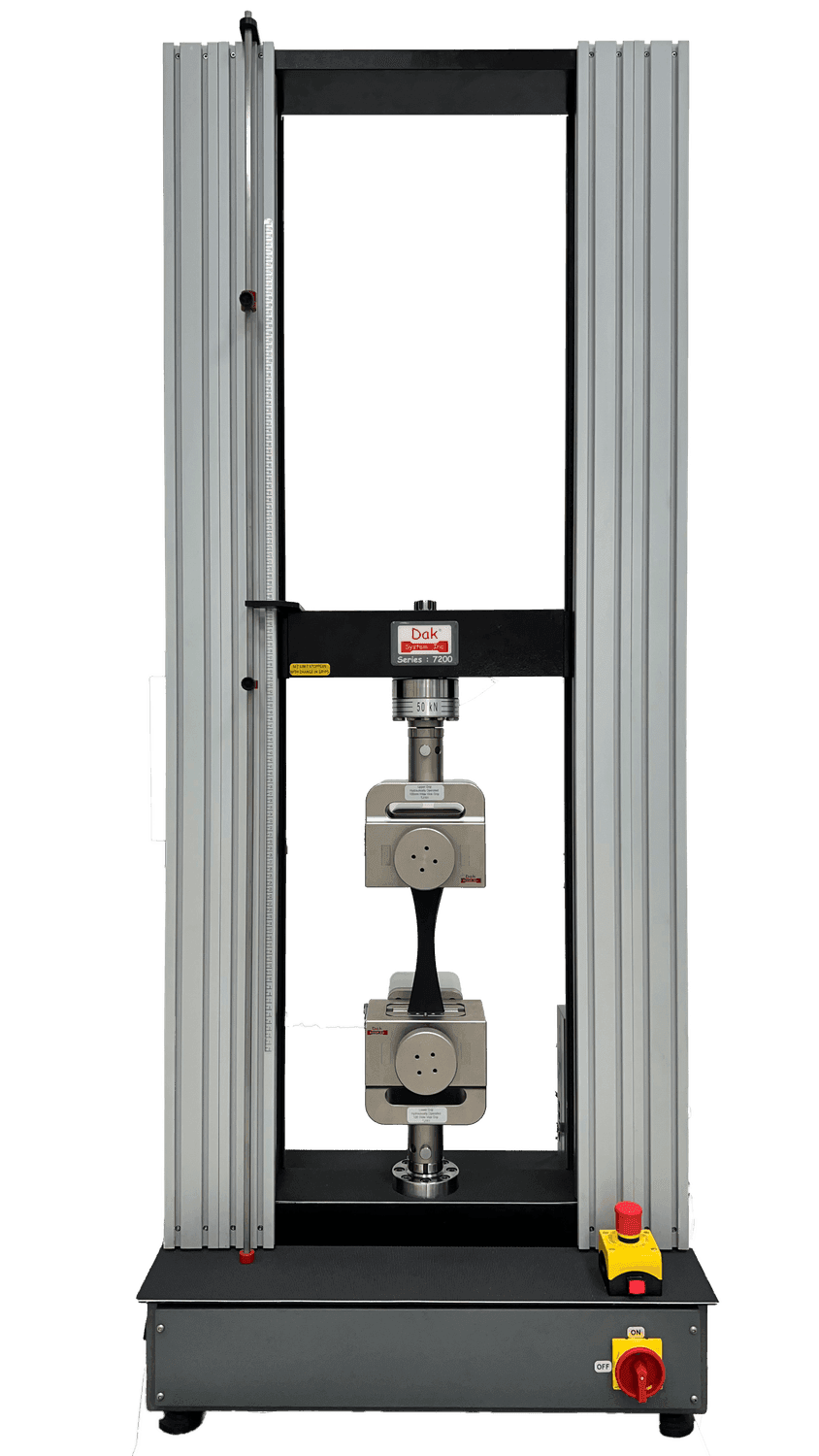 Universal Testing MachineSeries 7200Explore the machine →
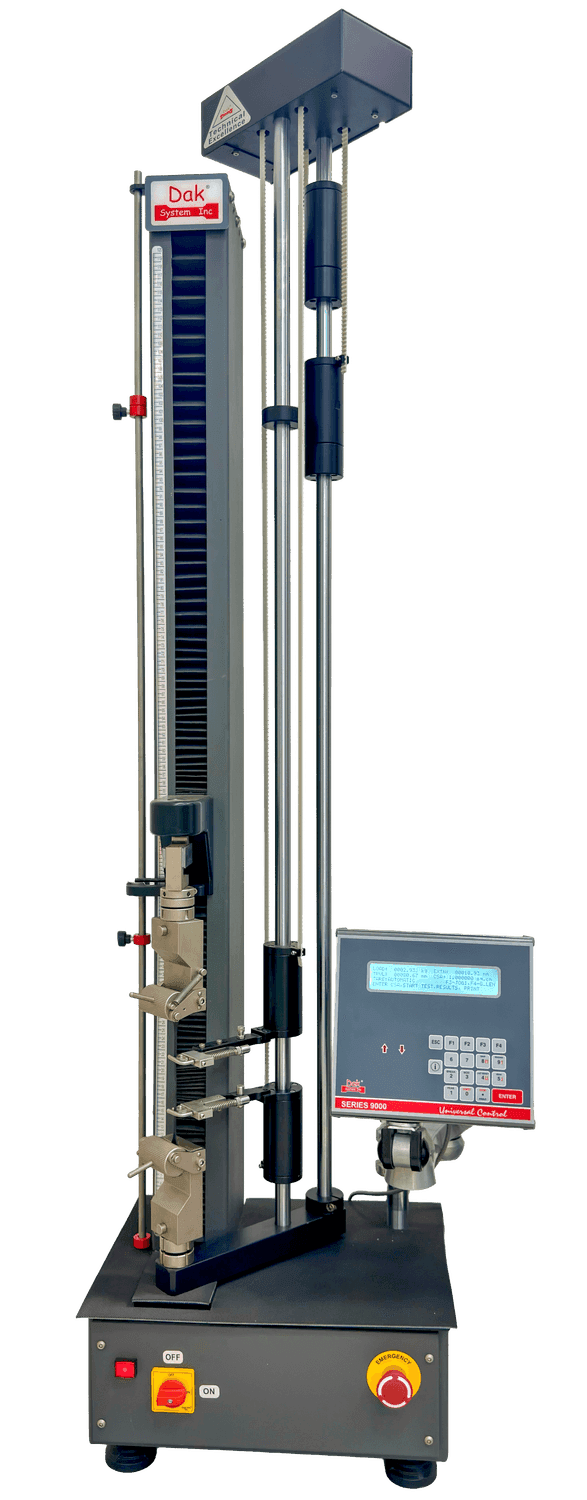 Universal Testing MachineSeries 9000Explore the machine →
01Understand the method
A specimen of rigid cellular plastic is pulled apart in tension along one axis under controlled temperature, humidity and machine speed, all three of which the method fixes: 23 ± 2 °C, 50 ± 10 % relative humidity, and a speed set so that rupture arrives in three to six minutes. The suggested rate is 1.3 mm/min (0.05 in./min) per 25.4 mm (1 in.) of test-section gauge length — so on the recommended Type A specimen, a 645 mm² turned cylinder on a 25.4 mm gauge, that is 1.3 mm/min; on the 12.7 mm minimum gauge it is 0.65 mm/min, and the rate used is reported. Foam cannot be gripped like a plastic bar without being crushed, so load goes in through the end faces: the ends are bonded to loading blocks, and the blocks sit in self-aligning grips so the specimen sees axial tension, not bending. A second, closely related test bonds the foam to a substrate, so the interface fails rather than the foam.
Two different things, which is why the title names both. The tensile test gives the strength of the cellular material itself in the direction pulled. The tensile adhesion test gives the strength of the bond between the foam and whatever it is stuck to — a sandwich facing, or a single substrate.
The failure mode carries as much information as the force. A break through the foam says the bond was stronger than the material and reports the foam's strength; a clean separation at the glue line says the joint was the weak point and reports the bond. Confusing the two turns a good result into a false one: an adhesion figure that is really a cohesive foam failure says nothing useful about the adhesive. Rigid foams are also strongly anisotropic, because the cells elongate in the rise direction during foaming, so a through-thickness figure and an in-plane figure from the same board are not interchangeable.
02Prepare the specimen and test settings
Which type you use is decided by how much material you have and by which of the two properties in the title you are after. The method names all three by their preferred use rather than by a hierarchy.
Exact dimensions and tolerances for the three types are tabulated in the standard itself, and the type used must be reported with the result — a Type B figure and a Type A figure on the same foam are not interchangeable.
The method fixes temperature, humidity and machine speed together, which is why its scope names all three. Two laboratories running the same foam under different conditions will disagree, and both will be right.
03Build the test setup on a DAK machine
Low force, well resolved, and dead straight. Rigid foam in tension fails at a small fraction of what a solid plastic of the same section would carry, so the load cell must be chosen for the specimen and not for the frame's capacity — resolution at the bottom of the range is the whole game. The method specifies a constant-rate-of-crosshead-movement machine, self-aligning grips, and an extension indicator.
Self-aligning is not a preference here. Foam has almost no capacity to redistribute a bending stress, so any misalignment between the two loading blocks puts one edge of the specimen into tension well before the other and lowers the result without leaving evidence. Alignment, bond quality and cutting are the three things that decide whether the number means anything.
A low-range cell. Rigid foam in tension fails at a small fraction of what a solid plastic of the same section carries, so resolution at the bottom of the range decides whether the result is usable.
SpecificationsDak verifies against whichever standard the method names, and where a class applies our frames sit a class tighter than it asks.
| The method asks for | Dak supplies | |
|---|---|---|
| Capacity | Rigid foam in tension fails at a small fraction of what a solid plastic of the same section carries, so the useful working range is low — tens to a few hundreds of newtons on typical insulation-grade specimens. The cell is sized to the specimen, never to the frame. | Load cells from 1 kg to 60 ton on the Series 7200, and 0.5 to 100 kN on the Series 9000 |
| Force accuracy | not specified — the method references D638, D883 and E691 only, and names no force accuracy class | ISO 7500-1 Class 0.5 — the method sets no class of its own |
| Strain measurement | An extensometer to not specified — the method names an extension indicator without assigning a class, gauge length not specified — set by the specimen type, whose dimensions are tabulated in the standard | Certified to ISO 9513 Class 1 and ASTM E83 — non-contact video, clip-on and high-elongation |
| Gripping | Self-aligning grips holding loading blocks bonded or fitted to the specimen end faces; a lathe specimen cutter for preparing the geometry | Our a fixture built for this method, built to the specimen |
| Environment | Defined temperature and humidity, with the test run under the conditions used for conditioning | 3009 series chambers, −150 °C to +400 °C — temperature only |
04Run the test
Adhesive wicking into open cells reinforces the foam next to the block and moves the break away from the region being measured. It looks like a valid cohesive failure and is not one.
05Calculate, report and interpret
The arithmetic is trivial. What the number means depends entirely on where the specimen broke, which is why the failure mode is recorded as part of the result rather than as an observation.
σ = P / A
The same expression serves both properties. Which one it produced is decided by where the specimen failed, not by the equation.
Cohesive in the foam, or adhesive at the interface
A break through the foam reports the material's strength. A clean separation at the glue line reports the bond. Recorded and reported, always.
The bond failing when the foam was the subject, which is a wasted specimen rather than a low result. Adhesive wicking into open cells and locally reinforcing the material next to the block, so the break moves away from the region being measured. Misaligned blocks. Cutting the specimen from the wrong direction of the board, which measures anisotropy rather than the material. And reporting a strength without the failure mode, which leaves the reader unable to tell which of the two properties in the title was actually determined.
06Compare methods and find answers
Foam is far more often specified in compression than in tension, so D1623 usually appears beside a compression method rather than instead of one.
| ASTM D1623 | ASTM D1621 | ISO 844 | ASTM C297 | |
|---|---|---|---|---|
| Loading | Tension | Compression | Compression | Flatwise tension |
| Subject | Rigid cellular plastic, and its bond to a substrate | Rigid cellular plastic | Rigid cellular plastic | A whole sandwich construction |
| Specimen | Types A, B and C | Block specimen | Block specimen | Panel section bonded to loading blocks |
| Load introduced | Through bonded or held end faces | Between platens | Between platens | Through bonded loading blocks |
| Typical use | Adhesion and tensile strength of foam | Acceptance of insulation board | Acceptance of insulation board | Core-to-facing bond in a panel |
ASTM C297 asks the panel-level version of D1623's Type C question. Where the item under test is a finished sandwich rather than a foam sample, C297 is usually the method a specification means.
It is the ASTM test method for the tensile and tensile adhesion properties of rigid cellular plastics. A foam specimen of standard shape is pulled in tension under defined temperature, humidity and machine speed, either to measure the strength of the foam itself or, using a different specimen, the strength of its bond to a substrate. The current edition is D1623-17(2023).
The tensile test measures the strength of the cellular material along the axis pulled. The tensile adhesion test measures the strength of the interface between the foam and whatever it is bonded to — a sandwich facing or a single substrate. The Type C specimen is the one defined for adhesion. Which property the test actually produced is decided by where the specimen broke.
Type A wherever there is enough sample material, which makes it the default for the foam's own tensile strength. Type B when only smaller pieces are available, such as from a sandwich panel. Type C when the tensile adhesion of the foam to a substrate is the point. The type used has to be reported, because results from different types are not interchangeable.
Because foam has almost no capacity to redistribute a bending stress. Any misalignment between the two loading blocks puts one edge of the specimen into tension before the other, and the specimen fails early at a load that looks like a genuine result. The method names self-aligning grips among its required apparatus for exactly that reason.
Then the test has measured the bond, not the foam. If the foam's tensile strength was the objective, that specimen is discarded and the bonding procedure improved — a stronger adhesive, better surface preparation, or a longer cure. If tensile adhesion was the objective, an adhesive failure is the result you wanted and a cohesive foam failure is the one that tells you nothing about the adhesive.
Considerably. Rigid foams are anisotropic because the cells elongate along the rise direction during foaming, so a specimen cut through the thickness of a board and one cut in-plane measure different properties of the same material. The orientation must be recorded and reported, and figures from different orientations should never be averaged.
ASTM notes that no ISO equivalent to this test method is known. ISO 1926, Rigid cellular plastics — Determination of tensile properties, is the nearest international document covering foam in tension, but it is not declared an equivalent and results should not be assumed to transfer between the two.
Very little capacity and a great deal of resolution. Rigid foam fails in tension at a small fraction of the load a solid plastic of the same section would carry, so the load cell is chosen for the specimen rather than for the frame. A small universal testing machine with a properly sized cell and a well-aligned load train covers this method comfortably.
Discuss your specimen, test requirements and reporting needs with DAK engineering.
This page describes the method as practised. The governing text is the current edition from the issuing body. Tell us what you are testing and we will answer with the machine, the fixture and a quotation.