Standard Test Method for Determining Performance Strength of Geomembranes by the Wide Strip Tensile Method
Written and technically reviewed by Dak System Inc. engineering·Last reviewed
ASTM D4885 pulls a wide strip of geomembrane — much wider than its gauge length — so that the specimen cannot neck, and reports strength, elongation, three moduli and breaking toughness. It is a performance test intended as a design aid, not a specification test. The current edition is D4885-01, most recently reapproved as D4885-01(2023).
A wide strip of geomembrane — considerably wider than it is long in the gauge section — is clamped across its full width and pulled in tension until it fails. Strength and elongation are recorded, and the method also gives directions for calculating initial modulus, offset modulus, secant modulus and breaking toughness.
The two things that distinguish it from an ordinary tensile test are stated in the standard itself: the width of the specimens and the speed at which force is applied. Published work describes specimens 200 mm wide with a gauge length of 100 mm.
What it measures, and why it matters
The word in the title is *performance*. A dumbbell tensile test of the kind ASTM D6693 specifies is a control and specification test; it produces numbers that identify the material. This method is intended as a design aid, to determine whether a geomembrane can withstand the stresses and strains imposed under design conditions.
The difference is necking. Most geosynthetics contract laterally when they are pulled — a narrow specimen pulls in at the edges and the stress concentrates. That contraction edge effect is an artefact of the specimen, not a property of the sheet, and a liner spread over a subgrade cannot neck because the material either side of any point holds it. Making the specimen much wider than the gauge length suppresses the contraction and produces a closer relationship to how the material actually behaves in service. The slower rate of applied strain does the same thing on the time axis.
That is why both figures exist for the same product and why they differ. A specification quoting D6693 values and a design quoting D4885 values are both correct and are describing different things.
Wide, deliberately
The two things that make this method different are stated in the standard itself: the width of the specimen and the speed at which force is applied.
Material
Synthetic geomembranes
Specimen
A wide strip, considerably wider than the gauge lengthPublished work on this method describes specimens 200 mm wide at a gauge length of 100 mm.
Why wide
To minimise the contraction edge effect — neckingNecking is an artefact of a narrow specimen. A liner spread on a subgrade cannot neck, because the material either side holds it.
Direction
Machine and cross direction, both recorded
Edges
Clean and parallelPracticeA nicked edge still initiates failure on a wide specimen, and there is more edge to get wrong.
Say so if a seam is in the specimen
DakA wide strip across a weld is a different test from a wide strip of parent sheet, and the two are quoted against each other more often than they should be.
Narrowing the specimen to fit the available grips destroys the purpose of the method. The width is not a tolerance; it is the mechanism by which necking is suppressed, and a narrowed specimen reproduces exactly the artefact the method exists to remove.
The slower rate, and what it is for
Rate
Slower than a conventional tensile test, as specified in the methodThe standard names the speed of applied force as one of the two basic distinctions from other geomembrane tensile methods.
Purpose of the slower rate
A closer relationship to actual material behaviour in service
Reported
Tensile strength and elongation, plus moduli and breaking toughness
Take strain from the specimen where modulus is reported
DakGrip separation on a wide, compliant specimen includes machine compliance and any slip, both of them a significant share of the movement.
What is calculated
Performance strength—
Maximum force divided by specimen width
Reported per unit width, so specimens of different widths compare.
Initial, offset and secant modulus—
Three slopes taken from the load-elongation curve
initial
the slope at the origin
offset
a slope taken from a defined offset, for a curve with no straight start
secant
the slope between the origin and a defined strain
Directions for all three are given by the method. Which one a design uses depends on the strain the liner is expected to see.
Breaking toughness—
Energy absorbed by the specimen up to break
The wide-strip counterpart of tensile energy absorption: how much work the sheet takes before it splits.
How the test runs
01Cut wide strips to the specified width, with clean parallel edges.
02Take specimens in both machine and cross direction.
03Record whether the specimen is parent sheet or contains a seam.
04Condition in the standard laboratory atmosphere.
05Clamp evenly across the full specimen width.
06Attach or set up strain measurement on the specimen if moduli are required.
07Load at the specified slower rate to break.
08Record force and elongation throughout.
09Calculate strength, elongation, moduli and breaking toughness.
10Report per unit width, by direction.
Grips and fixtures for this method
TJ-144
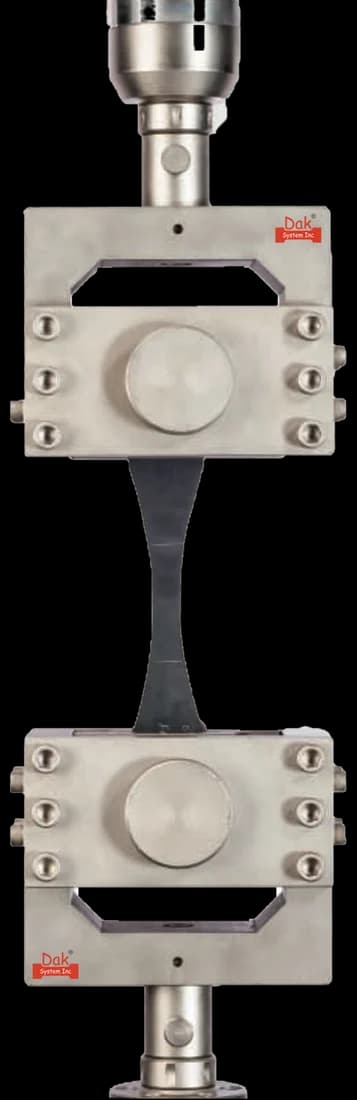
Heavy Duty Hydraulic Grips
Wide hydraulic faces clamping the full specimen width evenly. A 200 mm strip of heavy HDPE carries several times what a dumbbell does, and a specimen gripped only across its middle fails at the jaw corners rather than in the gauge section.
Optical strain from marks on the strip. Where three moduli are reported, strain has to come from the specimen: on a wide compliant sheet the machine compliance and any grip slip are a large share of the crosshead movement.
Polymer type, product designation and sheet thickness
Specimen width and gauge length
Whether the specimen was parent sheet or contained a seam
Specimen direction
Conditioning atmosphere
Rate of applied strain
Strength and elongation per specimen, per unit width
Initial, offset and secant modulus, and how strain was measured
Breaking toughness, mean and the number of specimens
What the machine must be capable of
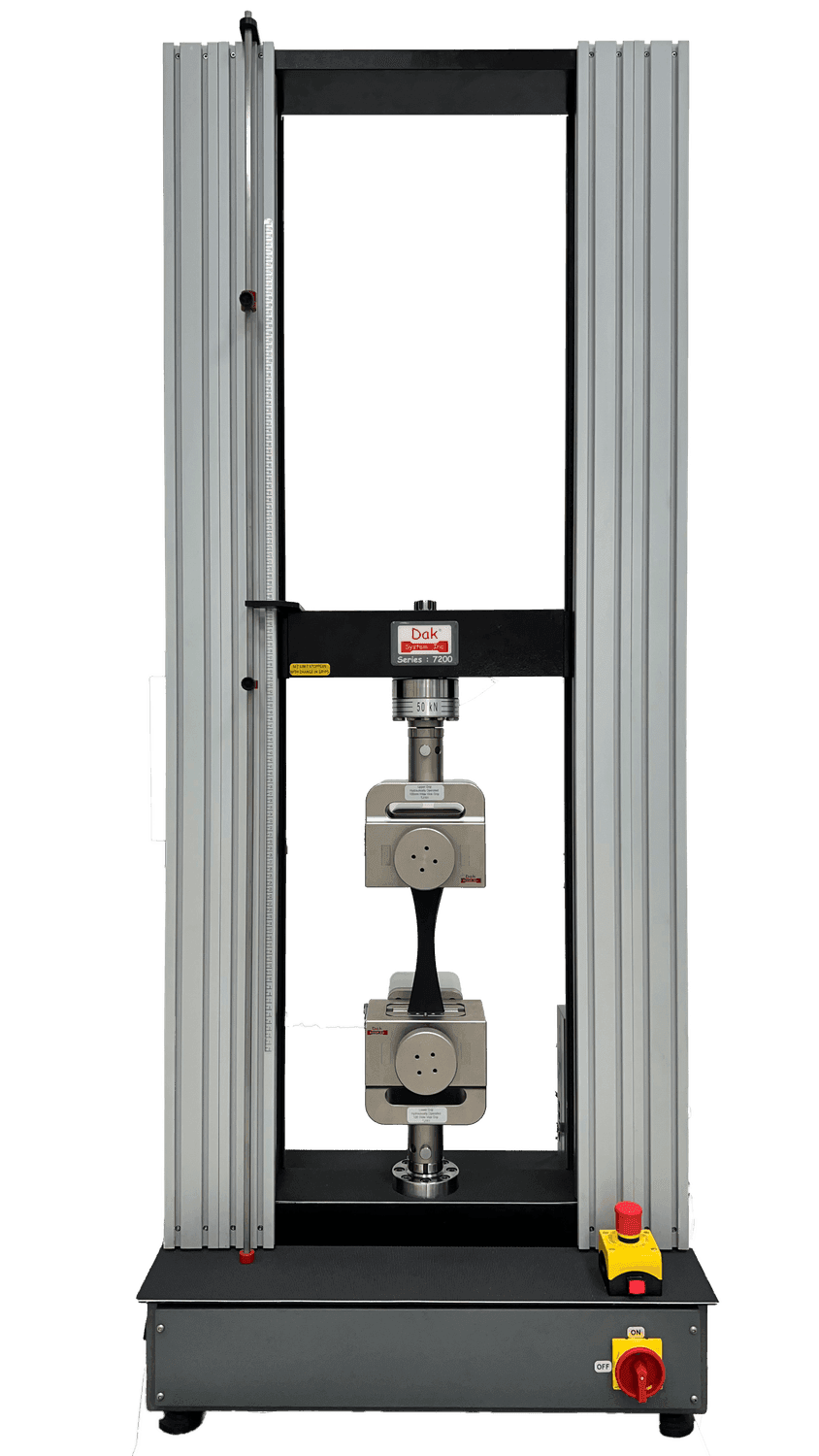
Force is the constraint here in a way it is not for the dumbbell method. A 200 mm wide strip of a heavy HDPE liner carries several times what a dumbbell does, so a frame of 50 to 100 kN with grips wide enough to clamp the full specimen width is a realistic requirement. Force accuracy to ASTM E4 applies.
Grip width is what rules most laboratories out. The whole specimen width has to be clamped evenly; a specimen gripped only in the middle loads unevenly and fails at the grip corners. Wide vice-action or hydraulic jaws with a face that holds a slippery liner without cutting it are needed, and the clamping has to be uniform across the width.
Travel again is long, and where modulus values are reported the strain has to come from the specimen. Grip separation includes machine compliance and any slip, both of which are significant fractions of the movement on a wide, compliant specimen.
What goes wrong in practice
Narrowing the specimen to fit available grips destroys the whole point of the method and reintroduces the necking it was designed to suppress. Uneven clamping across a wide jaw makes the specimen fail at a corner. Taking modulus from crosshead travel gives values that are low and repeatable. And quoting a D4885 result against a D6693 specification, or the reverse, compares two deliberately different tests.
Wide strip methods across the geosynthetics
The same reasoning about specimen width appears in three places, on three different products.
Geomembrane (D4885)
Geotextile (D4595)
Geotextile (ISO 10319)
Specimen
Wide strip, wider than gauge length
200 mm wide strip
200 mm wide strip
Problem solved
Necking of a ductile sheet
Contraction of a fabric
Result
Performance strength per unit width
kN/m
kN/m
Intended as
A design aid
Index and design
Index and design
Grip requirement
Full-width even clamping
All three fail the same way when the grips are too narrow: the specimen loads unevenly and fails at a grip corner. Grip width, not frame capacity, is what rules most laboratories out of wide strip work.
Questions we are asked about this test
What is ASTM D4885?+
ASTM D4885 is the wide strip tensile method for geomembranes. A strip much wider than its gauge length is pulled to failure, and the method reports tensile strength and elongation together with initial, offset and secant modulus and breaking toughness. It is described by the standard as a performance test intended as a design aid. The current edition is D4885-01, most recently reapproved in 2023.
Why is the specimen so wide?+
To stop it necking. A narrow tensile specimen contracts laterally as it is pulled, and the stress concentrates at that contraction — an artefact of the specimen shape rather than a property of the material. A geomembrane spread over a subgrade cannot contract that way, because the sheet either side of any point holds it. Making the specimen much wider than the gauge length suppresses the contraction and gives a closer relationship to how the liner actually behaves.
Why is the rate slower than a normal tensile test?+
For the same reason the specimen is wider: to move the test closer to service. The standard names the width of the specimen and the speed of applied force as the two basic distinctions between this method and the other geomembrane tensile tests. A liner in the ground is strained over months by a settling subgrade, not over a minute by a crosshead, and a slower rate is a partial correction for that.
Is it an alternative to ASTM D6693?+
No, and treating it as one causes real confusion. D6693 is a control and specification test on a dumbbell — it identifies the material. D4885 is a performance test on a wide strip — it supports a design. They give different numbers on the same sheet, deliberately, and quoting a result from one against a specification written for the other is the commonest reporting error on geomembranes.
What rules laboratories out of this test?+
Grip width, not frame capacity. The full specimen width has to be clamped evenly, which needs wide vice-action or hydraulic jaws with a face that holds a slippery liner without cutting it. A specimen gripped only across its middle loads unevenly and fails at a jaw corner. Narrowing the specimen to fit smaller grips is not a workaround, because the width is the mechanism the method depends on.
What force does it need?+
Substantially more than the dumbbell method. A 200 mm wide strip of a heavy HDPE liner carries several times the load of a die-cut dumbbell, so a frame of 50 to 100 kN with full-width grips is a realistic requirement, with force accuracy to ASTM E4. Travel is long as well, because the sheet elongates a great deal before it breaks.
Which of the three moduli should be quoted?+
The one the design uses, and the report should say which. Initial modulus is the slope at the origin, offset modulus is taken from a defined offset for a curve with no straight portion, and secant modulus is the slope between the origin and a stated strain. A geomembrane curve rarely has a long linear region, so an unqualified modulus figure is ambiguous and the strain it was taken at matters as much as the number.
This page describes the method as practised. The governing text is the current edition from the issuing body. Tell us what you are testing and we will answer with the machine, the fixture and a quotation.