Testing standard

ASTM D5083

Standard Test Method for Tensile Properties of Reinforced Thermosetting Plastics Using Straight-Sided Specimens

Written and technically reviewed by Dak System Inc. engineeringLast reviewed

ASTM D5083 determines the tensile properties of reinforced thermosetting plastics using straight-sided specimens: a coupon of uniform nominal width, up to 14 mm thick, pulled to break under defined pretreatment, temperature, humidity and machine-speed conditions. The specimen is straight-sided because machining a waist through a fibre-reinforced laminate cuts the reinforcement and moves the failure to the radius. The current edition is D5083-26.

At a glance

Test type
Tensilethe specimen is pulled apart
Published by
ASTM
Edition
D5083-26

What the test does

A rectangular coupon of reinforced thermoset — a laminate of constant nominal width rather than a moulded dumbbell — is gripped at both ends and pulled along its axis at a controlled rate until it breaks. Force and extension are recorded throughout, so the whole stress–strain response is captured. The specimen is straight-sided on purpose. Machining a waisted profile into a fibre-reinforced laminate cuts through the reinforcement at the radius, and the coupon then fails where the knife went rather than where the material is weakest, which is a measurement of the machining and not of the laminate.

What it measures, and why it matters

Tensile strength, elongation at break and tensile modulus, in whichever direction the coupon was cut. For a glass-reinforced thermoset those figures belong to a lay-up rather than to a resin, so the same material gives quite different answers along the fibres, across them and at forty-five degrees, and a single number quoted without a direction is close to meaningless. The method exists because the general plastics tensile test does not serve these materials: the scope directs unreinforced and injection-moulded thermoplastics to D638, thin sheeting under 1.0 mm to D882, and unidirectional fibre-reinforced laminates to D3039/D3039M. What is left — hand lay-up, moulded and pressed reinforced thermosets, most of them glass — is what D5083 covers, for quality control, specification and research work.

Specimen and how it is cut

A laminate coupon, not a moulded dumbbell. Everything that matters about the preparation is about not damaging the reinforcement.

Material
Reinforced thermosetting plastics, chiefly glass-reinforcedExperience with the method has been largely on glass-reinforced thermosets.
Geometry
Straight-sided, of uniform nominal widthNo waist and no radius, so the reinforcement runs unbroken through the gauge length.
Thickness
Any thickness up to 14 mm (0.55 in.)Testing thicker material than this is outside what the method recommends.
Not covered
Unreinforced and injection-moulded thermoplastics, sheeting under 1.0 mm, unidirectional laminatesThe scope sends those to D638, D882 and D3039/D3039M respectively.
Direction
Cut in the principal directions of the reinforcement, and each reported separatelyPracticeA reinforced laminate has no single tensile strength. A figure without a direction attached to it cannot be used.
End tabs
Bonded to the gripped length on thick or high-strength couponsPracticeThey spread the clamping load so the grip faces do not crush the fibres and start the failure under the jaw.
Edges
Cut clean and square, free of chipping and delaminationPractice

A coupon with a ragged sawn edge or delamination at the cut has a starter crack built into it. The result will be low, repeatable and wrong.

Test speed and conditions

Speed
From the governing material specification; otherwise from the method's own tableReinforced thermosets are far less rate-sensitive than unreinforced plastics, but the speed used is still reported with the result.
Conditions
Defined pretreatment, temperature and humidity, all reportedThe scope names them as part of the test definition rather than as good practice.
Report the direction with every figure
DakStrength, modulus and elongation all belong to a lay-up direction. Averaging across directions produces a number describing no real material.

Calculations

Tensile strengthσ

σ = F / A

F
maximum force carried, N
A
original cross-sectional area of the coupon, mm²

Based on the original area, so it is a nominal stress rather than a true one.

Tensile modulusE

E = Δσ / Δε over the initial straight portion

Δσ
change in stress across the chosen strain interval, MPa
Δε
the corresponding change in strain, dimensionless

Strain must come from an extensometer on the gauge length. Crosshead travel carries grip seating and frame compliance and gives a modulus that is too low.

Elongation at break

Extension at rupture divided by the original gauge length, as a percentage

Small for a stiff glass-reinforced laminate, and sensitive to where the coupon actually broke.

How the test runs

  1. 01Cut coupons of uniform nominal width in each principal direction of the reinforcement.
  2. 02Dress the edges clean and square; reject any coupon with delamination at the cut.
  3. 03Bond end tabs where the coupon is thick or the laminate is strong.
  4. 04Measure width and thickness at several points and use the mean area.
  5. 05Condition to the specified pretreatment, temperature and humidity.
  6. 06Set the grips so the coupon is aligned with the load axis, and seat it without pre-loading.
  7. 07Fit the extensometer on the gauge length where modulus is required.
  8. 08Pull at the specified speed and record force and extension continuously.
  9. 09Note where the coupon failed, and discard any that fails inside or at the grips.
  10. 10Calculate strength, modulus and elongation, and report them by direction.

A break at the grip line is not a result. It is a tabbing or clamping problem, and repeating the test without changing the set-up simply repeats it.

Grips and fixtures for this method

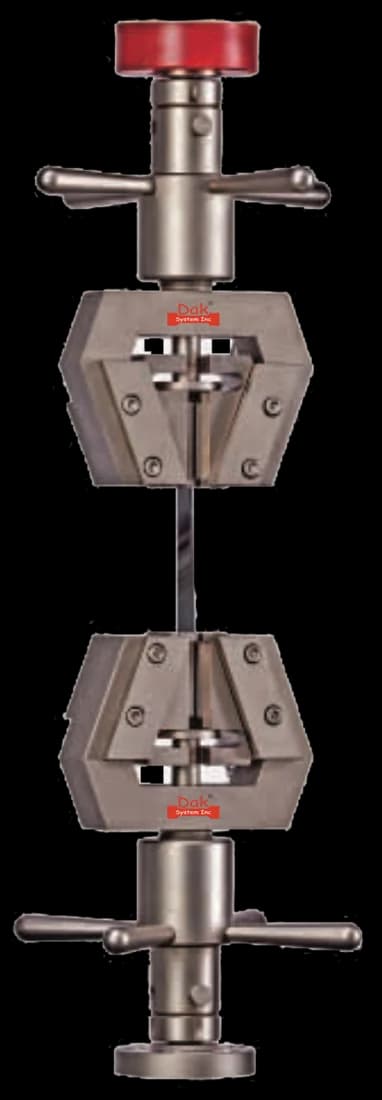
Universal parallel wedge grips holding a flat specimen between self-tightening jaws
Self-tighteningTJ-15

Universal Parallel Wedge Grips

Self-tightening wedge grips with serrated faces suit thinner laminate coupons. The wedge action rises with load, which is what stops a hard, smooth coupon slipping without needing crushing clamp pressure at the start.

Specifications
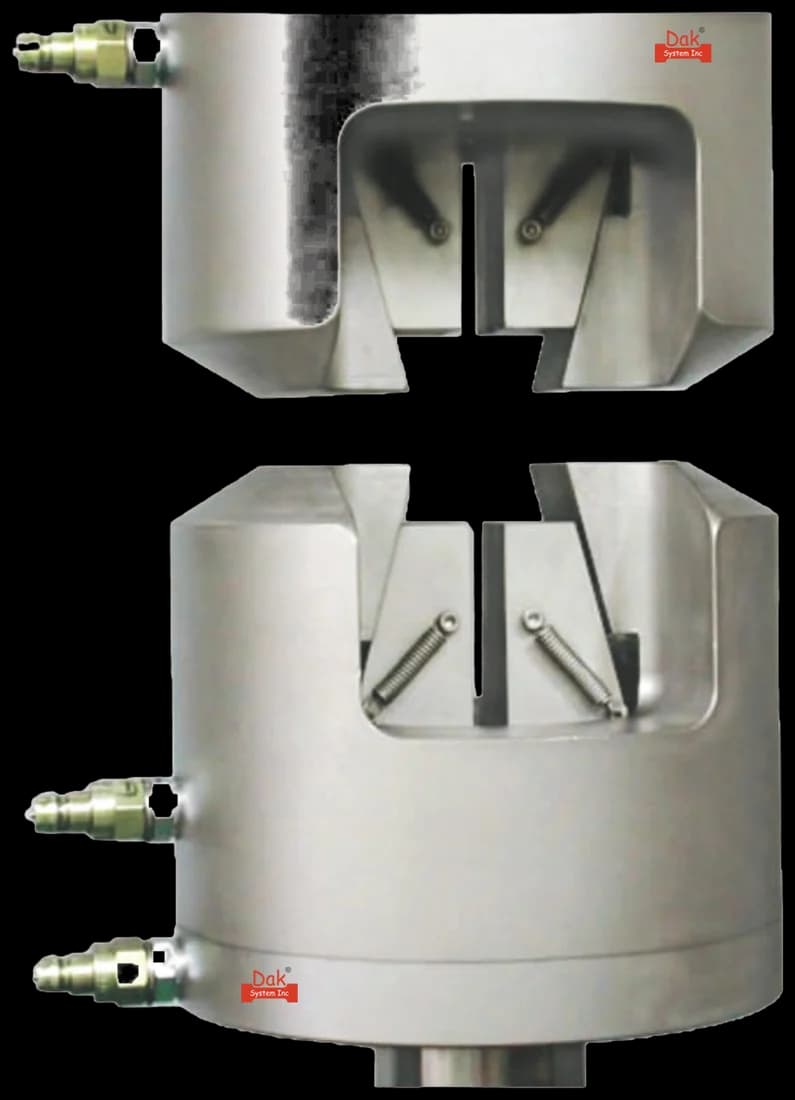
Heavy duty circular hydraulic wedge grips with hose couplings
Self-tighteningTJ-135

Heavy Duty Circular Hydraulic Wedge Grips

For thicker sections and higher loads. Hydraulic closure holds a constant clamping force on a coupon up to 25 mm thick, and the foot-switch operation leaves both hands free to align it — alignment being the thing that decides whether a stiff laminate is pulled or bent.

Specifications
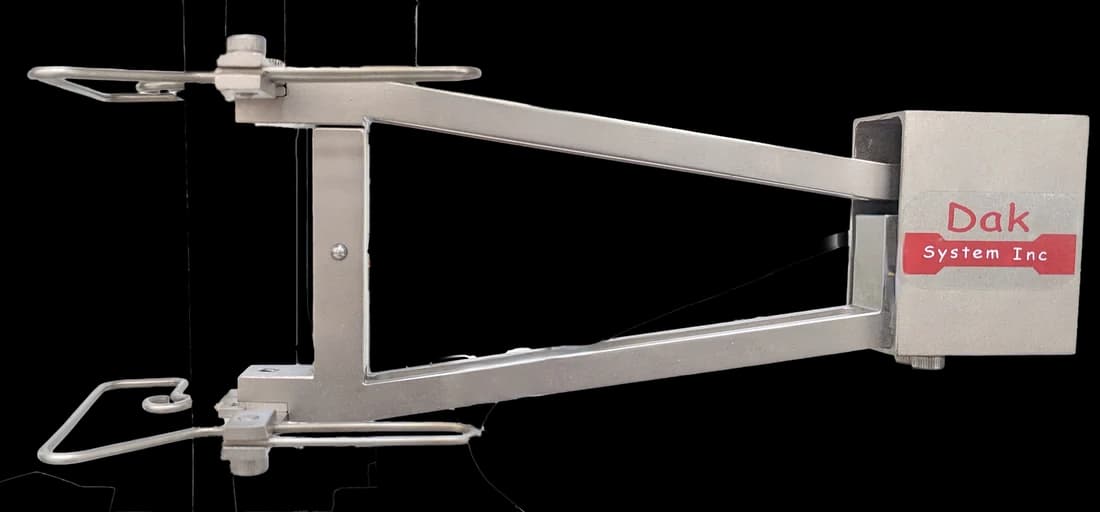
Clip-on cross-flexure extensometer on its mounting arm
Axial & transverse

Clip-On Extensometers

Modulus has to be measured on the gauge length. A clip-on gauge with an activation force under 60 g adds nothing to a stiff laminate, and gets strain from the specimen rather than from the load train.

Specifications

What the report has to contain

  • Reference to ASTM D5083 and the edition
  • Full identification of the laminate, resin system and reinforcement
  • Lay-up and the direction each coupon was cut in
  • Coupon width and thickness, and the area used
  • Whether end tabs were fitted, and how
  • Pretreatment, conditioning atmosphere and duration
  • Testing machine speed
  • Extensometer type and gauge length where modulus is reported
  • Tensile strength, tensile modulus and elongation at break, by direction
  • Failure location for every coupon, and any discarded for grip failure
  • Number of specimens and the mean and scatter

What the machine must be capable of

Considerably more force than a plastics dumbbell needs. A 25 mm wide glass-reinforced coupon several millimetres thick can carry tens of kilonewtons, so a frame sized for unreinforced plastics will not reach failure — capacity has to be chosen from the section area and the expected strength, not from habit. Force indication must meet ASTM E4. Grips have to hold a thick, hard, slippery laminate without slipping and without crushing it, which in practice means self-tightening wedges with serrated faces, or hydraulic wedges where the section is thick and the load is high. Alignment matters more here than on a ductile plastic: any eccentricity in the load path bends the coupon and the outer surface reaches its strain limit first. Modulus needs an extensometer on the gauge length rather than crosshead travel, since grip seating and machine compliance both appear as extra extension.

What goes wrong in practice

Failure inside the grips, which is the classic invalid result and is usually a tab problem or a clamping-pressure problem rather than a material one. Slipping, which produces a curve that looks soft and destroys the modulus. Cutting the coupon without regard to the fibre direction, so that a nominally identical set of specimens is really several different materials. Testing a laminate with a delaminated or ragged sawn edge. And quoting a figure with no direction, no thickness and no conditioning attached to it, which is the commonest way a valid test becomes an unusable number.

Which tensile method for which plastic

ASTM D5083ASTM D638ASTM D3039ASTM D882
MaterialReinforced thermosetsUnreinforced and moulded thermoplasticsUnidirectional fibre-reinforced laminatesThin sheeting and film
SpecimenStraight-sided couponDumbbellStraight-sided tabbed couponStrip
ThicknessUp to 14 mmAs tabulated by typeAs the laminateUnder 1.0 mm
Result belongs toA lay-up directionThe materialA lay-up directionA machine direction

The scope names D638, D882 and D3039/D3039M explicitly and sends material to each of them. ISO 527-4 and ISO 527-5 are the international counterparts and are comparable rather than equivalent: geometry, speed and modulus evaluation differ, so results do not transfer between the two families without checking.

Questions we are asked about this test

What is ASTM D5083?

It is the ASTM method for the tensile properties of reinforced thermosetting plastics using straight-sided specimens. A coupon of uniform nominal width is pulled to break under defined pretreatment, temperature, humidity and machine-speed conditions, and tensile strength, modulus and elongation are reported. The current edition is D5083-26, which supersedes D5083-17.

Why is the specimen straight-sided rather than a dumbbell?

Because machining a waist into a fibre-reinforced laminate cuts through the reinforcement at the radius. The coupon then fails where the cutter went rather than where the material is weakest, which measures the machining and not the laminate. A straight-sided coupon leaves the fibres continuous through the gauge length, and the clamping problem it creates is solved with end tabs instead.

When should D638 be used instead?

For unreinforced and injection-moulded thermoplastics, which the scope of D5083 explicitly directs to D638. D882 takes over for sheeting under 1.0 mm thick, and D3039/D3039M is the method for unidirectional fibre-reinforced laminates. D5083 covers what is left: moulded, pressed and laid-up reinforced thermosets, most of them glass-reinforced.

How thick a laminate can be tested?

Any thickness up to 14 mm (0.55 in.). The method does not recommend testing material thicker than that. Thickness matters for more than the scope limit: a thick, strong coupon needs both a frame with the capacity to break it and grips that will hold it without crushing the fibres under the jaws.

Do the coupons need end tabs?

Not always, but they solve the commonest problem with the method. A straight-sided coupon has to be clamped hard enough not to slip, and on a thick or high-strength laminate that clamping crushes the fibres under the jaw and starts the failure there. Bonded tabs spread the load into the coupon and move the break back into the gauge length where it belongs.

Why does the direction have to be reported?

Because a reinforced laminate has no single tensile strength. The same material gives quite different figures along the fibres, across them and at forty-five degrees, so strength, modulus and elongation all belong to a direction rather than to the material. A figure quoted with no direction, thickness or conditioning attached to it cannot be used for anything.

Can the modulus be taken from crosshead travel?

No, not usefully. Crosshead travel includes grip seating, tab compliance and the elastic stretch of the whole load train, all of which appear as extra extension and make the modulus too low. Modulus needs an extensometer fixed on the gauge length of the coupon itself.

Are ISO 527-4 and ISO 527-5 equivalent to it?

They are counterparts, not equivalents. The scope names them as comparable standards, but specimen geometry, test speed and the way modulus is evaluated differ between the ASTM and ISO families, so a result generated under one should not be quoted against a specification written to the other without checking those three things first.

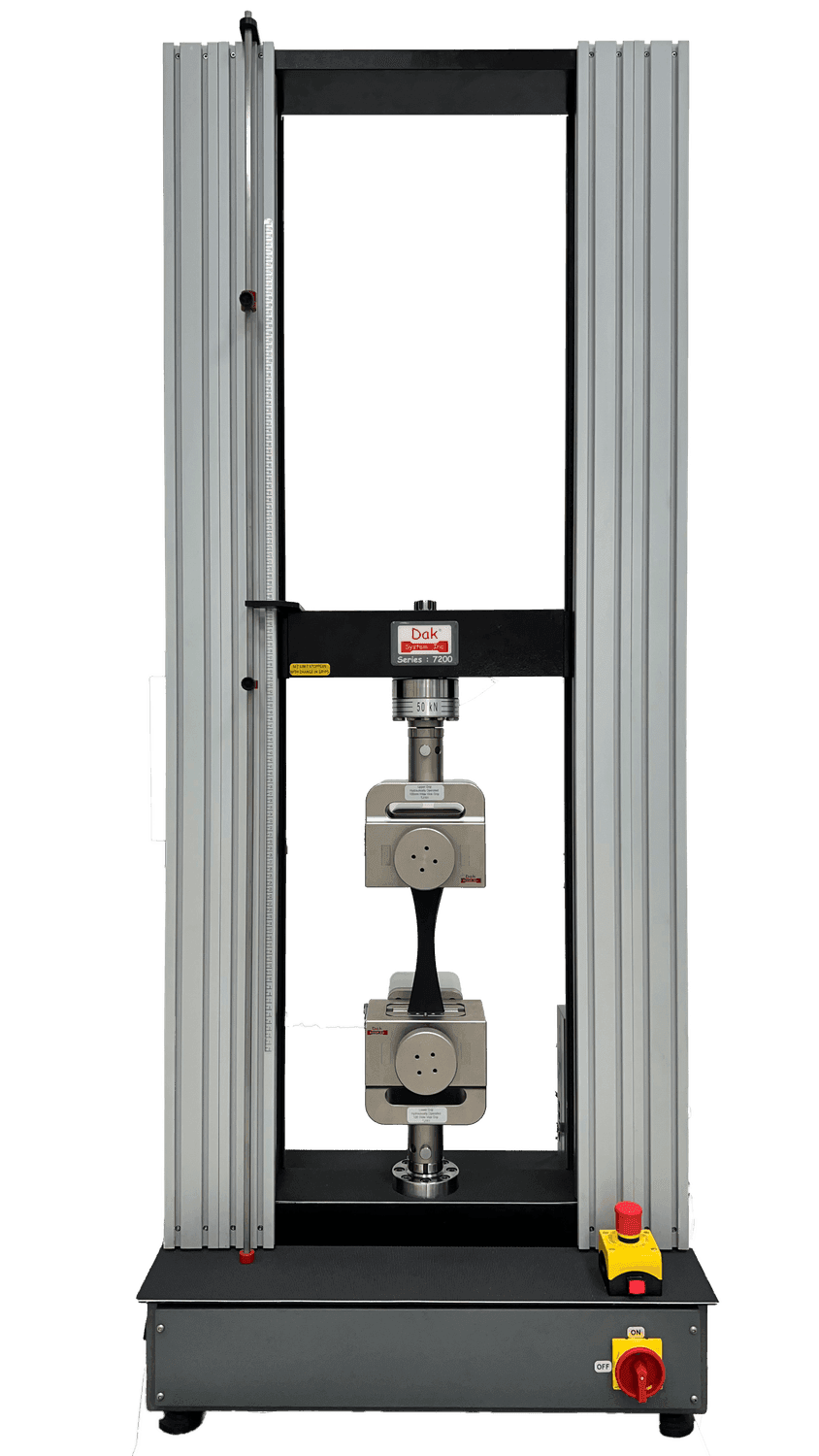
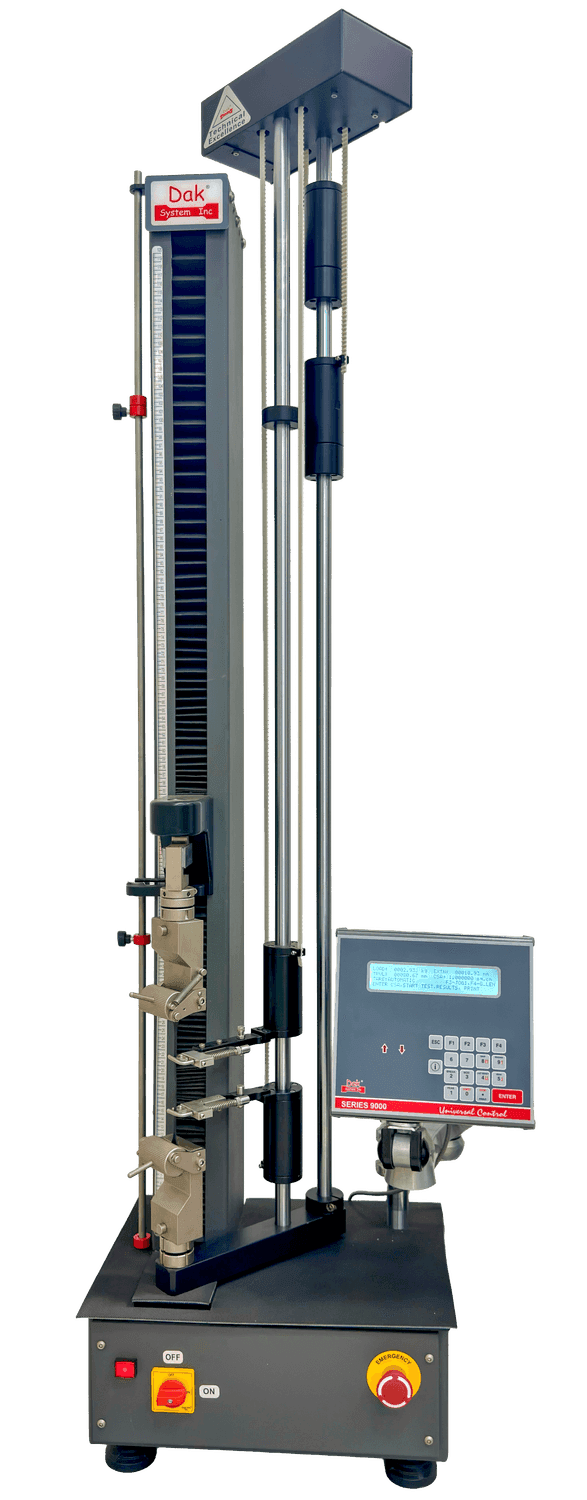
Running ASTM D5083 on the Series 7200 and Series 9000

Dak verifies against whichever standard the method names, and where a class applies our frames sit a class tighter than it asks.

The method asks forDak supplies
CapacityNot prescribed. Chosen from the section area and the expected strength — a 25 mm wide glass-reinforced coupon a few millimetres thick reaches tens of kilonewtons, beyond what a frame sized for unreinforced plastics will deliver.Load cells from 1 kg to 60 ton on the Series 7200, and 0.5 to 100 kN on the Series 9000
Force accuracyForce verification to Practices E4, which the method referencesISO 7500-1 Class 0.5, verified to ASTM E4, DIN 51221 and BS 1610
Strain measurementAn extensometer to Practice E83, class as the material specification requires, gauge length unknown — the specimen table is paywalled and no gauge length could be corroborated from two independent sourcesCertified to ISO 9513 Class 1 and ASTM E83 non-contact video, clip-on and high-elongation
GrippingSelf-tightening or hydraulic wedge grips with serrated faces; bonded end tabs on thick or high-strength couponsOur self-tightening serrated wedge grips, with V-jaws for round specimens, built to the specimen
EnvironmentDefined pretreatment, temperature and humidity, reported with the result; Practice D618 conditioning is referenced3009 series chambers, −150 °C to +400 °C — temperature only

This page describes the method as practised. The governing text is the current edition from the issuing body. Tell us what you are testing and we will answer with the machine, the fixture and a quotation.

Materials tested to it

The test it standardises

Other standards explained