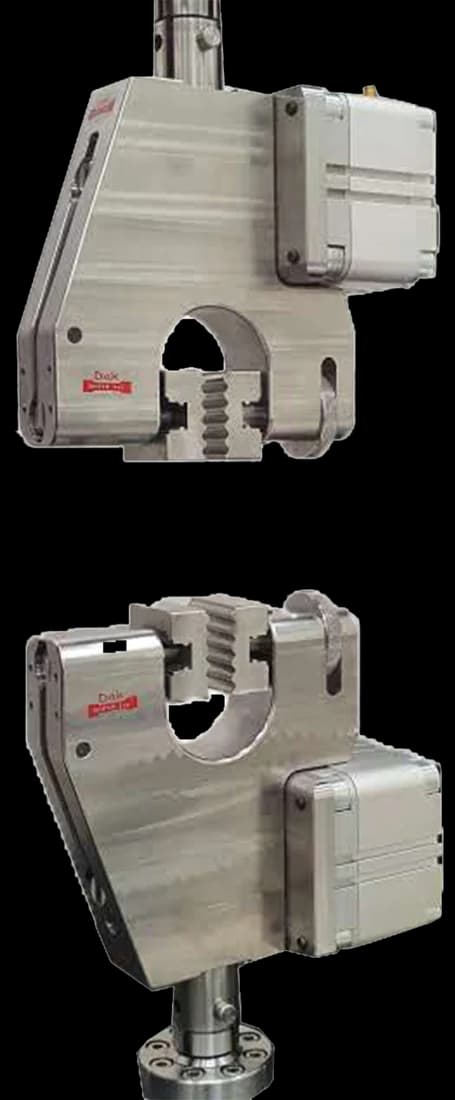
Standard 25 mm
Pneumatic Vice Action Grip
Pneumatic vice action grips clamp the full specimen width at a constant, even pressure — which is what stops one side slipping or tearing before the other.
Specifications
Testing standard
Standard Test Method for Tearing Strength of Fabrics by Trapezoid Procedure
Written and technically reviewed by Dak System Inc. engineeringLast reviewed
ASTM D5587 measures the force required to propagate a tear across a fabric by the trapezoid procedure, the jaws starting 25 mm apart and separating at 300 mm/min. It provides two calculations from the same trace — the single-peak force and the average of the five highest peaks — and they are different numbers, so the one used has to be stated.
From the test method to your testing system
Explore the DAK machines already listed for ASTM D5587, then review the grips, measurement and setup requirements below.
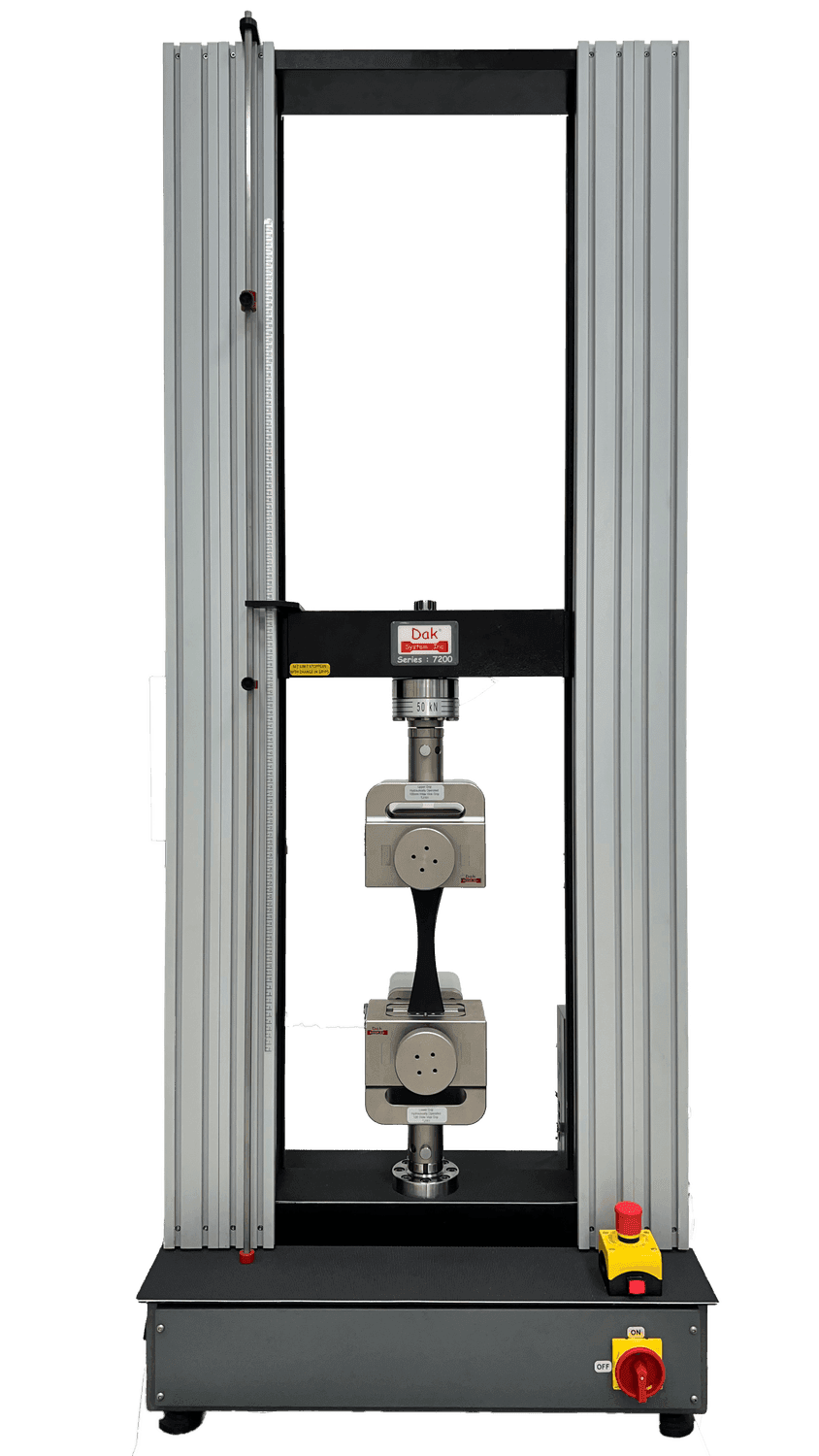 Universal Testing MachineSeries 7200Explore the machine →
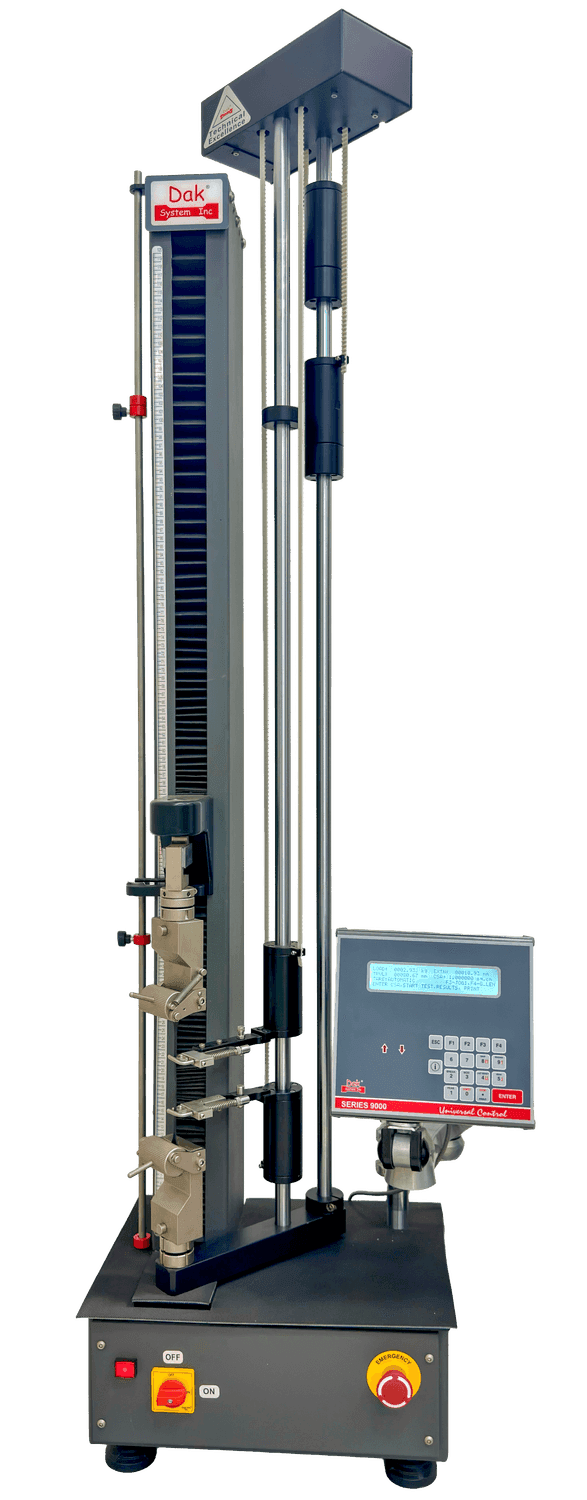 Universal Testing MachineSeries 9000Explore the machine →
01Understand the method
An isosceles trapezoid is marked on a rectangular specimen of conditioned fabric and a slit cut at the centre of its smallest base to start the tear. The non-parallel sides of the marked trapezoid are clamped in parallel jaws, and the jaws are separated at a constant rate on a recording constant-rate-of-extension machine. The tear propagates across the specimen and the force is captured throughout. Two calculations are then available from the same trace: the single-peak force, and the average of the five highest peak forces.
The force needed to keep a tear running once it has started — the question that decides whether a small snag becomes a failure. Fabrics rarely tear from an unblemished surface; something catches, and what matters is whether the damage propagates. The reason the method offers two calculations is that the trace is a saw-tooth rather than a curve: the tear advances yarn by yarn, each resisting and then giving way, so there is no single obvious point to read. Both readings are defensible, they are not variants of the same figure, and on a coarse fabric they can differ by a wide margin.
02Prepare the specimen and test settings
The trace is a saw-tooth because the tear advances yarn by yarn. Which peaks you take from it is a decision the method leaves open, so it must be reported.
The two calculations are not variants of the same figure. On a coarse or unevenly constructed fabric they can differ substantially, and mixing them within a data set produces scatter that looks like material variability.
03Build the test setup on a DAK machine
A constant rate of extension of 300 mm/min ± 10 mm/min (12 in./min ± 0.5 in./min) — other speeds only by agreement between the parties — with the jaws starting 25 mm ± 1 mm apart and running until the tear has travelled about 75 mm. Critically, a recording data system. This is not a machine on which a peak-hold reading will do: the five-peak average cannot be extracted from a stored maximum, so half the method becomes unavailable and the qualitative information in the trace — whether the tear ran steadily or jumped — is lost with it. At that rate the peaks arrive quickly, so the sampling rate has to be high enough to catch them; a slow one clips the tops and reads low. Forces are modest, from a few newtons to a few hundred, so the load cell is chosen for the fabric rather than for the frame, and the jaws — faces at least 50 mm by 75 mm — must clamp along the marked sloping sides.
Pneumatic vice action grips clamp the full specimen width at a constant, even pressure — which is what stops one side slipping or tearing before the other.
SpecificationsDak verifies against whichever standard the method names, and where a class applies our frames sit a class tighter than it asks.
| The method asks for | Dak supplies | |
|---|---|---|
| Capacity | Low — fabric trapezoid tear forces commonly run from a few newtons to a few hundred | Load cells from 1 kg to 60 ton on the Series 7200, and 0.5 to 100 kN on the Series 9000 |
| Force accuracy | ASTM D76 requirements for textile testing machines | ISO 7500-1 Class 0.5, verified to ASTM E4, DIN 51221 and BS 1610 |
| Gripping | Parallel jaws clamping the non-parallel sides of a trapezoid marked on the specimen | Wedge, vice-action, pneumatic and hydraulic grips, built to the specimen |
| Environment | 23 ± 2 °C standard laboratory atmosphere | 3009 series chambers, −150 °C to +400 °C — temperature only |
04Run the test
05Calculate, report and interpret
The maximum force on the trace
One reading from one event. It is sensitive to whichever yarn happened to be strongest.
Mean of the five largest peak forces on the trace
A more stable statistic from the same trace, and the one most specifications intend. It cannot be derived from the single-peak value.
Reporting a tearing strength without saying which calculation produced it, which makes it uncomparable and, worse, mixes silently into data sets that used the other one. Clamping square to the specimen rather than along the marked sides, which stops the tear propagating as the geometry intends. A ragged starting slit. Discarding deviated tears without recording how many. And substituting this method where a geosynthetic specification named D4533, where the reviewer is right to query it. A last one is testing a napped or pile fabric without recording which face was uppermost — the pile lies in a direction, and a tear travelling with it behaves differently from one travelling against it.
06Compare methods and find answers
| ASTM D5587 | ASTM D4533 | |
|---|---|---|
| Written for | Textile fabrics generally | Geotextiles |
| Geometry | Trapezoid | Trapezoid |
| Calculations | Single peak or five-peak average | Per the method's own rule |
| Cite | Where the specification names it | Where the specification names it |
The same geometry serving two industries. Geosynthetic acceptance documents name D4533 specifically, and substituting D5587 will be queried even though the principle is identical.
It is the ASTM trapezoid tear method for fabrics. An isosceles trapezoid is marked on a rectangular specimen, a slit is cut at the centre of its smallest base, and the non-parallel sides are clamped in parallel jaws so that separating them propagates the tear across the specimen. It applies to woven, air bag, blanket, napped, knitted, layered and pile fabrics.
Because the trace is a saw-tooth and there is no single obvious point on it. The tear advances yarn by yarn — each resists, gives way, and the load falls before building against the next — so the record is a series of peaks rather than one rise and fall. Taking the single highest peak and taking the mean of the five highest are both defensible readings of the same event, and the method offers both.
Whichever the specification names, and if it does not say, the five-peak average is usually what is meant because it is the more stable statistic. What matters more than the choice is stating it: on a coarse or unevenly constructed fabric the two can differ by a wide margin, and mixing them within one data set produces scatter that reads as material variability when it is really an inconsistent calculation.
Because the calculation is made from the trace. A peak-hold reading gives only the single highest force and cannot supply the five highest peaks, so half the method becomes unavailable. It also hides whether the tear ran cleanly or jumped, which is the qualitative information a trapezoid trace carries and a single number does not.
Because that geometry is what makes the tear travel. Clamping the non-parallel sides puts the short base closest to the jaws and loads it first, so stress concentrates at the slit and the tear propagates progressively towards the wide end. Clamping the specimen squarely would simply stretch it, and the tear would either not start or would jump unpredictably across the width.
The specimen is discarded and the number of discards recorded. A tear that turns into a grip or leaves the edge has not propagated across the width in the way the geometry intends, so its force is not comparable with specimens that tore correctly. A high discard rate is itself information — usually about clamping, or about a fabric with a strong directional bias.
Not safely. The two use the same trapezoid geometry, but D4533 is written for geotextiles and geosynthetic acceptance documents name it specifically, with their own specimen and calculation details. A substituted result will be queried, and the reviewer is right to query it — the principle being identical does not make the designations interchangeable.
Discuss your specimen, test requirements and reporting needs with DAK engineering.
This page describes the method as practised. The governing text is the current edition from the issuing body. Tell us what you are testing and we will answer with the machine, the fixture and a quotation.