Standard Test Method for Determining Tensile Properties of Nonreinforced Polyethylene and Nonreinforced Flexible Polypropylene Geomembranes
Written and technically reviewed by Dak System Inc. engineering·Last reviewed
ASTM D6693 pulls die-cut dumbbells of polyethylene or flexible polypropylene geomembrane to break and reports strength and elongation at yield and at break. It covers sheet from 0.25 mm to 6.3 mm and exists for the control and specification of these materials. The current edition is D6693/D6693M-20, reapproved 2024.
Dumbbell specimens are die-cut from a geomembrane sheet and pulled to break under defined conditions of pretreatment, temperature and machine speed. Strength and elongation are recorded at yield and at break.
It is a conventional plastics tensile test applied to a specific family of products, and its value is that it fixes the specimen and the conditions so that one manufacturer's HDPE liner can be compared with another's.
What it measures, and why it matters
A geomembrane is the barrier in a landfill cell, a leach pad or a pond. It is a sheet of polyethylene or flexible polypropylene, welded into panels on site, and it has to survive being deployed over subgrade, backfilled, and then loaded for decades.
Four numbers come out and they are the ones written into every geomembrane specification: strength at yield, elongation at yield, strength at break and elongation at break. Yield is what matters for a stressed liner, because yielding is where permanent deformation and local thinning begin. Elongation at break describes how much abuse the sheet can absorb over a settling subgrade before it splits.
The method is explicit that it is for the control and specification of these materials, and it covers sheet from 0.25 mm to 6.3 mm thick. It is a quality-control and conformance test, not a design method: long-term performance involves stress cracking, oxidative ageing and installation damage that a short pull says nothing about.
Specimen, and the die that cuts it
Die condition decides more of this result than anything else the laboratory does. Polyethylene is notch-sensitive and a rough edge in the narrow section is a crack starter.
Material
Nonreinforced polyethylene and nonreinforced flexible polypropylene geomembranes
Thickness range
0.25 mm [0.010 in.] to 6.3 mm [0.25 in.]
Specimen
Standard dumbbell, die-cut
Direction
Machine and cross direction, both recordedExtruded sheet is directional, and the difference is larger in elongation than in strength.
Conditions
Defined pretreatment, temperature and machine speed
Change the die before it argues with you
DakA worn die leaves a nicked edge in the narrow section. The specimen fails there, well below its real strength, and the spread widens in a way that reads as variable resin.
State how thickness was measured on textured sheet
DakThe method is written for nonreinforced sheet. Where a product is textured, the measured thickness and the section actually carrying load are not the same.
Rate, temperature and travel
Machine speed
Defined by the method; the figure sits in the purchased text
Temperature
Standard laboratory atmosphere, conditioned and tested in it
Reported
Strength and elongation, at yield and at break
Provide long travel
DakPolyethylene geomembranes elongate to several hundred percent. A frame that runs out of stroke before break has truncated the result rather than measured it.
The four numbers a specification asks for
Strength at yield—
Force at yield divided by the original cross-sectional area
The figure that matters for a stressed liner: yielding is where permanent deformation and local thinning start.
Elongation at yield—
Extension at yield as a percentage of gauge length
Small, and tightly specified, because it describes the onset of that permanent change.
Strength and elongation at break—
Force and extension at rupture
Elongation at break describes how much abuse the sheet absorbs over a settling subgrade before it splits.
A short pull says nothing about any of them, and a liner is bought for decades of service.
How the test runs
01Check the sheet thickness is within 0.25 mm to 6.3 mm.
02Measure and record thickness, stating how on textured product.
03Die-cut dumbbells with a sharp die on a clean backing.
04Take specimens in both machine and cross direction.
05Condition in the standard laboratory atmosphere.
06Clamp without nicking the specimen, using a controlled grip force.
07Pull at the defined machine speed to break.
08Record force and extension throughout.
09Take yield and break values from the curve.
10Report all four values by direction.
Grips and fixtures for this method
Standard 25 mm
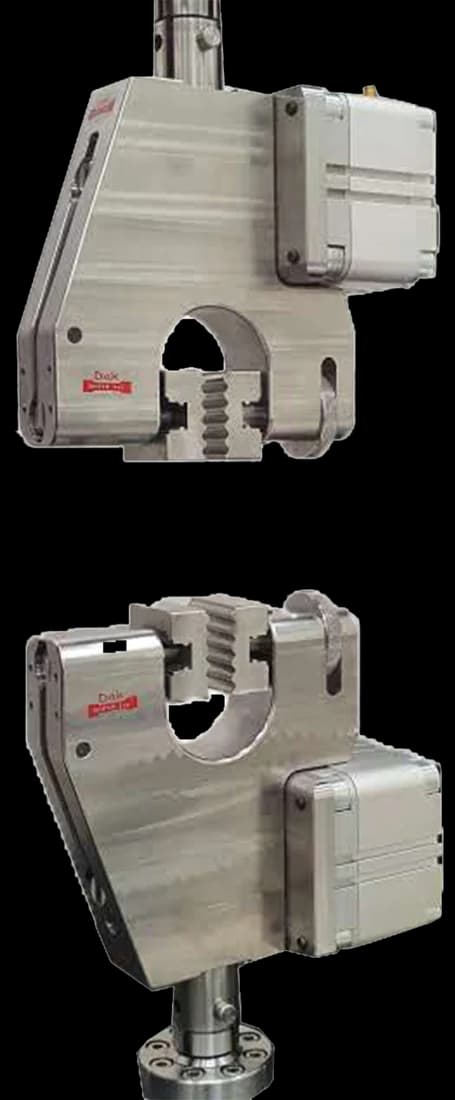
Pneumatic Vice Action Grip
Air-driven jaws closing to a controlled force on a slippery, ductile sheet. Serrations that bite a rigid plastic will nick a liner and start the failure, so the face is chosen for the material and the closing force is set rather than guessed.
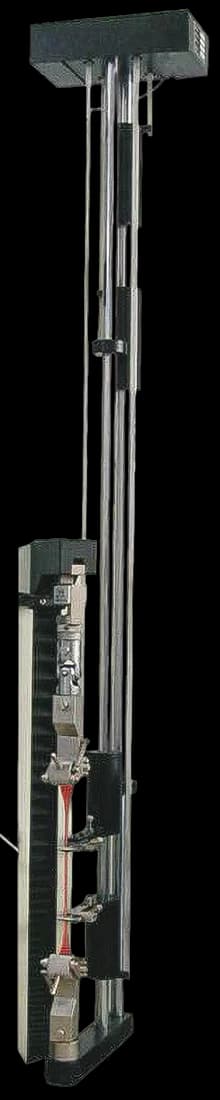
Polyethylene geomembranes run to several hundred percent elongation. A clip-on gauge does not survive that; a long-travel device follows the specimen to break where elongation has to be measured on the specimen rather than taken from grip separation.
Where the sheet is thin, tacky or textured and any attached device would mark it, an optical gauge tracks printed marks through the whole elongation without touching the specimen.
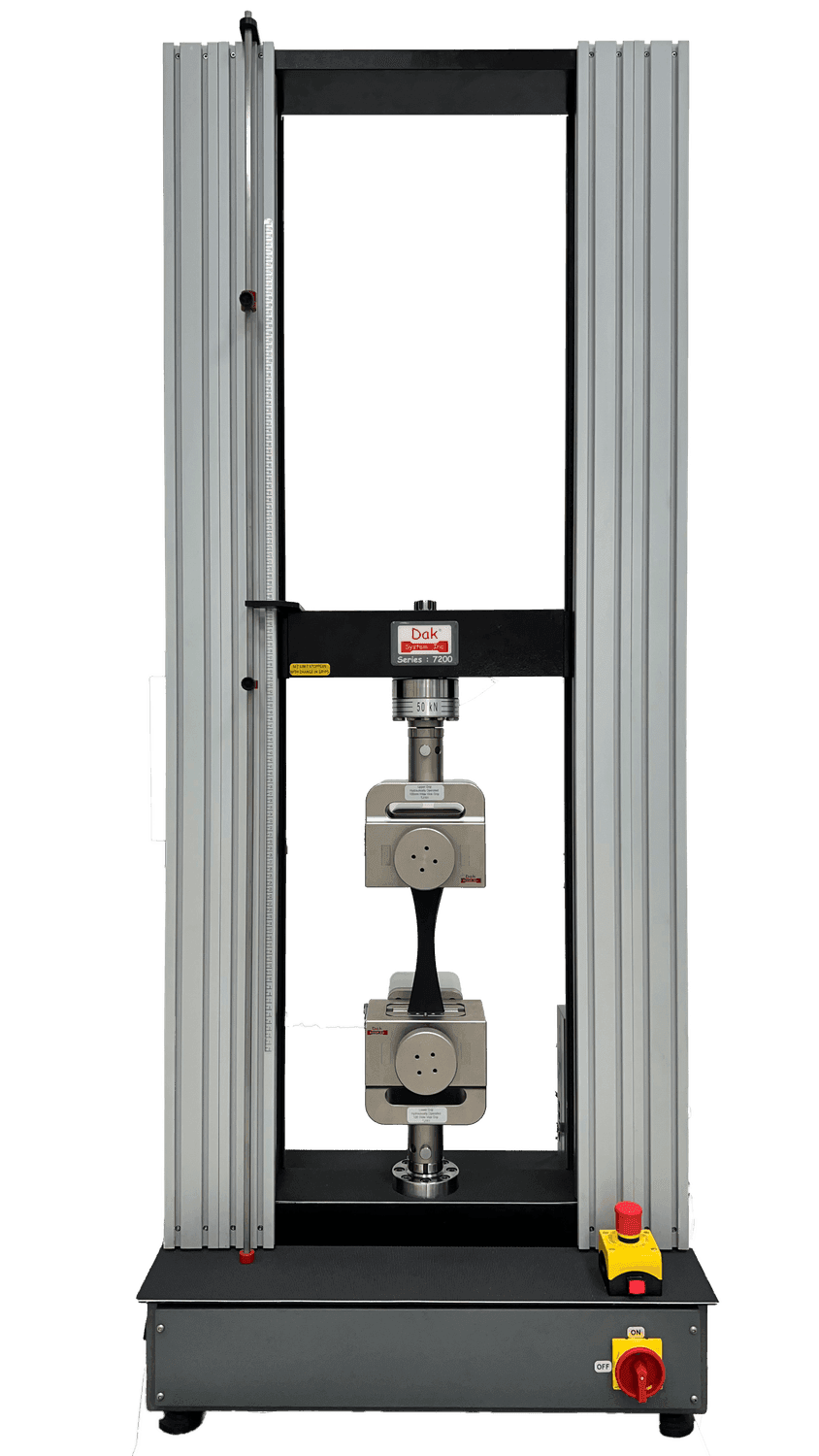
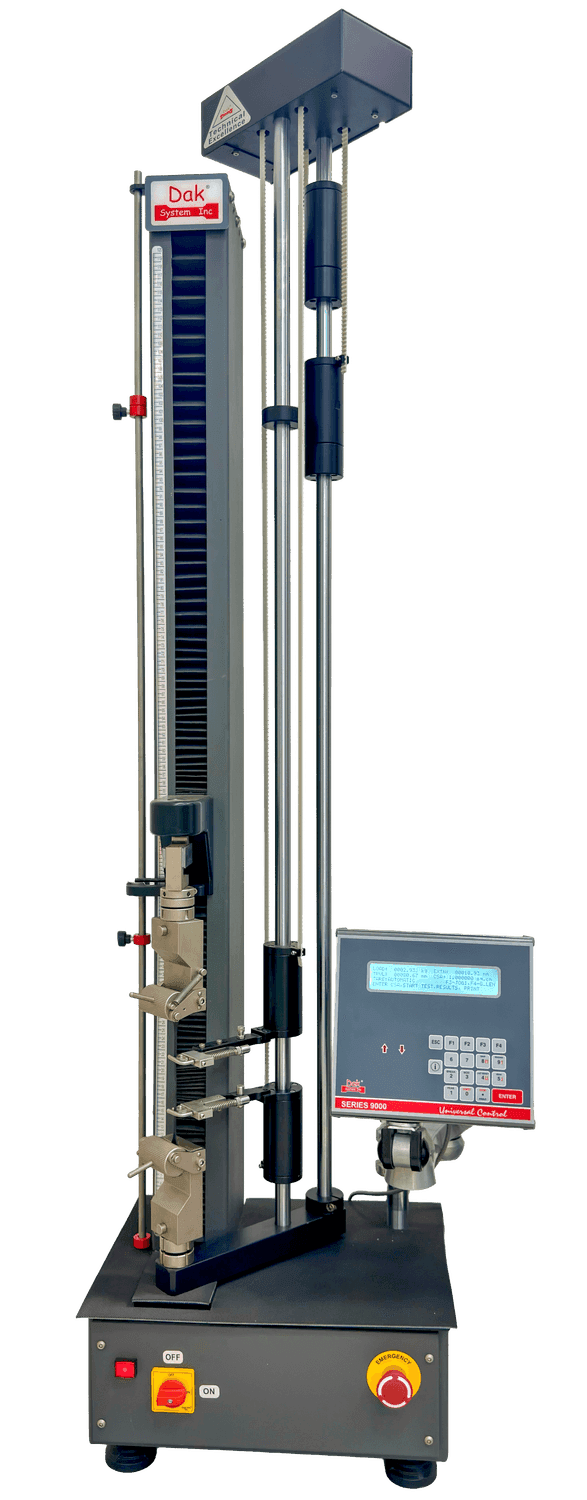
Forces are modest — a dumbbell of a typical liner breaks well under 1 kN — so a 5 to 10 kN frame is ample and low-end resolution matters. Force accuracy to ASTM E4 is the requirement.
Travel is the real constraint. Polyethylene geomembranes elongate to several hundred percent before break, so the frame needs long crosshead travel and a means of following that elongation. A clip-on extensometer will not survive it; a long-travel or video extensometer is the practical instrument where elongation is measured on the specimen rather than taken from grip separation.
Grips must hold a slippery, ductile sheet without cutting it. Serrated faces that bite a rigid plastic will nick a liner; pneumatic vice-action or wedge grips with a suitable face, closed to a controlled force, are the usual answer. Slippage on a specimen that is still elongating looks exactly like elongation.
What goes wrong in practice
Grip slip reported as elongation is the classic error on this material and it inflates elongation at break substantially. Worn dies that leave a nicked edge give low strengths and a wide spread. Running out of crosshead travel before break truncates the result. And testing a textured sheet with a thickness taken over the texture, rather than over the load-bearing core, produces a stress that is not comparable with anything.
D6693 against D4885 on the same liner
Both are tensile tests on geomembrane and they are written for different purposes. Neither is a substitute for the other.
ASTM D6693
ASTM D4885
Purpose
Control and specification
Performance, as a design aid
Specimen
A die-cut dumbbell
A wide strip, wider than the gauge length
Necking
Occurs, and is part of the result
Suppressed by specimen width
Rate
Standard plastics tensile speed
Slower, closer to service
Force needed
Well under 1 kN
Tens of kN
Answers
Is this the material specified
Will it take the design strain
The two give different numbers on the same sheet, deliberately. Quoting one against a specification written for the other is the commonest reporting error on geomembranes.
Questions we are asked about this test
What is ASTM D6693?+
ASTM D6693, published as D6693/D6693M, is the tensile test method for nonreinforced polyethylene and nonreinforced flexible polypropylene geomembranes. Die-cut dumbbells are pulled to break under defined conditions of pretreatment, temperature and machine speed, and strength and elongation are reported at yield and at break. It covers sheet from 0.25 mm to 6.3 mm thick. The current edition is D6693/D6693M-20.
Why are yield values reported as well as break values?+
Because yield is where a liner stops recovering. A geomembrane spread over a subgrade that settles is strained locally, and once it yields the sheet thins permanently at that point — which is where a leak eventually starts. Break values describe the ultimate abuse the sheet can absorb; yield values describe the point at which it has already been damaged. Specifications carry both for that reason.
How does it differ from ASTM D4885?+
D6693 is a control and specification test on a dumbbell; D4885 is a performance test on a wide strip. The dumbbell necks as it is pulled, which is an artefact of the specimen shape rather than something a liner in the ground can do. D4885 uses a specimen much wider than its gauge length, and a slower rate, precisely to suppress that. The two give different numbers on the same sheet and both are correct.
What is the biggest source of scatter?+
The die. Polyethylene is notch-sensitive, and a worn or chipped die leaves a rough edge in the narrow section that acts as a crack starter. Specimens then fail below their real strength, with a spread that looks like variable resin or variable extrusion. Die condition is worth checking on a schedule rather than when results start to look odd.
Can it be used on textured geomembrane?+
The method is written for nonreinforced sheet, and texturing complicates it because the thickness measured over the texture is not the thickness carrying load. The test can be run, but the report has to state how thickness was determined, and a stress calculated over the full textured thickness is not comparable with one calculated over the core. Where a project specification covers textured product it normally says which convention applies.
What machine does it need?+
A small frame with long travel. Forces are modest — a dumbbell of a typical liner breaks well under 1 kN — so a 5 to 10 kN frame with good low-end resolution and force accuracy to ASTM E4 is right. The real requirement is stroke and strain measurement: elongations of several hundred percent need a long-travel or video extensometer, because a clip-on gauge will not survive and grip separation includes slip and machine compliance.
Why does grip slip matter so much on this material?+
Because it is indistinguishable from elongation in the data. A liner is slippery and ductile, so a specimen creeping out of the jaws produces extra crosshead travel that is recorded as extra stretch. Elongation at break comes out high, the curve still looks plausible, and nothing in the trace announces the problem. Checking the specimen for jaw witness marks and measuring elongation on the specimen rather than from grip separation are the two defences.
This page describes the method as practised. The governing text is the current edition from the issuing body. Tell us what you are testing and we will answer with the machine, the fixture and a quotation.