Standard 25 mm
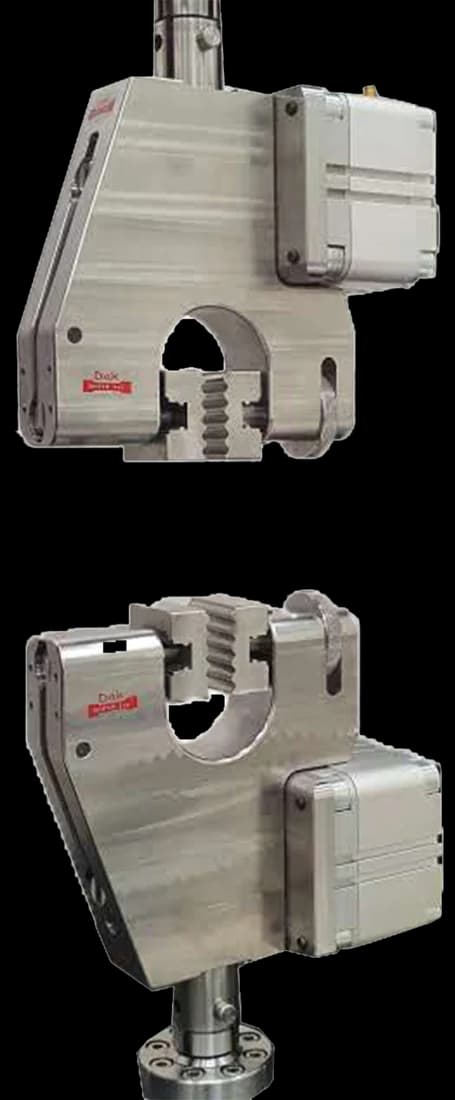
Pneumatic Vice Action Grip
Pneumatic vice action grips clamp the full specimen width at a constant, even pressure — which is what stops one side slipping or tearing before the other.
Specifications
Testing standard
Rubber- or plastics-coated fabrics — Determination of tear resistance — Part 1: Constant rate of tear methods
Written and technically reviewed by Dak System Inc. engineeringLast reviewed
ISO 4674-1 specifies two methods for the forces needed to initiate and propagate tearing in a rubber- or plastics-coated fabric at a constant rate of tear: method A, the tongue tear, and method B, the trouser tear. The rate of jaw traverse is (100 ± 10) mm/min from a starting jaw separation of 100 mm.
From the test method to your testing system
Explore the DAK machines already listed for ISO 4674-1, then review the grips, measurement and setup requirements below.
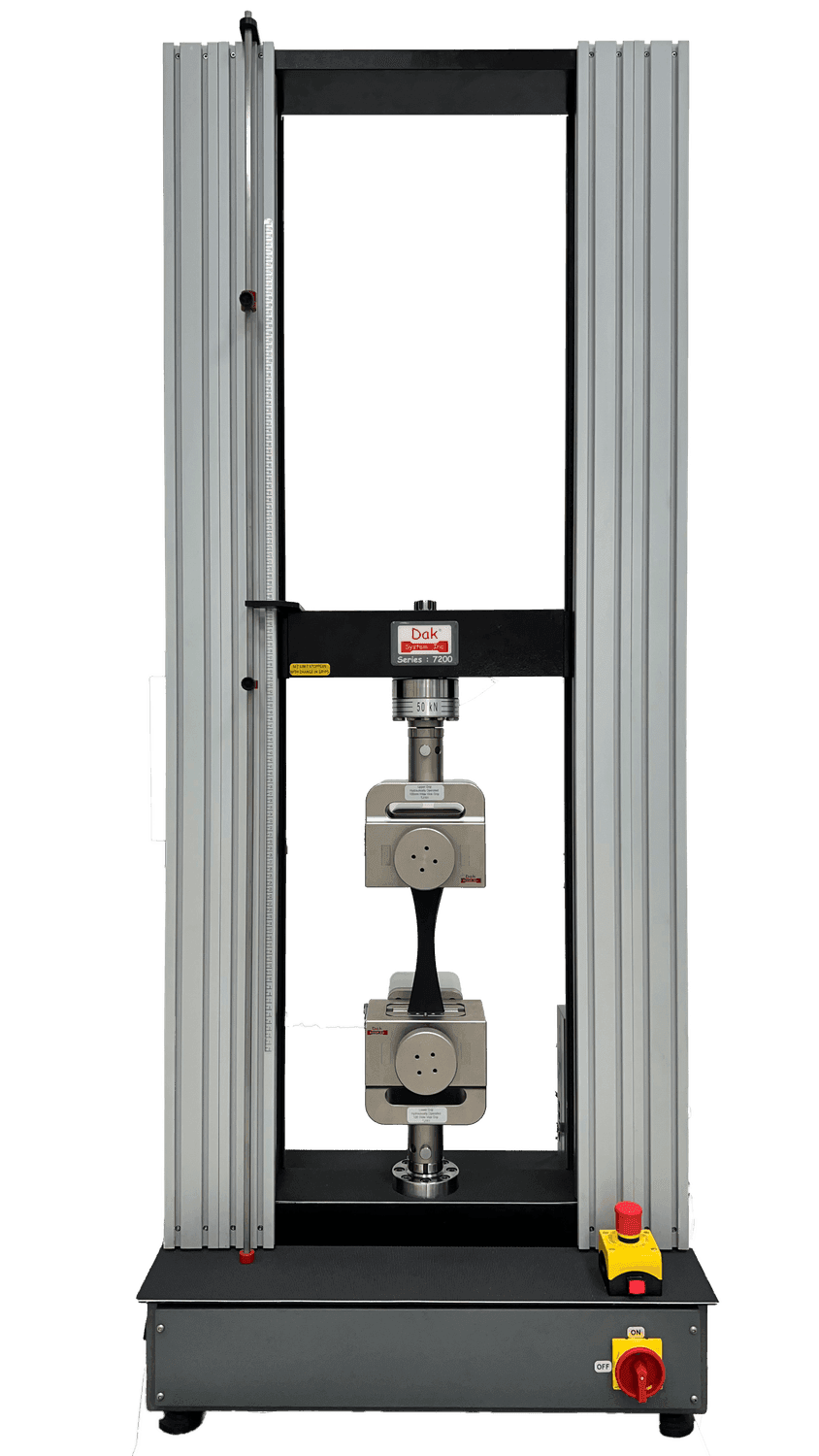 Universal Testing MachineSeries 7200Explore the machine →
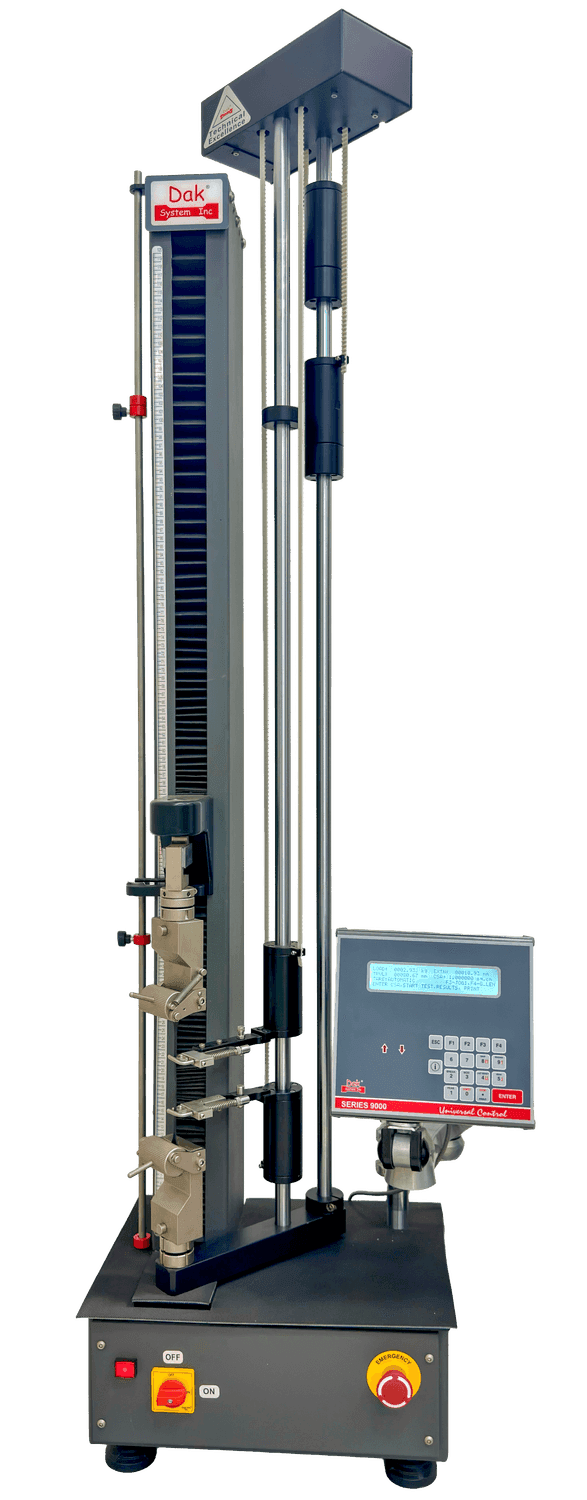 Universal Testing MachineSeries 9000Explore the machine →
01Understand the method
A conditioned specimen of coated fabric is cut in the warp or weft direction and prepared as one of two geometries. Method A is a tongue tear, cut so that two tear fronts propagate at once. Method B is a trouser tear, a single slit along which one tear runs. Either is pulled at a rate of jaw traverse of (100 ± 10) mm/min while the whole force trace is recorded, and the tear force is read from that trace by the rule the method gives for the geometry used — not simply as its highest point.
Whether damage spreads. This is the property that actually governs the life of a coated fabric: an architectural membrane, a tarpaulin, an awning or a truck curtain almost never fails by being pulled apart in a clean sheet. Something catches it, a fixing works loose, a stone punctures it — and what decides the outcome is whether the resulting hole stays a hole or runs into a split. Tensile strength describes a condition the product rarely experiences, which is why tear resistance and tensile strength are specified together and neither substitutes for the other.
02Prepare the specimen and test settings
Two geometries, two tear fronts, two different numbers from the same material.
Coated fabric tear is the property that decides whether a puncture in a membrane or a tarpaulin stays a hole or becomes a split. It matters more in service than tensile strength does.
03Build the test setup on a DAK machine
Modest force with a faithful data record, and a crosshead that holds (100 ± 10) mm/min — the rate of jaw traverse clause 7.2 sets, from a starting jaw separation of 100 mm, with the tongue test stopped once 60 mm has torn. The machine itself must be a constant-rate-of-extension frame complying with ISO 1421, which runs at the same 100 mm/min ± 10 mm/min, so one speed setting covers the tensile and the tear tests on the same cloth. Where force and extension are logged digitally rather than drawn, clause 4.1 fixes a floor on the sampling: not less than 8 readings per second. Coated fabric tear forces commonly run from tens to a few hundred newtons, and the trace matters as much as the peak — the tear advances yarn by yarn, so the record is a saw-tooth and the method's reading rule is what makes two laboratories agree on it. Grips need to hold a slick coated surface at a pressure that does not cut through the coating into the substrate, which is the same narrow window ISO 1421 has to find.
Pneumatic vice action grips clamp the full specimen width at a constant, even pressure — which is what stops one side slipping or tearing before the other.
SpecificationsDak verifies against whichever standard the method names, and where a class applies our frames sit a class tighter than it asks.
| The method asks for | Dak supplies | |
|---|---|---|
| Capacity | Low to moderate — coated fabric tear forces commonly run from tens to a few hundred newtons | Load cells from 1 kg to 60 ton on the Series 7200, and 0.5 to 100 kN on the Series 9000 |
| Force accuracy | Class 1 over the working range | ISO 7500-1 Class 0.5, verified to ASTM E4, DIN 51221 and BS 1610 |
| Gripping | Grips holding the tongues or the trouser legs, wide enough for the specimen | Wedge, vice-action, pneumatic and hydraulic grips, built to the specimen |
| Environment | 23 ± 2 °C standard laboratory atmosphere | 3009 series chambers, −150 °C to +400 °C — temperature only |
04Run the test
05Calculate, report and interpret
Read from the trace by the method's rule for the geometry used
Not simply the highest point. Each yarn rupture is a peak, and the rule exists so two laboratories read the same saw-tooth the same way.
Two simultaneous tear fronts against one
The tongue geometry propagates two tears at once and distributes the work differently, so it does not produce the trouser number on the same cloth.
Reporting a tear force without the method letter, when tongue and trouser give different numbers on the same cloth. Averaging warp and weft. Reading the single highest peak from a saw-tooth trace rather than applying the method's rule. Sampling a digital trace too slowly to resolve the peaks the rule then asks you to count. A ragged starting cut. And missing the case where the coating split ahead of the yarns — that is a real observation about the product, but the resulting force describes the coating rather than the reinforced composite, and a reader needs to be told which happened.
06Compare methods and find answers
| ISO 4674-1 — tear | ISO 1421 — tensile | |
|---|---|---|
| Question | Does damage spread? | How much load does it carry? |
| Failure | A tear runs | The fabric breaks |
| Predicts the other | No | No |
| Specified together | Usually | Usually |
Tensile strength describes an unblemished sheet. A membrane or a tarpaulin almost never fails that way — something catches it, and tear resistance decides what happens next.
It is the ISO tear resistance method for rubber- or plastics-coated fabrics using a constant rate of tear. It specifies two methods: method A, the tongue tear, and method B, the trouser tear. Both determine the forces needed to initiate and to propagate tearing. The current edition is ISO 4674-1:2016, superseding the 2003 edition.
The number of tear fronts. A trouser specimen has a single slit and one tear runs along it, the same geometry used for films and solid rubber. A tongue specimen is cut so that two tear fronts propagate at once, which distributes the work differently and is closer to how a tear behaves in a tensioned membrane. They do not give the same number on the same cloth, so the method letter belongs with every value.
Because that is how these materials actually fail. An architectural membrane, a tarpaulin, an awning or a truck curtain almost never fails by being pulled apart in a clean sheet — something catches it, a fixing works loose, a stone punctures it, and what decides the outcome is whether that damage stays a hole or runs into a split. Tensile strength describes a condition the product rarely experiences.
Because the tear advances yarn by yarn. Each yarn in the base fabric resists, then ruptures, and the load falls before building against the next, so the record is a series of peaks rather than a smooth curve. That is why the method specifies how to read the force from the trace — taking the single highest point would report whichever yarn happened to be strongest.
It is worth noting in the report, because the trace then describes the coating rather than the composite. On a heavily coated cloth the coating can split ahead of the yarns, and the force required to do that is not the same as the force to tear the reinforced material. It is a real observation about the product rather than a failed test, but a reader needs to know which happened.
Because the base fabric is woven and therefore directional, and coating it does not remove that. Warp and weft yarns differ in count, tension and crimp from manufacture, so a coated fabric tears at different forces in the two directions — often substantially. A membrane is engineered around that difference and an average would describe neither axis.
They are the two halves of specifying a coated fabric's mechanical behaviour, and neither predicts the other. ISO 1421 measures how much load the material carries before it breaks; this measures whether damage in it spreads. ISO 4674-1 also borrows its machine requirement from ISO 1421, and the two run at the same rate — (100 ± 10) mm/min here, 100 mm/min ± 10 mm/min there — so a single speed setting covers both tests on the same cloth. Both usually appear in the same specification, alongside ISO 2411 for whether the coating stays attached at all.
Discuss your specimen, test requirements and reporting needs with DAK engineering.
This page describes the method as practised. The governing text is the current edition from the issuing body. Tell us what you are testing and we will answer with the machine, the fixture and a quotation.