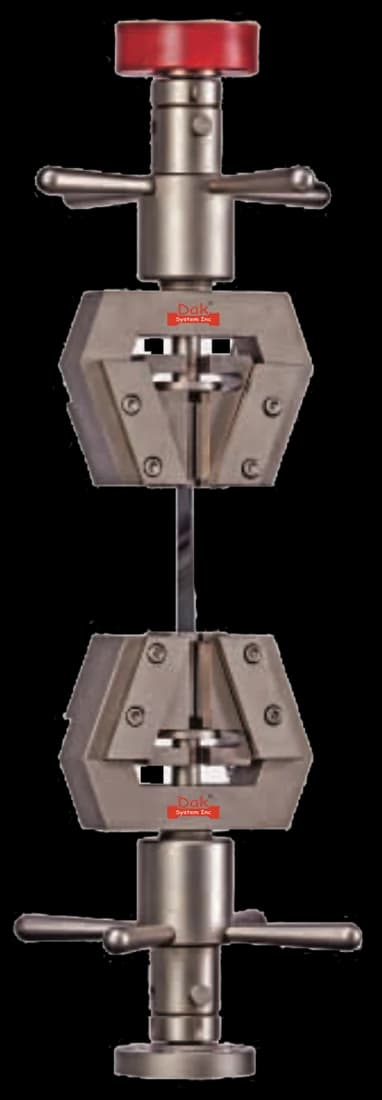
Self-tighteningTJ-15
Universal Parallel Wedge Grips
Self-tightening wedges for rigid dumb-bells — clamping rises with load, which holds the tab without the crush that starts a jaw-line break.
Specifications
Testing standard
Plastics — Determination of tensile properties — Part 1: General principles
Written and technically reviewed by Dak System Inc. engineeringLast reviewed
ISO 527-1 sets the general principles for tensile testing of plastics — the definitions, the equations and the machine requirements that every part of the series shares. It defines tensile modulus, yield stress and strain, and stress and strain at break. The specimen geometry itself belongs to a daughter part: ISO 527-2 for moulding compounds, ISO 527-3 for films and sheets.
From the test method to your testing system
Explore the DAK machines already listed for ISO 527-1, then review the grips, measurement and setup requirements below.
 Universal Testing MachineSeries 7200Explore the machine →
 Universal Testing MachineSeries 9000Explore the machine →
01Understand the method
A plastics specimen is clamped at both ends and pulled along its long axis at a constant crosshead speed until it breaks. Force is taken from the load cell; extension is taken over a marked gauge length, by extensometer rather than by crosshead travel. The recorded output is a continuous stress–strain curve, so the whole deformation history is captured, not a single breaking figure.
The method defines tensile modulus, yield stress and yield strain, stress and strain at break, and nominal strain for cases where no extensometer follows the gauge. Modulus is a direct design input, feeding stiffness calculations and finite-element models. Yield stress bounds the load a moulded part carries before it deforms permanently. Strain at break separates ductile grades from brittle ones and exposes degraded regrind, so it does most of the work in incoming-lot release and in failure investigation.
02Prepare the specimen and test settings
Part 1 deliberately carries no geometry. It is the umbrella document, and testing to it alone is not possible — the daughter part supplies the specimen.
A report citing ISO 527-1 alone has not named a test. It must name the daughter part — ISO 527-2 or ISO 527-3 — and the specimen type within it, or the result cannot be reproduced.
03Build the test setup on a DAK machine
Part 1 covers the whole plastics range, so force demand follows the daughter part. A thin film strip breaks at a few newtons, an unfilled moulding dumb-bell at roughly 1 to 3 kN, and a glass-filled or high-performance grade at about 10 kN. One 10 kN frame with interchangeable low-capacity load cells covers the family, provided each cell holds ISO 7500-1 Class 1 over the range actually used — a 10 kN cell reading a 30 N film break is not Class 1 there.
Speeds are drawn from a nominal series running 0.125, 0.25, 0.5, 1, 2, 5, 10, 20, 50, 100, 200, 300 and 500 mm/min. Plastics are rate-sensitive, so the speed used is part of the result. Modulus is stricter: the crosshead must give a strain rate as near as possible to 1 % of gauge length per minute, which is 1 mm/min for the type 1A and 1B dumb-bells.
Modulus is evaluated between 0.05 % and 0.25 % strain. That interval rules out crosshead travel and requires an extensometer to ISO 9513 Class 1, while the same test then has to follow elongation to break — under 2 % for a filled thermoset, beyond 500 % for a ductile polyolefin or film. Grips must hold the specimen with its long axis on the line of pull, so self-tightening serrated wedges suit rigid dumb-bells and pneumatic side-action jaws suit soft or thin material where clamping force must stay constant; jaw faces should be at least as wide as the specimen.
Self-tightening wedges for rigid dumb-bells — clamping rises with load, which holds the tab without the crush that starts a jaw-line break.
Specifications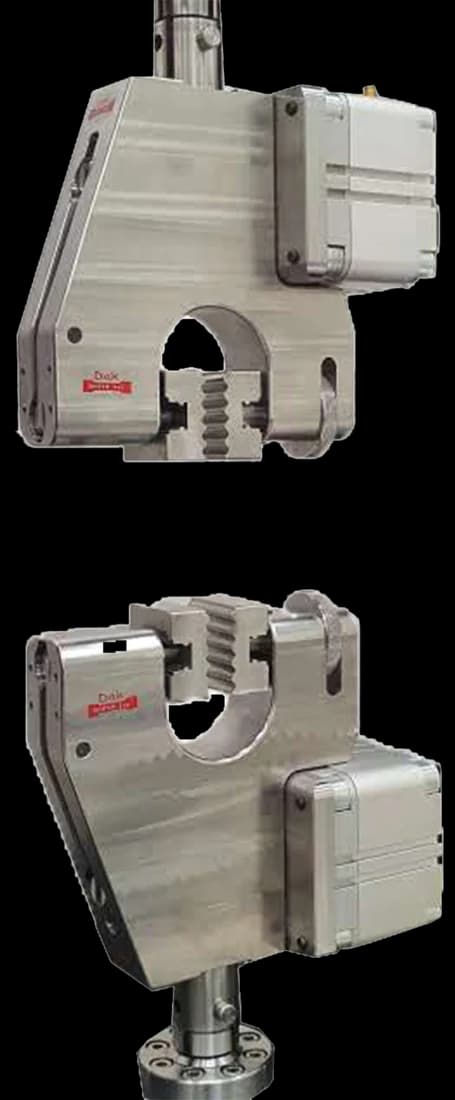
Constant air pressure for soft or thin material, where clamping force has to stay the same rather than rise. Jaw faces at least as wide as the specimen, as the method requires.
SpecificationsDak verifies against whichever standard the method names, and where a class applies our frames sit a class tighter than it asks.
| The method asks for | Dak supplies | |
|---|---|---|
| Capacity | Part 1 governs the whole plastics range, so the force demand is set by whichever daughter part is in play: a few newtons for a thin film strip under Part 3, roughly 1-3 kN for an unfilled moulding dumb-bell, and about 10 kN for a glass-filled or high-performance grade under Part 2. A 10 kN frame carrying interchangeable low-capacity load cells covers the family. | Load cells from 1 kg to 60 ton on the Series 7200, and 0.5 to 100 kN on the Series 9000 |
| Force accuracy | ISO 7500-1 Class 1 | ISO 7500-1 Class 0.5 — a class tighter than the method asks |
| Strain measurement | An extensometer to ISO 9513 Class 1, gauge length 50 or 75 (dumb-bells under Part 2); 50 (film strips under Part 3) — fixed by the specimen type in the relevant part, not by Part 1 | Certified to ISO 9513 Class 1 and ASTM E83 — non-contact video, clip-on and high-elongation |
| Gripping | Self-aligning tensile grips — wedge or pneumatic side-action — matched to the specimen type of the daughter part | Our self-tightening serrated wedge grips, with V-jaws for round specimens or vice-action grips, built to the specimen |
| Environment | Condition and test in the ISO 291 standard atmosphere, 23 °C and 50 % RH; 27 °C / 65 % RH is the subtropical alternative | 3009 series chambers, −150 °C to +400 °C — temperature only |
04Run the test
05Calculate, report and interpret
The stress and strain definitions are conventional. The modulus interval is not, and it is the reason an ISO modulus and an ASTM modulus are different quantities rather than different measurements of one quantity.
σ = F / A
ε = ΔL₀ / L₀
Nominal strain, taken from grip separation, is defined separately and is not the same quantity — it is used only where no extensometer follows the gauge.
Et = (σ2 − σ1) / (ε2 − ε1)
A SECANT ACROSS A FIXED, NARROW INTERVAL. Crosshead travel cannot supply strain this small — the machine's own flex is a large fraction of it — so an extensometer to ISO 9513 Class 1 is required, not merely recommended.
Slippage is the quiet failure: the specimen creeps through the jaws, the crosshead logs extension the gauge never saw, and modulus reads low while strength looks near-normal. Over-clamping does the opposite damage — the specimen fails at the jaw line and the number belongs to the grip, not the material. Off-axis clamping puts a bending moment into the gauge and scatters the set. Conditioning drift leaves no trace in the curve; polyamides take up moisture within hours outside the standard atmosphere and simply read softer.
06Compare methods and find answers
The pair a supplier and a customer most often find themselves on opposite sides of.
| ISO 527-1 / -2 | ASTM D638 | |
|---|---|---|
| Structure | Umbrella part plus daughter parts | One document, five specimen types |
| Specimen | Type 1A / 1B dumb-bell | Type I to V dumb-bell |
| Gauge length | 50 or 75 mm | 50 mm for Type I |
| Modulus | Secant, 0.05 % to 0.25 % strain | Initial tangent |
| Modulus speed | ≈ 1 % of gauge per minute, 1 mm/min | The test speed, not a separate one |
| Thin film route | ISO 527-3 | ASTM D882 |
The modulus definitions are different quantities, not different measurements of the same one. A grade certified to one and verified against the other can appear to fail on figures that are both correct, which is why a datasheet that does not name its method is not usable for acceptance.
It is the general-principles part of the ISO 527 series for tensile testing of plastics. It defines the quantities — tensile modulus, yield stress and strain, stress and strain at break — and sets the machine and measurement requirements. It deliberately contains no specimen geometry: that comes from a daughter part.
No. Part 1 carries the principles but no specimen, so a report citing it alone has not named a reproducible test. It has to be paired with the daughter part that governs the material — ISO 527-2 for moulding and extrusion compounds, ISO 527-3 for films and sheets — and the specimen type within that part.
The specimen geometries differ, the speeds differ, and most consequentially the modulus definitions differ: ISO takes a secant between 0.05 % and 0.25 % strain, ASTM takes the initial tangent. Those are different quantities rather than two measurements of one quantity. A material certified under one and checked under the other can appear non-compliant on numbers that are both right.
As close as possible to 1 % of the gauge length per minute, which works out at 1 mm/min for the type 1A and 1B dumb-bells. That is normally slower than the speed used for the strength properties, so a single test commonly runs at two speeds — the slow one through the modulus interval, then the specified speed to break.
Because modulus is evaluated between 0.05 % and 0.25 % strain, and over an interval that small the machine's own stretch is a large fraction of the movement being measured. Crosshead travel therefore cannot supply it. The method calls for a device to ISO 9513 Class 1, and the same test then has to follow elongation to break, which may be beyond 500 % for a ductile grade.
It follows the daughter part. A thin film strip breaks at a few newtons, an unfilled moulding dumb-bell at roughly 1 to 3 kN, and a glass-filled or high-performance grade at about 10 kN. One 10 kN frame with interchangeable low-capacity load cells covers the family — provided each cell meets ISO 7500-1 Class 1 over the range actually used, since a 10 kN cell reading a 30 N film break is not Class 1 there.
It is strain taken from grip separation rather than from an extensometer on the gauge length, and the method defines it as a separate quantity precisely so it is not confused with true tensile strain. It is used only where no extensometer follows the gauge — typically at very large elongations after the gauge device has been removed — and it must be reported as nominal rather than presented as strain.
Grip pressure or alignment. Serrations biting too hard start a crack at the jaw line; a specimen clamped out of square carries bending on top of tension. Either way it was not loaded uniaxially, so the method requires it to be replaced rather than averaged in. Jaw faces at least as wide as the specimen, and pneumatic side-action for softer material, remove most occurrences.
Discuss your specimen, test requirements and reporting needs with DAK engineering.
This page describes the method as practised. The governing text is the current edition from the issuing body. Tell us what you are testing and we will answer with the machine, the fixture and a quotation.