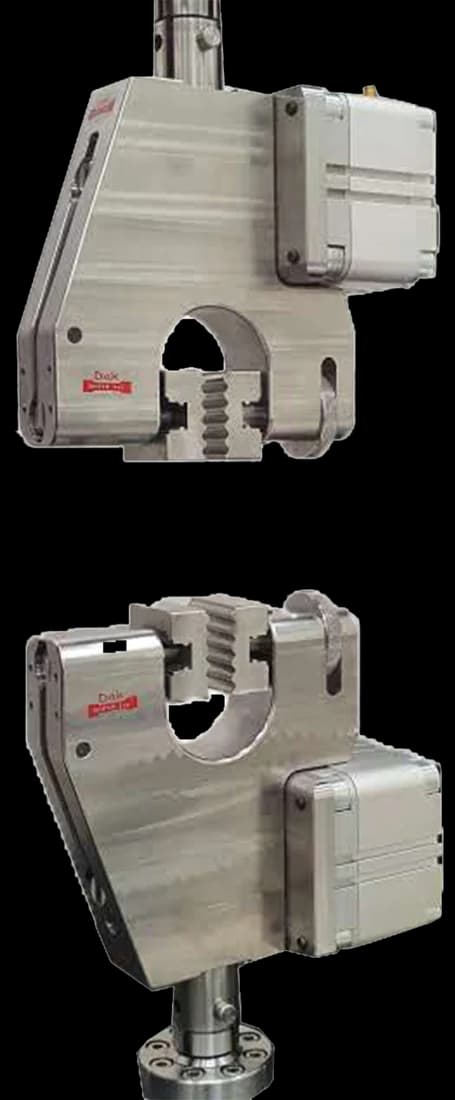
Standard 25 mm
Pneumatic Vice Action Grip
Pneumatic vice action grips clamp the full specimen width at a constant, even pressure — which is what stops one side slipping or tearing before the other.
Specifications
Testing standard
Methods of Test for Vulcanized Rubber — Part 1: Tensile Stress-Strain Properties
Written and technically reviewed by Dak System Inc. engineeringLast reviewed
IS 3400 (Part 1) is the Bureau of Indian Standards method for the tensile stress-strain properties of vulcanized and thermoplastic rubber. It is aligned with ISO 37, and gives tensile strength, elongation at break, stress at a given elongation and elongation at a given stress.
From the test method to your testing system
Explore the DAK machines already listed for IS 3400 (Part 1), then review the grips, measurement and setup requirements below.
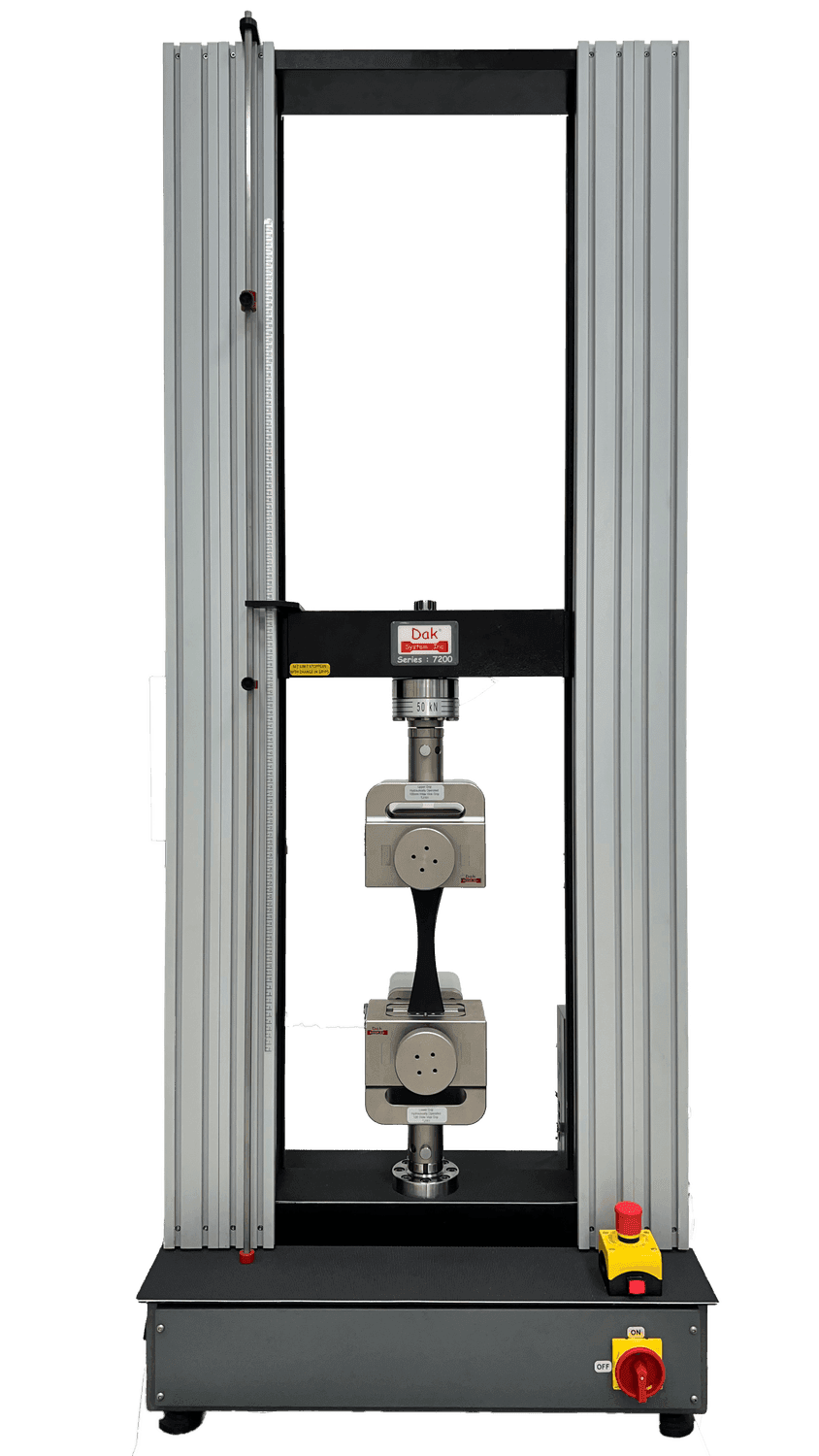 Universal Testing MachineSeries 7200Explore the machine →
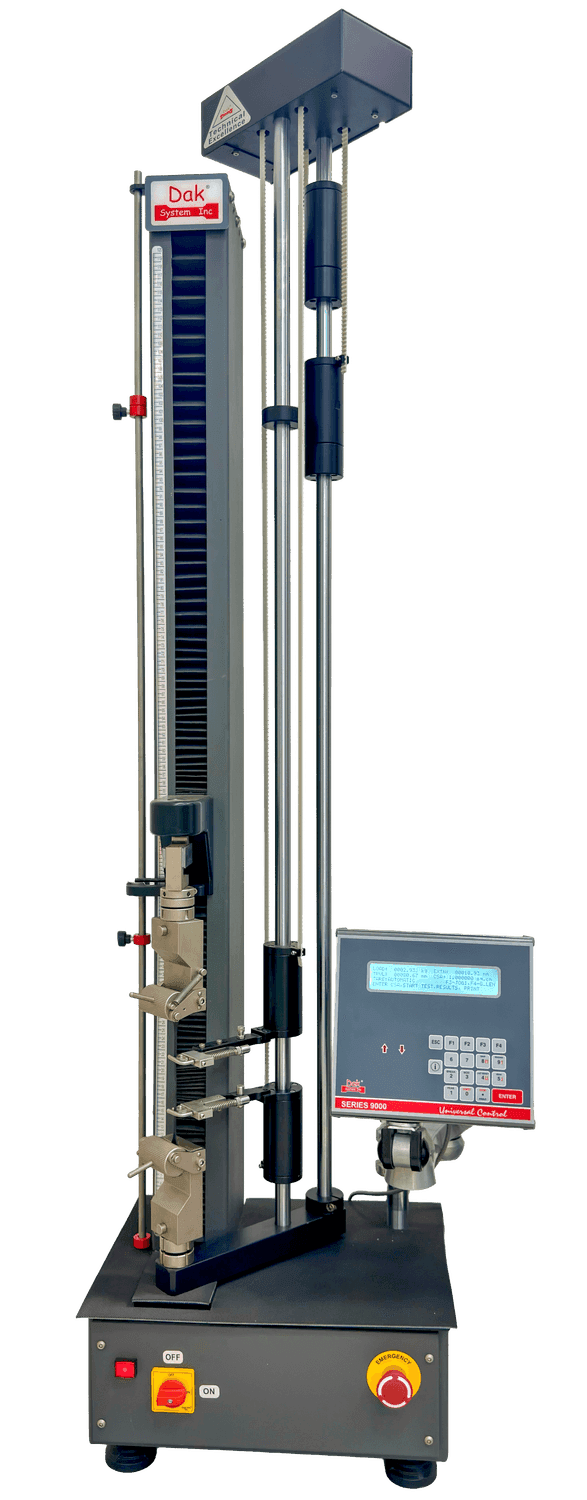 Universal Testing MachineSeries 9000Explore the machine →
01Understand the method
A dumb-bell is cut from vulcanized sheet with a sharp die, conditioned after vulcanization, and its narrow portion measured and gauge-marked. It is gripped in pneumatic jaws and extended at 500 mm/min for most dumb-bell types, with strain followed by a non-contacting extensometer on the gauge marks. The run yields tensile strength, elongation at break, stress at a given elongation, elongation at a given stress, and — for some thermoplastic rubbers and certain compounds — the stress and strain at yield.
Several properties, and the one most people quote is often not the one the specification uses. Tensile strength gets the headline, but rubber compounds are usually bought and sold against stress at a stated elongation — M100, M300 and similar — because those describe the material at the strains it actually works at, whereas the breaking strength describes a condition a seal or a mount will never see. Both are calculated on the original cross-section by convention: rubber thins enormously before it breaks, so the true stress at failure is far higher than the number reported, and the convention exists to make laboratories comparable rather than to be physically true.
02Prepare the specimen and test settings
Not one number but several, and the ones a rubber specification actually uses are often the modulus values rather than the strength.
Rubber is aligned with ISO 37 in India, and ISO 37 has moved to its seventh edition. Confirm which ISO edition the current IS revision adopts before claiming the two results are interchangeable.
03Build the test setup on a DAK machine
Modest force but a great deal of travel. Rubber dumb-bells commonly break between a few tens and a few hundred newtons, while reaching elongations of several hundred per cent, so the frame needs the stroke more than the capacity. Grips must hold a soft specimen without squeezing it out of shape, which is why pneumatic jaws at a controlled pressure are preferred to screw grips tightened by hand. Strain is followed by a non-contacting extensometer, since a clip-on gauge both loads the specimen and cannot survive the extension.
Pneumatic vice action grips clamp the full specimen width at a constant, even pressure — which is what stops one side slipping or tearing before the other.
SpecificationsDak verifies against whichever standard the method names, and where a class applies our frames sit a class tighter than it asks.
| The method asks for | Dak supplies | |
|---|---|---|
| Capacity | Low — rubber dumb-bells commonly break between a few tens and a few hundred newtons | Load cells from 1 kg to 60 ton on the Series 7200, and 0.5 to 100 kN on the Series 9000 |
| Force accuracy | A machine complying with ISO 5893 with force measurement to class 2 (clause 7.4.1); an extensometer, where used, to class D for type 1, 1A and 2 dumb-bells and class E for types 3 and 4 | ISO 7500-1 Class 0.5, verified to ASTM E4, DIN 51221 and BS 1610 |
| Strain measurement | An extensometer of the class the method specifies | Certified to ISO 9513 Class 1 and ASTM E83 — non-contact video, clip-on and high-elongation |
| Gripping | Pneumatic grips holding a dumb-bell without pre-stressing it, and a non-contacting extensometer | Our pneumatic grips, built to the specimen |
| Environment | one of the standard laboratory temperatures specified in ISO 23529 (clause 14); samples other than latex are conditioned at a standard laboratory temperature without humidity control for not less than 3 h (clause 10.3). Read from IS 3400 (Part 1):2012; the 2021 text is not publicly retrievable | 3009 series chambers, −150 °C to +400 °C — temperature only |
04Run the test
05Calculate, report and interpret
TS = F / (w × t)
On the original cross-section, measured on the specimen. Rubber thins enormously before it breaks and none of that is accounted for.
Eb = (L − L₀) / L₀ × 100
Measured on gauge marks, not from the crosshead. Grip take-up and the shoulders of the dumb-bell both extend, and neither belongs in the gauge.
M = F at the stated elongation / original cross-section
Conventionally called the modulus, though it is not a modulus in the elastic sense — it is a stress at a strain, and the strain has to be stated.
Assuming an IS result automatically satisfies the current ISO 37, when an adopted standard does not move as its parent does. Nicked specimens, which read low and look like material variability. Taking elongation from the crosshead, which includes grip take-up and the extension of the dumb-bell shoulders, neither of which belongs in the gauge. Reporting tensile strength when the specification asks for a stress at elongation. And omitting the cutting direction, which leaves a real variable unrecorded.
06Compare methods and find answers
| IS 3400 (Part 1) | ISO 37 | |
|---|---|---|
| Published by | BIS | ISO |
| Relationship | Aligned with ISO 37 | The parent method |
| Current | IS 3400 (Part 1) : 2021 | ISO 37:2024, seventh edition |
| Assume equivalence | Only after checking the adopted edition | — |
An Indian Standard adopted from an ISO method does not move when the ISO method does. Check which ISO edition the IS revision in force actually adopts before treating a result as satisfying both.
It is the Bureau of Indian Standards method for the tensile stress-strain properties of vulcanized and thermoplastic rubber — tensile strength, elongation at break, stress at a given elongation, elongation at a given stress, and for some thermoplastic rubbers the stress and strain at yield. It is aligned with ISO 37, and the current edition is IS 3400 (Part 1) : 2021.
Usually, but it should be checked rather than assumed. The Indian Standard is adopted from ISO 37, and the 2012 third revision was identical with ISO 37:2011. ISO 37 has since moved on and is now in its seventh edition, ISO 37:2024. An adopted standard does not update when its parent does, so before treating one result as satisfying both, confirm which ISO edition the IS revision in force actually adopts.
Conventionally, the stress at a stated elongation — M100 is the stress at 100 % elongation, M300 at 300 %, and so on. It is not a modulus in the elastic sense, since it is a stress at a strain rather than a slope, but the usage is universal in the rubber trade. Most rubber specifications are written against these values rather than against tensile strength, because they describe the compound at the strains it actually works at.
Two reasons. It loads the specimen — a soft rubber dumb-bell is stiff enough to be influenced by the weight and spring force of a contacting gauge — and it cannot survive the travel, since rubber elongations at break commonly run to several hundred per cent. A non-contacting extensometer following gauge marks handles both, which is why it is the normal arrangement for this method.
Because rubber tears far more easily than it pulls apart. A small nick in the edge of a dumb-bell is a tear origin, and the specimen will fail from it at a fraction of the tensile strength the compound would otherwise show. It is the single most common cause of a low outlier, which is why every edge is inspected before testing and cutting is done with a sharp die on a clean backing.
By convention, and everyone using the figure needs to know it is a convention. Rubber thins enormously before it breaks — a dumb-bell at four hundred per cent elongation has a section a fraction of what it started with — so the true stress at failure is far higher than the reported tensile strength. The original-section basis is what makes results comparable between laboratories, not what makes them physically true.
Yes, on milled or calendered sheet. Rubber sheet carries a grain from processing, and dumb-bells cut along and across it can differ measurably in both strength and elongation. The direction is recorded for that reason, and a specification that does not name one leaves a variable open that will show up as scatter between laboratories cutting differently.
Discuss your specimen, test requirements and reporting needs with DAK engineering.
This page describes the method as practised. The governing text is the current edition from the issuing body. Tell us what you are testing and we will answer with the machine, the fixture and a quotation.