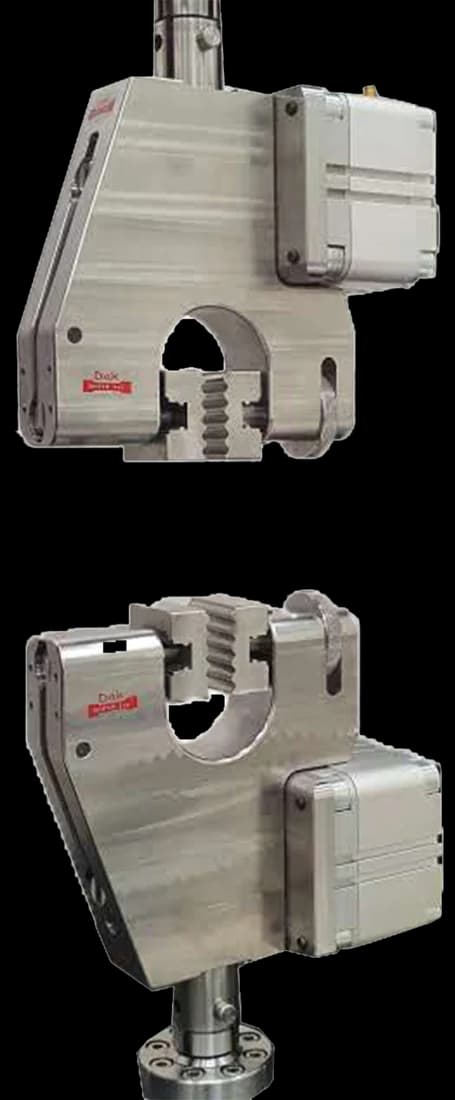
Standard 25 mm
Pneumatic Vice Action Grip
Pneumatic vice action grips clamp the full specimen width at a constant, even pressure — which is what stops one side slipping or tearing before the other.
Specifications
Testing standard
Methods of Test for Cables — Part 7: Tensile Strength and Elongation at Break of Thermoplastic and Elastomeric Insulation and Sheath
Written and technically reviewed by Dak System Inc. engineeringLast reviewed
IS 10810 (Part 7) determines the tensile strength and elongation at break of thermoplastic and elastomeric insulation and sheath on electric cables. Dumb-bells are punched from the insulation or sheath itself and pulled to break.
From the test method to your testing system
Explore the DAK machines already listed for IS 10810 (Part 7), then review the grips, measurement and setup requirements below.
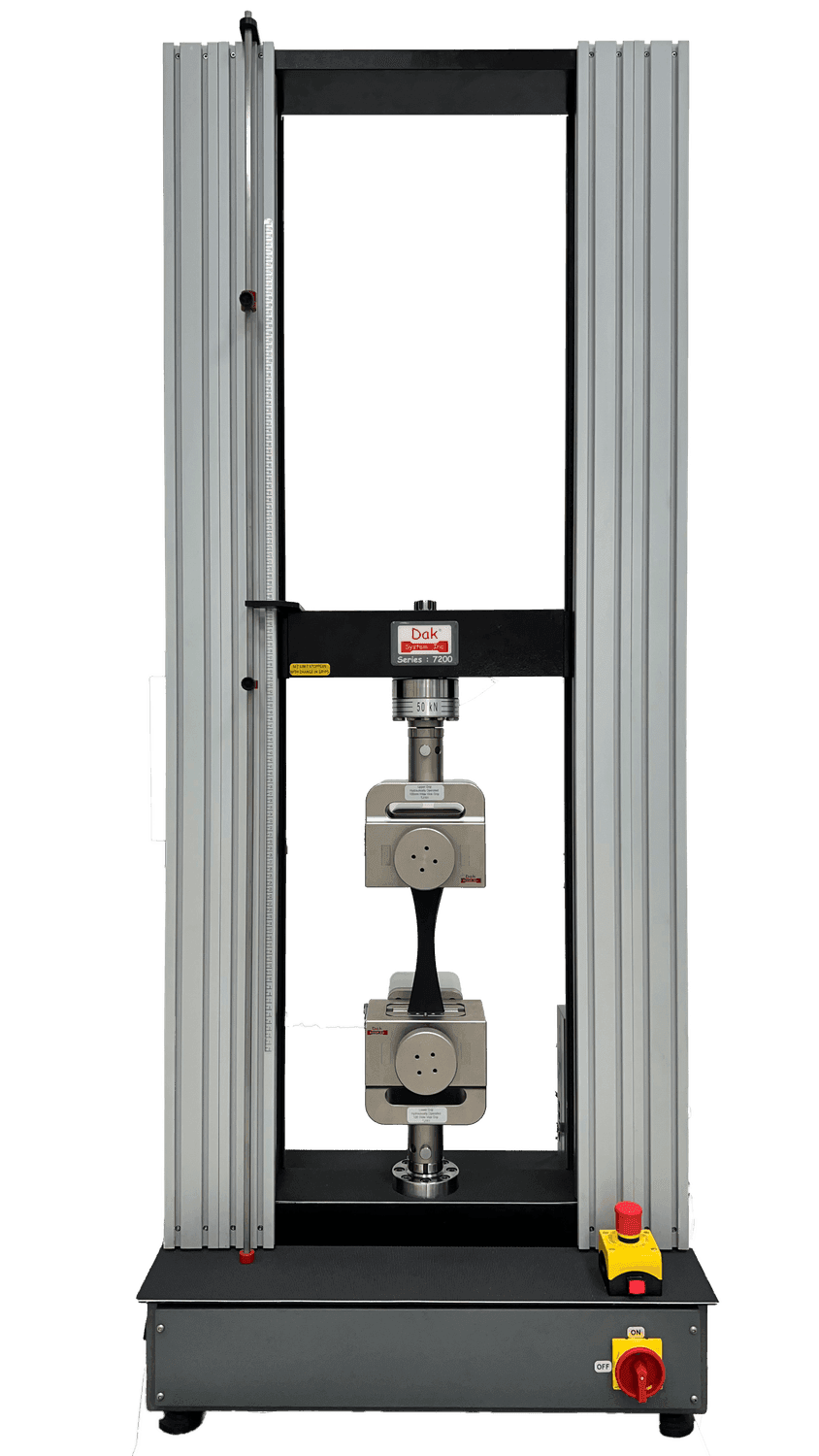 Universal Testing MachineSeries 7200Explore the machine →
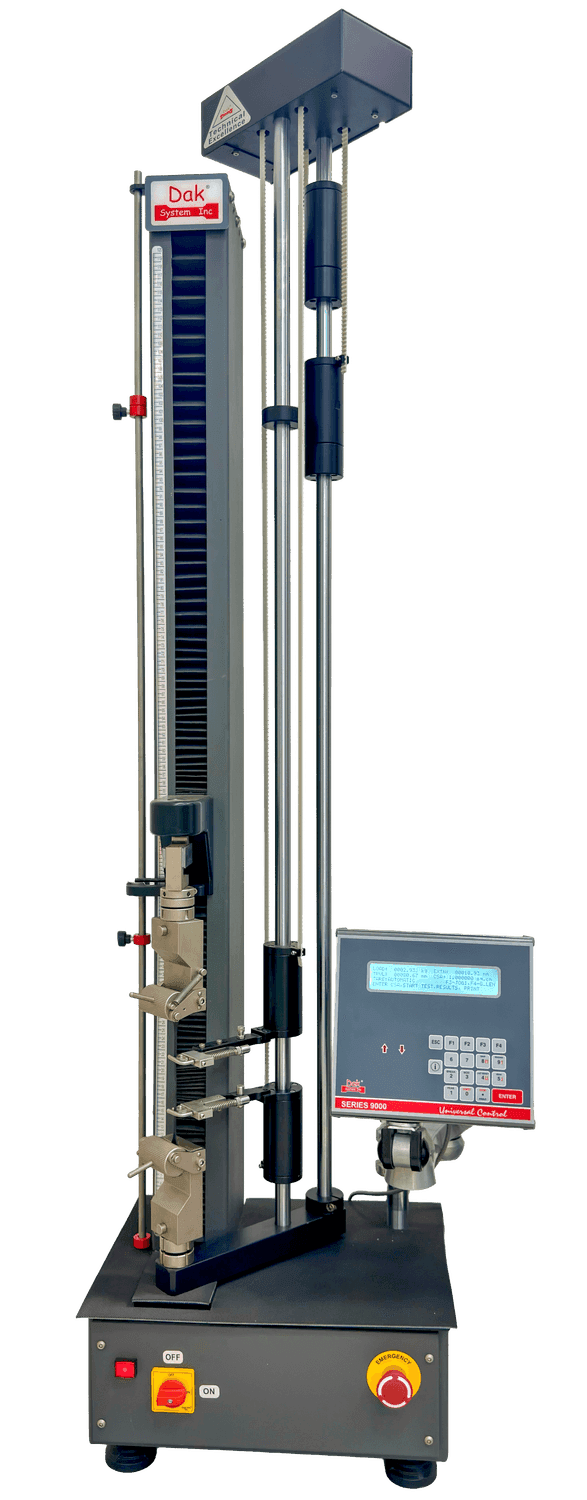 Universal Testing MachineSeries 9000Explore the machine →
01Understand the method
A sample is taken from a finished cable, the conductor and any tapes or separators removed cleanly, and the insulation or sheath straightened without stretching it. Dumb-bells are punched from that material with a sharp die and their edges inspected, their width and thickness measured individually, and the specimens conditioned. They are then pulled to break at a jaw separation rate of 250 ± 50 mm/min, with strain followed by a non-contacting extensometer, giving tensile strength on the measured area and elongation at break on the gauge length.
Whether the insulation and sheath as manufactured can take the mechanical handling a cable receives — pulling into conduit, bending round corners, being trodden on and clamped. The specimen comes from the cable rather than from moulded compound, and that is the substance of the method: extrusion orients the polymer, applies a thermal history and can introduce voids or contamination that a moulded plaque of the same material never sees. The test is also routinely repeated after ageing, because a compound that starts strong and embrittles is worse in service than one that starts lower and holds.
02Prepare the specimen and test settings
The specimen is taken from the finished cable, so it carries whatever the extrusion process did to the compound.
This is a routine acceptance test in cable manufacture, and it is usually run twice — once on the material as made, and again after ageing, because the ageing figure is what predicts service life.
03Build the test setup on a DAK machine
Low force, well measured, and a great deal of travel. An insulation or sheath dumb-bell commonly breaks below a hundred newtons while reaching several hundred per cent elongation, so the frame needs stroke more than capacity and the load cell has to be chosen for the specimen rather than for the machine. Grips must hold a soft compound at a controlled pressure without squeezing it out of shape or letting it creep out of the jaws during the pull, and strain is followed by a non-contacting extensometer since a clip gauge could neither survive the travel nor avoid loading the specimen.
The rate is 250 ± 50 mm/min of jaw separation in all cases, and that is the figure to set. In case of doubt or dispute the standard substitutes a strain rate: the material between the gauge marks elongates at about 600 per cent per minute. That converts to a machine speed only once the gauge length is known — 120 mm/min on the 20 mm gauge the method specifies for a tubular specimen, 60 mm/min on the 10 mm gauge of the small dumb-bell. A frame able to run a controlled 60 mm/min as well as 250 mm/min covers both.
Pneumatic vice action grips clamp the full specimen width at a constant, even pressure — which is what stops one side slipping or tearing before the other.
SpecificationsDak verifies against whichever standard the method names, and where a class applies our frames sit a class tighter than it asks.
| The method asks for | Dak supplies | |
|---|---|---|
| Capacity | Low — an insulation or sheath dumb-bell commonly breaks below 100 N | Load cells from 1 kg to 60 ton on the Series 7200, and 0.5 to 100 kN on the Series 9000 |
| Force accuracy | unknown — clause 4.2 sets capacity, rate of jaw separation and grip requirements and states no accuracy class; the only accuracy figures in the method are dimensional (0.01 mm) and gravimetric (0.001 g) | ISO 7500-1 Class 0.5 — the method sets no class of its own |
| Strain measurement | An extensometer of the class the method specifies | Certified to ISO 9513 Class 1 and ASTM E83 — non-contact video, clip-on and high-elongation |
| Gripping | Pneumatic grips holding a soft polymer dumb-bell, with a non-contacting extensometer | Our pneumatic grips, built to the specimen |
| Environment | 27 ± 2 °C for not less than 3 h before test (clause 7), the test made within 5 min of removing the specimen from the conditioning cabinet (clause 8.1); no humidity is specified | 3009 series chambers, −150 °C to +400 °C — temperature only |
04Run the test
05Calculate, report and interpret
Breaking load divided by the original cross-sectional area
On the punched specimen's own dimensions. A cable's nominal wall thickness is not the specimen's thickness.
(final gauge length − original) / original × 100
Large for these compounds — often several hundred per cent — which is why non-contacting strain measurement is used.
The retained percentage after ageing, against the unaged value
A compound that starts strong and embrittles is worse than one that starts lower and holds. The retention figure is the useful one.
Calculating on the cable's nominal wall thickness instead of the dumb-bell's measured one. Nicked or dragged specimen edges, which are the commonest cause of a low outlier in any soft-polymer tensile work. Leaving a trace of conductor or tape on the strip, which stiffens it locally so it breaks there. Reporting only the unaged values when the specification asks for retention after ageing, which turns a two-part requirement into a half-answered certificate. And citing IEC 60811 on a certificate where the cable specification named the IS series, or the reverse.
06Compare methods and find answers
| IS 10810 (Part 7) | IEC 60811 | |
|---|---|---|
| Family | BIS | IEC |
| Specimen | Dumb-bells from the cable | Dumb-bells from the cable |
| Also covers | Other parts cover other cable tests | A large series covering the same ground |
| Cite | Where the specification names it | Where the specification names it |
Indian cable specifications call up the IS 10810 series; international ones call up IEC 60811. The principle is the same and the numbers are close, but the documents are not interchangeable on a certificate.
It is the Indian Standard method for the tensile strength and elongation at break of thermoplastic and elastomeric insulation and sheath on electric cables. Dumb-bell specimens are punched from the insulation or sheath itself and pulled to break. It is part of the wider IS 10810 series of cable test methods.
Because the extruded material is what the cable is actually made of. Extrusion orients the polymer, applies a thermal history and can introduce voids or contamination that a moulded plaque of the same compound never sees. The point of the test is to confirm that the insulation or sheath as manufactured can withstand mechanical stresses and strains, and only material taken from the finished cable answers that.
Because insulation wall thickness varies around a cable, and the dumb-bell is punched from one part of that wall. The strength is load over area, so using the nominal wall would introduce an error straight into the result. Measuring the punched specimen's own width and thickness is what makes the arithmetic describe the specimen that broke.
Because these are soft, extensible polymers, and they tear from a nick at a fraction of the load they would carry intact. A blunt die, a die that drags rather than cuts, or a trace of conductor left on the strip all produce the same result: a specimen that fails early at a location determined by the preparation. Inspecting every edge before testing is the cheapest quality step in the method.
Because the ageing result is what predicts service life. A cable compound that starts strong and embrittles after thermal ageing is worse in service than one that starts lower and holds its properties, and only the retained percentage after ageing shows that. Cable specifications almost always give both an initial requirement and a retention requirement for exactly this reason.
Because elongations are large — often several hundred per cent for an elastomeric sheath — and a clip-on gauge cannot survive that travel and would load the specimen while it lasted. A non-contacting system following gauge marks handles both, which is the same reasoning that applies to rubber dumb-bells under IS 3400 (Part 1) and ISO 37.
They cover the same ground in different families. Indian cable specifications call up the IS 10810 series and international ones call up IEC 60811, and while the principle is identical and the numbers are close, the documents are not interchangeable on a test certificate. Cite whichever the cable specification names.
Discuss your specimen, test requirements and reporting needs with DAK engineering.
This page describes the method as practised. The governing text is the current edition from the issuing body. Tell us what you are testing and we will answer with the machine, the fixture and a quotation.