
Testing standard
ISO 3377-2 Double Edge Tear Load Testing of Leather
Leather — Physical and mechanical tests — Determination of tear load — Part 2: Double edge tear
Written and technically reviewed by Dak System Inc. engineeringLast reviewed
ISO 3377-2 determines the tear load of leather by the double edge method, widely known as the Baumann tear. A slot is cut in a rectangular test piece, the piece is slipped over two upturned pins, and the pins are drawn apart at 100 mm/min until it tears. The maximum force is the result.
At a glance
- Test type
- Tear — a cut or nick is forced to grow
- Published by
- ISO
- Edition
- ISO 3377-2:2016
- Material
- Leather & coated materials
- Runs on
- Series 7200 and Series 9000
From the test method to your testing system
Explore DAK equipment for ISO 3377-2, then review the specimen and setup requirements below.
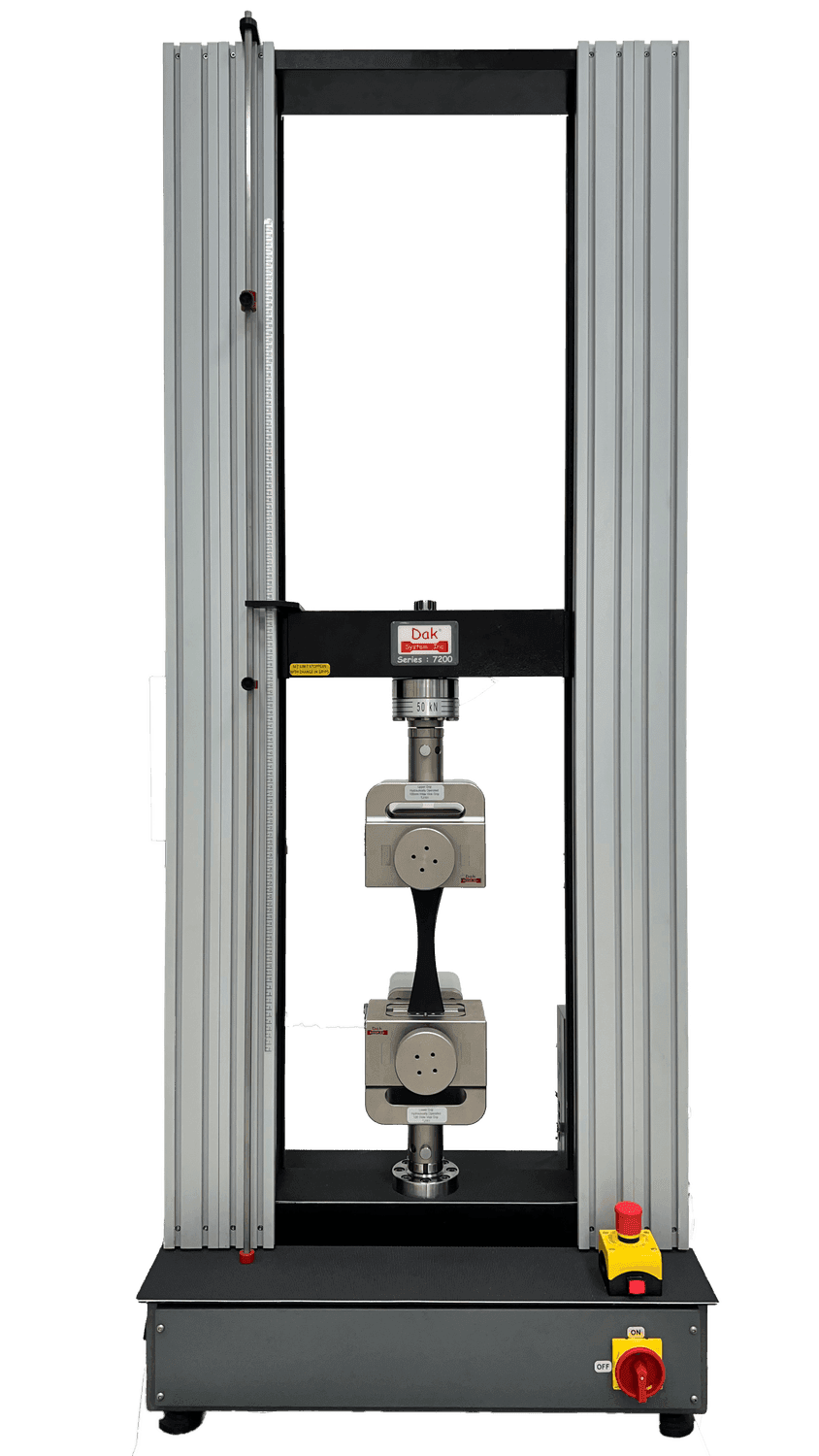 Universal Testing MachineSeries 7200Explore the machine →
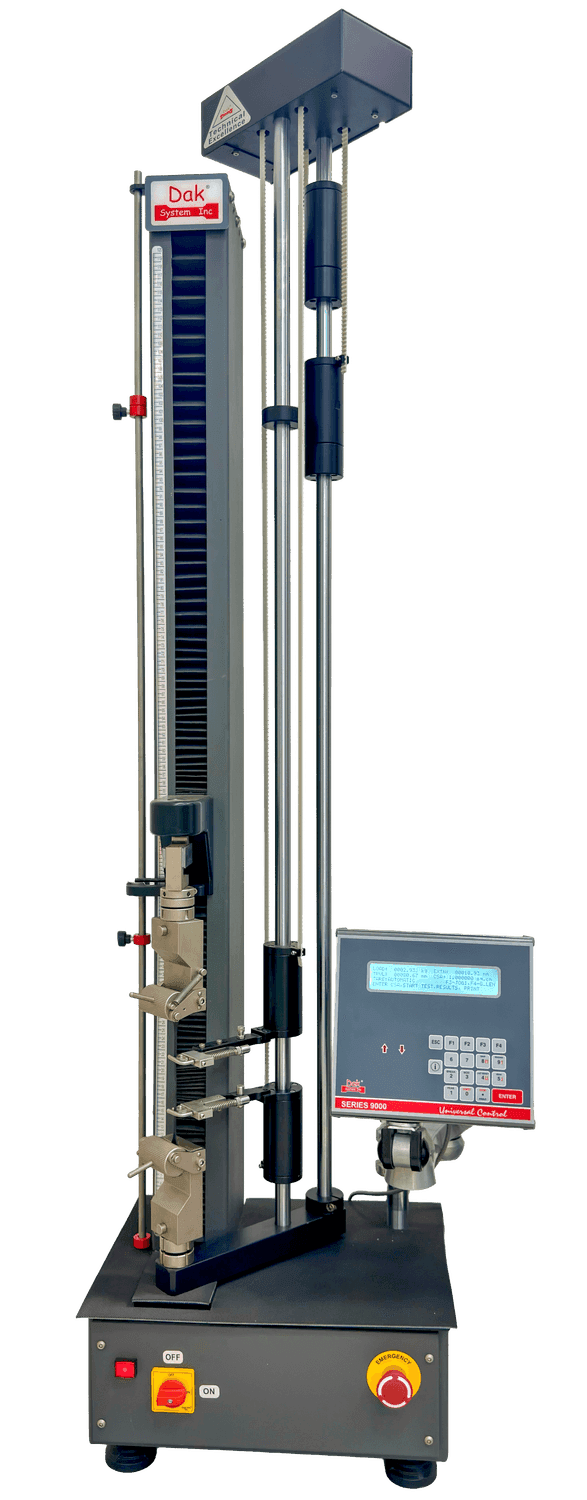 Universal Testing MachineSeries 9000Explore the machine →
Jump to a specific section
01Understand the method
What the test does
A rectangular test piece is conditioned, its thickness measured, and a slot of specified shape cut into it with a sharp die. The piece is then slipped over two upturned pins so that they protrude through the slot, and the pins are drawn apart at 100 mm/min. The leather tears from both ends of the slot at once, and the maximum force reached is reported as the tear load. Nothing is clamped: the load enters through the slot, so grip pressure is not a variable in this method at all.
What it measures, and why it matters
How readily a tear runs in leather once it has started — which is the failure that actually ends the life of most leather goods. A shoe upper, a bag or an upholstery panel rarely fails by being pulled apart in tension; it fails because a stitch hole, a fitting or a cut propagates. The double edge geometry exists because leather is a natural, variable material: a single tear front finds and follows the weakest path, so its result swings with wherever a soft spot sits, while two simultaneous fronts average that out and give a far more repeatable number.
02Prepare the specimen and test settings
Why two edges
The slot tears at both of its ends at once. Tearing on two fronts averages out the local variation that makes a single tear erratic in a natural material.
- Specimen
- Rectangular, with a slot of specified shape
- Loading
- Over two upturned pins that protrude through the slotNo clamping. The pins bear on the ends of the slot.
- Speed
- 100 mm/min grip separation
- Result
- The maximum force reached
- Applicability
- All types of leather
- Cut the slot cleanly, with a sharp die
- DakThe ends of the slot are the tear origins. A ragged end has already started the tear and the load reads low.
Double edge is not simply two single-edge tears. Because both ends of the slot propagate together, the result is far less sensitive to where a weak spot happens to sit than a single tear is — which is why it suits a natural, variable material.
Test speed
- Rate
- 100 mm/min
- Reported
- Maximum tear load
- Direction
- Recorded relative to the backboneTear load is directional in leather, as tensile strength is.
- Watch for the slot stretching rather than tearing
- DakOn a soft, stretchy leather the slot can elongate around the pins without a tear starting, which is not a tear load.
03Build the test setup on a DAK machine
What the machine must be capable of
Little force and a specific fixture. Double edge tear loads on leather commonly run from tens to a few hundred newtons, so the load cell is chosen for that rather than for the frame. The fixture is a pair of upturned pins sized to the slot, and what matters mechanically is that they stay parallel and draw apart squarely — if one pin leads, one end of the slot tears first and the double-edge averaging that justifies the method is lost.
Running ISO 3377-2 on the Series 7200 and Series 9000
Dak verifies against whichever standard the method names, and where a class applies our frames sit a class tighter than it asks.
| The method asks for | Dak supplies | |
|---|---|---|
| Capacity | Low — leather double edge tear loads are commonly tens to a few hundred newtons | Load cells from 1 kg to 60 ton on the Series 7200, and 0.5 to 100 kN on the Series 9000 |
| Force accuracy | Class 1 over the working range | ISO 7500-1 Class 0.5, verified to ASTM E4, DIN 51221 and BS 1610 |
| Gripping | Two upturned pins that pass through a slot cut in the specimen, held in the grips | Our a fixture built for this method, built to the specimen |
| Environment | 23 ± 2 °C standard laboratory atmosphere | 3009 series chambers, −150 °C to +400 °C — temperature only |
04Run the test
How the test runs
- Condition the leather in the specified atmosphere.
- Cut rectangular specimens in the required directions, recording their position in the hide.
- Measure and record the thickness.
- Cut the slot with a sharp die, in one clean pass.
- Fit the pin fixture to the machine.
- Slip the specimen over the pins so they protrude through the slot.
- Check the specimen sits square and both ends of the slot bear evenly.
- Separate at 100 mm/min.
- Record the maximum force.
- Confirm the failure was a tear and not the slot simply stretching.
- Report the load with the thickness and the direction.
05Calculate, report and interpret
Calculations
The maximum force recorded as the pins separate
A force, reported as such. It is not divided by thickness in this method, so thickness must be reported alongside if leathers of different substance are being compared.
Report thickness with the load
A thicker leather tears at a higher load for that reason alone. Without the thickness, two figures cannot be told apart.
What the report has to contain
- Reference to ISO 3377-2 and the edition
- Leather type, tannage and finish
- Position in the hide and direction of cutting
- Conditioning atmosphere
- Measured thickness
- Speed of grip separation
- Maximum tear load for each specimen
- Mean and variability
- Whether any specimen failed by slot elongation rather than tearing
- Number of specimens rejected and why
What goes wrong in practice
Reporting the load without the thickness, which makes it incomparable between leathers of different substance. Omitting which part of ISO 3377 was used, when Part 1 and Part 2 give different numbers on the same material. A ragged slot. And averaging in specimens where the slot simply elongated around the pins without a tear starting — that is not a tear load, and it usually says the material sits outside what the method discriminates well rather than that it is exceptionally tough. Uneven pin travel belongs on the same list: if one pin leads, one end of the slot tears first, and the test quietly becomes a single edge tear reported under a double edge designation.
06Compare methods and find answers
ISO 3377-2 or ISO 3377-1
| Part 2 — double edge | Part 1 — single edge | |
|---|---|---|
| Geometry | Slot over two pins | Trouser-style single tear |
| Tear fronts | Two, simultaneously | One |
| Sensitivity to local variation | Lower | Higher |
| Common name | Baumann tear | Single edge tear |
Two parts of the same standard measuring the same property by different geometries, and they do not give the same number. A specification names the part, and a report that omits it cannot be checked.
Questions we are asked about this test
What is ISO 3377-2?
It is the ISO double edge tear test for leather, widely known as the Baumann tear. A slot is cut in a rectangular test piece, the piece is slipped over two upturned pins so they protrude through the slot, and the pins are drawn apart at 100 mm/min until the leather tears. The maximum force is the tear load. The current edition is ISO 3377-2:2016.
Why is the specimen not clamped?
Because the load is meant to enter at the ends of the slot, not through a jaw face. Slipping the piece over two pins puts the force exactly where the tear is intended to start and nowhere else, which avoids the crushing and slippage that clamping a soft, unevenly thick material invites. It also means grip pressure is simply not a variable in this test.
What does double edge mean, and why does it help?
That both ends of the slot tear at the same time, so the specimen is propagating two tear fronts rather than one. In a natural, variable material that averaging matters: a single tear finds and follows the weakest path, so its result swings with wherever a soft spot happens to be. Two simultaneous fronts are far less sensitive to that, which is why the double edge method suits leather.
Does it give the same answer as Part 1?
No. ISO 3377-1 is the single edge tear, a trouser-style geometry with one tear front, and it produces a different number on the same leather. The two parts measure the same property by different means and are not interchangeable, so a specification names the part and a report that omits it cannot be checked against anything.
Why does the slot have to be cut cleanly?
Because the ends of the slot are where the tear starts. A ragged or repeatedly cut end has already broken fibres beyond the intended origin, so the tear begins from damage rather than from the defined geometry, and the load reads low. Cutting with a sharp die in a single pass removes what is otherwise a common source of low outliers.
What if the slot stretches instead of tearing?
Then there is no tear load to report. On a soft or stretchy leather the slot can elongate around the pins without a tear ever initiating, which looks like a test but is not one. It should be recorded as such rather than averaged in — and it usually indicates the material is outside what the method discriminates well, not that it is exceptionally tear-resistant.
Should the result be divided by thickness?
Not in this method — the tear load is reported as a force. That makes reporting the thickness alongside it essential, because a thicker leather tears at a higher load for that reason alone. Two tear loads without their thicknesses cannot be compared, and leather substance varies enough that the omission is not a small one.
Related
Materials tested to it
The test it standardises
Industries that test to it
Planning ISO 3377-2 testing?
Discuss your specimen, test requirements and reporting needs with DAK engineering.
This page describes the method as practised. The governing text is the current edition from the issuing body. Tell us what you are testing and we will answer with the machine, the fixture and a quotation.