Two face setsTJ-26
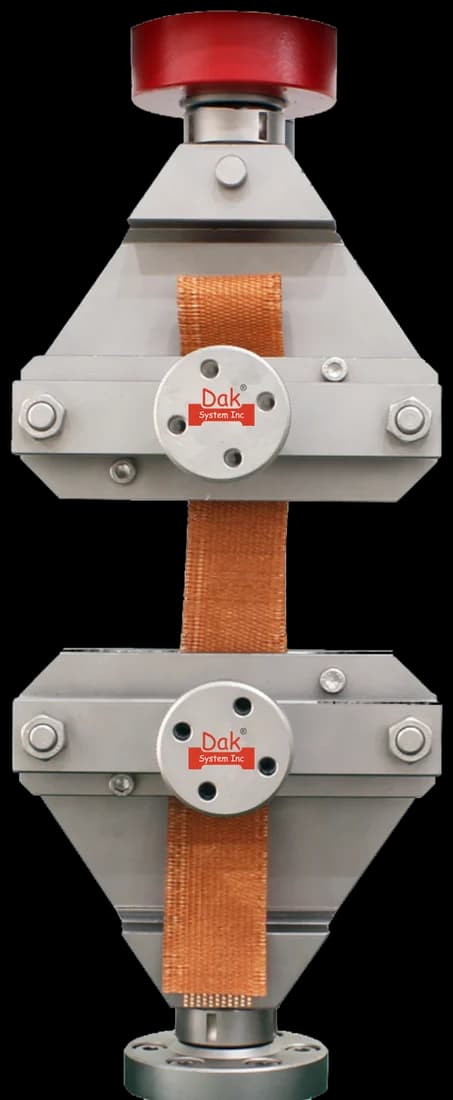
100mm Wide Vice Action Grips
Wide vice-action jaws hold the two sides of the cut across their full width. Rubber slips by creeping rather than jumping, so grip area matters more than clamping pressure alone.
Specifications
Testing standard
Conveyor belts — Method for the determination of the tear propagation resistance of textile conveyor belts
Written and technically reviewed by Dak System Inc. engineeringLast reviewed
ISO 505 cuts an initial tear in a textile conveyor belt and then measures the force needed to make that tear run, drawing the jaws apart at (50 ± 10) mm/min until it has propagated at least 100 mm. It is aimed squarely at longitudinal ripping — the failure that takes a whole belt out of service — and it is run either on the full belt thickness or on the carcass alone. The current edition is ISO 505:2025, superseding ISO 505:2017.
From the test method to your testing system
Explore the DAK machines already listed for ISO 505, then review the grips, measurement and setup requirements below.
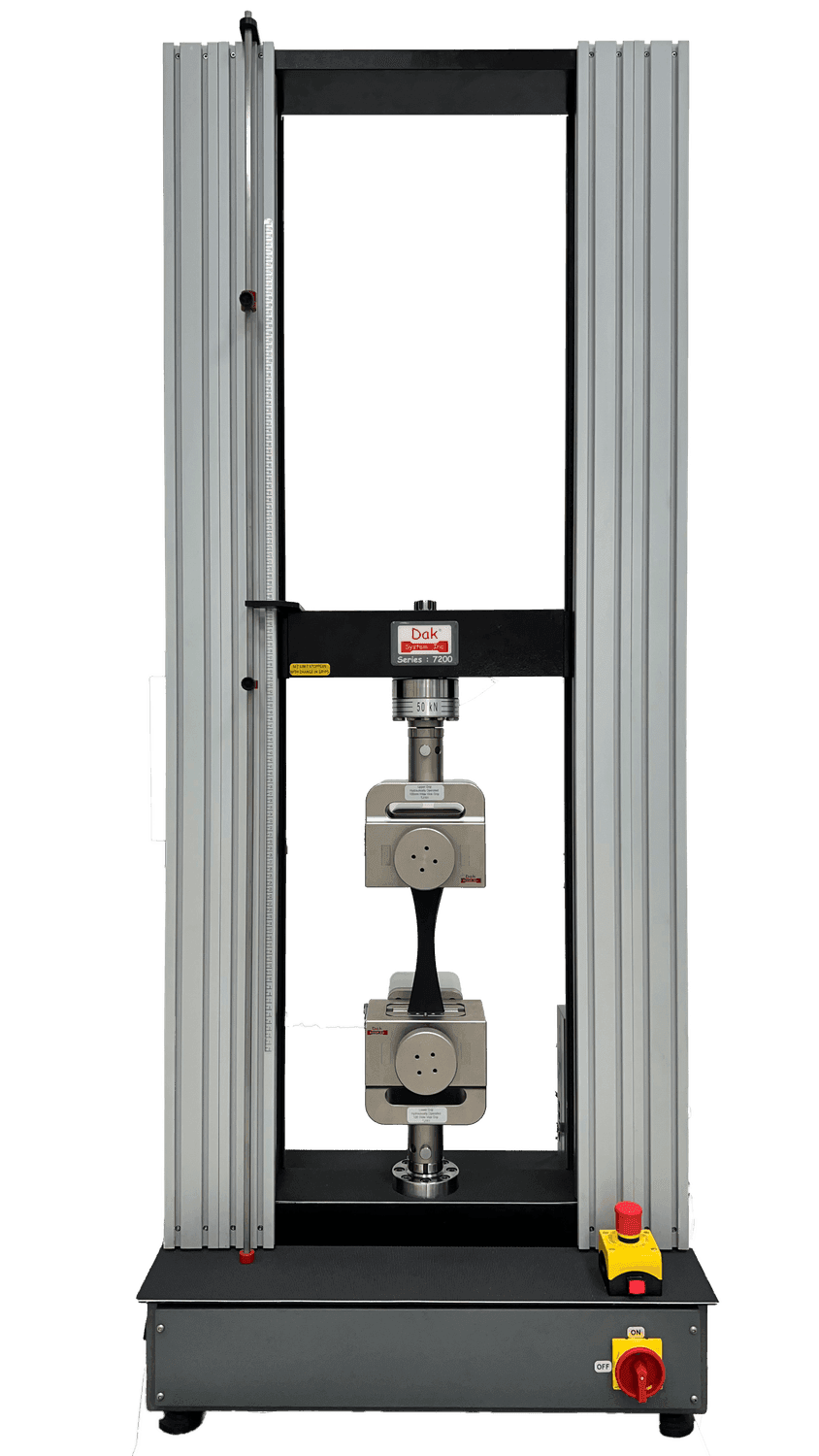 Universal Testing MachineSeries 7200Explore the machine →
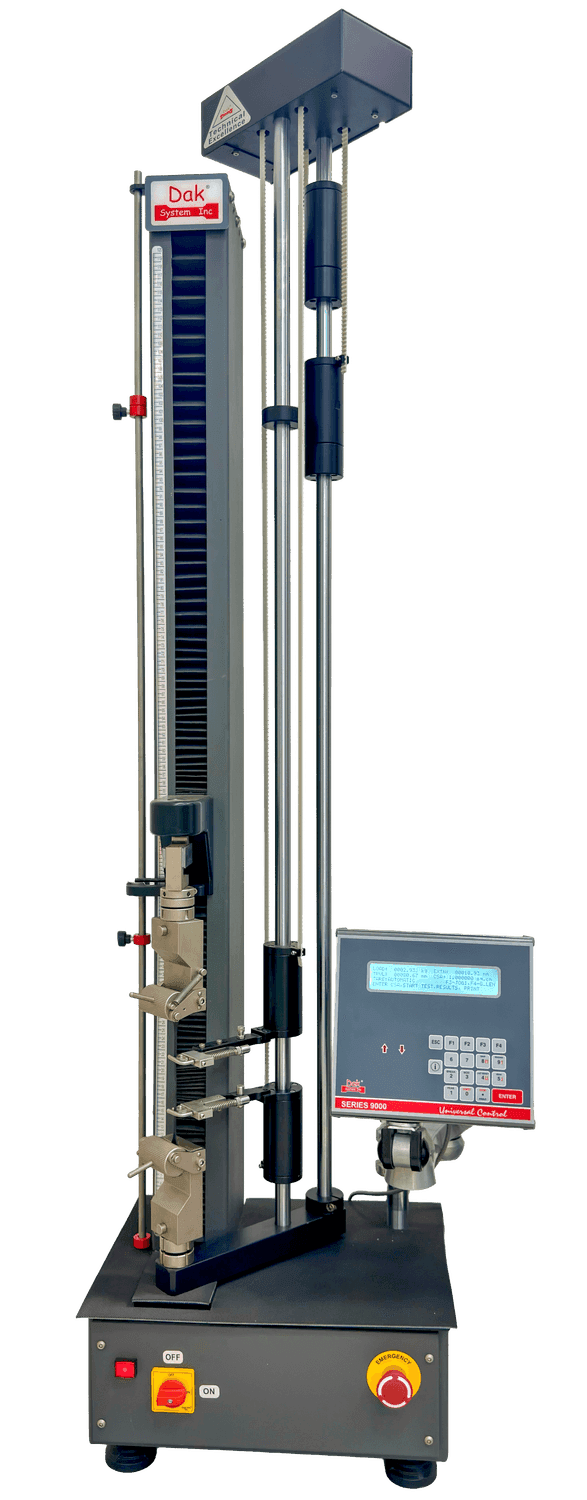 Universal Testing MachineSeries 9000Explore the machine →
01Understand the method
A test piece is cut from a textile conveyor belt and an initial tear made in it. The two sides of the cut are clamped and drawn apart at (50 ± 10) mm/min until the tear has run at least 100 mm. The force required to keep it running is what the method measures.
The test piece may be full thickness, covers included, or the carcass alone. The two variants answer different questions and are not interchangeable: full thickness tells you what the belt as built will do, carcass only isolates the fabric.
Longitudinal ripping is the most expensive single failure mode on a bulk-handling conveyor. A tramp iron bar, a broken idler or a sharp lump of ore punches through the belt, and belt tension then drives the tear along for tens or hundreds of metres. The belt is not repaired; it is replaced, and the plant stops while it happens.
The method is aimed squarely at that risk: its scope names installations where longitudinal tearing is a risk, and the number it produces selects a belt construction for a duty that makes ripping likely — a primary crusher discharge, a run-of-mine transfer, anywhere the material is sharp and large.
What it does not measure is puncture resistance. Making the initial tear is part of the method; whether the belt would have been torn in the first place is a separate question, and one this test deliberately sets aside.
02Prepare the specimen and test settings
Two decisions have to be recorded before anything is pulled: full thickness or carcass only, and which direction the specimen was cut in. Neither is recoverable afterwards.
The scope of the method is installations where there is a risk of longitudinal tearing. It measures how hard it is to keep a tear running — not how hard it is to start one. Puncture resistance is a separate property and this test says nothing about it.
03Build the test setup on a DAK machine
A crosshead that holds (50 ± 10) mm/min, a free distance between the jaws settable to at least 300 mm, and stroke enough to let the tear run its full 100 mm. Propagation forces on textile belting are modest but the travel is long: a 5 to 50 kN frame, a load cell sized for the specimen, continuous graphical recording, and force accuracy to ISO 7500-1 Class 1.
The method is explicit about capacity: the forces measured must fall in the upper 90 % of the machine's rated range — above a tenth of full scale. A cell chosen for the frame rather than the specimen turns a detailed trace into a flat line. Grips must hold a rubber-faced strip without slipping. No extensometer is needed: the reported quantity is a force.
Wide vice-action jaws hold the two sides of the cut across their full width. Rubber slips by creeping rather than jumping, so grip area matters more than clamping pressure alone.
SpecificationsA cell sized for the specimen. Tear propagation forces sit far below the belt rated strength, and a cell chosen for the frame flattens the trace the method depends on.
SpecificationsDak verifies against whichever standard the method names, and where a class applies our frames sit a class tighter than it asks.
| The method asks for | Dak supplies | |
|---|---|---|
| Capacity | Low to moderate — well below the rated tensile strength of the same belt | Load cells from 1 kg to 60 ton on the Series 7200, and 0.5 to 100 kN on the Series 9000 |
| Force accuracy | ISO 7500-1 Class 1 | ISO 7500-1 Class 0.5 — a class tighter than the method asks |
| Gripping | Vice-action grips holding the two sides of the initial cut | Our vice-action grips, built to the specimen |
| Environment | Standard atmosphere for conveyor belt testing | 3009 series chambers, −150 °C to +400 °C — temperature only |
04Run the test
05Calculate, report and interpret
The force required to keep the initial tear running
Reported as a force, with the variant and the specimen direction against it.
Belt tension drives a started tear along the belt
A tramp bar, a broken idler or a sharp lump starts it; the conveyor then does the rest, for tens or hundreds of metres. The belt is replaced, not repaired.
Covers contribute, and the two figures are not interchangeable
Quoting one against a specification written for the other is a common and expensive mismatch.
Slippage in the grips is the standard failure, and on rubber it shows as a creeping specimen rather than a sudden jump. Too short a propagation length gives a force averaged over too little tearing to mean anything. An initial cut made with a worn blade blunts the tip and inflates the result. And reporting a figure without saying whether it was full thickness or carcass only, and in which direction the specimen was cut, makes it uninterpretable later.
06Compare methods and find answers
| Tear propagation (ISO 505) | Full-thickness tensile (ISO 283) | Adhesion (ISO 252) | |
|---|---|---|---|
| Starts from | A cut already in the belt | An intact specimen | A separated interface |
| Failure driven by | Crack running under tension | Fibre breakage | Bond separation |
| Predicts | Longitudinal ripping | Rated belt strength | Delamination |
| Direction matters | Strongly | Yes | Less so |
| Force required | Low to moderate | High | Low |
A belt selected on rated strength alone can still be the wrong belt for a crusher discharge. Tear propagation is the property that governs whether a sharp lump costs a repair or a replacement.
ISO 505 is the international method for the tear propagation resistance of textile conveyor belts. An initial tear is cut into a specimen, the two sides of the cut are pulled apart at a specified speed, and the force required to make the tear run is recorded. The specimen may be full thickness or carcass only. The current edition is ISO 505:2025, superseding ISO 505:2017; the 1982 edition, titled for the carcass alone, is withdrawn.
Because longitudinal ripping is the most expensive single belt failure. A tramp bar, a broken idler or a sharp lump punches the belt, and belt tension then drives that tear along the belt for tens or hundreds of metres. The belt is not repaired, it is replaced, and the plant stops while that happens. The standard scope names installations where there is a risk of longitudinal tearing, which is exactly this case.
No, and the distinction matters. Making the initial tear is part of the specimen preparation, so the method deliberately sets aside the question of whether the belt would have been cut in the first place. It measures only how hard it is to keep a tear running once one exists. A belt can be hard to puncture and easy to rip, or the reverse.
Full thickness includes the covers and describes the belt as built; carcass only strips them away and isolates the fabric. Covers contribute real resistance, so the two figures differ and are not interchangeable. Quoting a carcass-only result against a specification written for full thickness, or the reverse, is a common mismatch and one that is invisible unless the report says which was run.
Because a woven carcass is strongly anisotropic. A tear running along the warp meets a different structure from one running across it, and the two forces can differ substantially. Specimens are normally taken in both directions, and a propagation force reported without its direction cannot be interpreted or compared afterwards.
A modest-capacity frame with a long stroke, continuous graphical recording, a crosshead that holds (50 ± 10) mm/min and a free distance between the jaws settable to at least 300 mm. Propagation forces are well below the belt rated strength, so 5 to 50 kN with a load cell sized for the specimen and force accuracy to ISO 7500-1 Class 1 is right. Travel is the constraint people miss: the tear has to run at least 100 mm, and a frame that runs out of stroke forces a restart in the middle of the record.
Across the width, and in both directions. Cover thickness and carcass construction are not uniform from edge to centre, and a set of specimens taken from one edge describes that edge rather than the belt. The same discipline applies to the other belting methods, and it is the difference between a result that represents production and one that represents a convenient offcut.
Discuss your specimen, test requirements and reporting needs with DAK engineering.
This page describes the method as practised. The governing text is the current edition from the issuing body. Tell us what you are testing and we will answer with the machine, the fixture and a quotation.