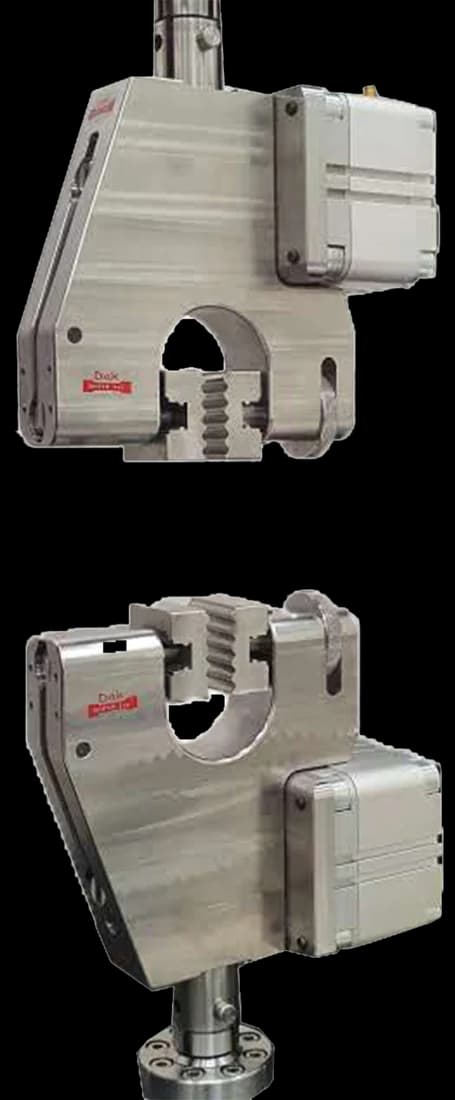
Standard 25 mm
Pneumatic Vice Action Grip
Pneumatic vice action grips clamp the full specimen width at a constant, even pressure — which is what stops one side slipping or tearing before the other.
Specifications
Testing standard
Flexible cellular polymeric materials — Determination of tear strength
Written and technically reviewed by Dak System Inc. engineeringLast reviewed
ISO 8067 specifies two methods for the tear strength of flexible cellular polymeric materials: method A using a trouser test piece, and method B using an angle test piece without a nick. The absence of a nick in method B is the substantive difference.
From the test method to your testing system
Explore the DAK machines already listed for ISO 8067, then review the grips, measurement and setup requirements below.
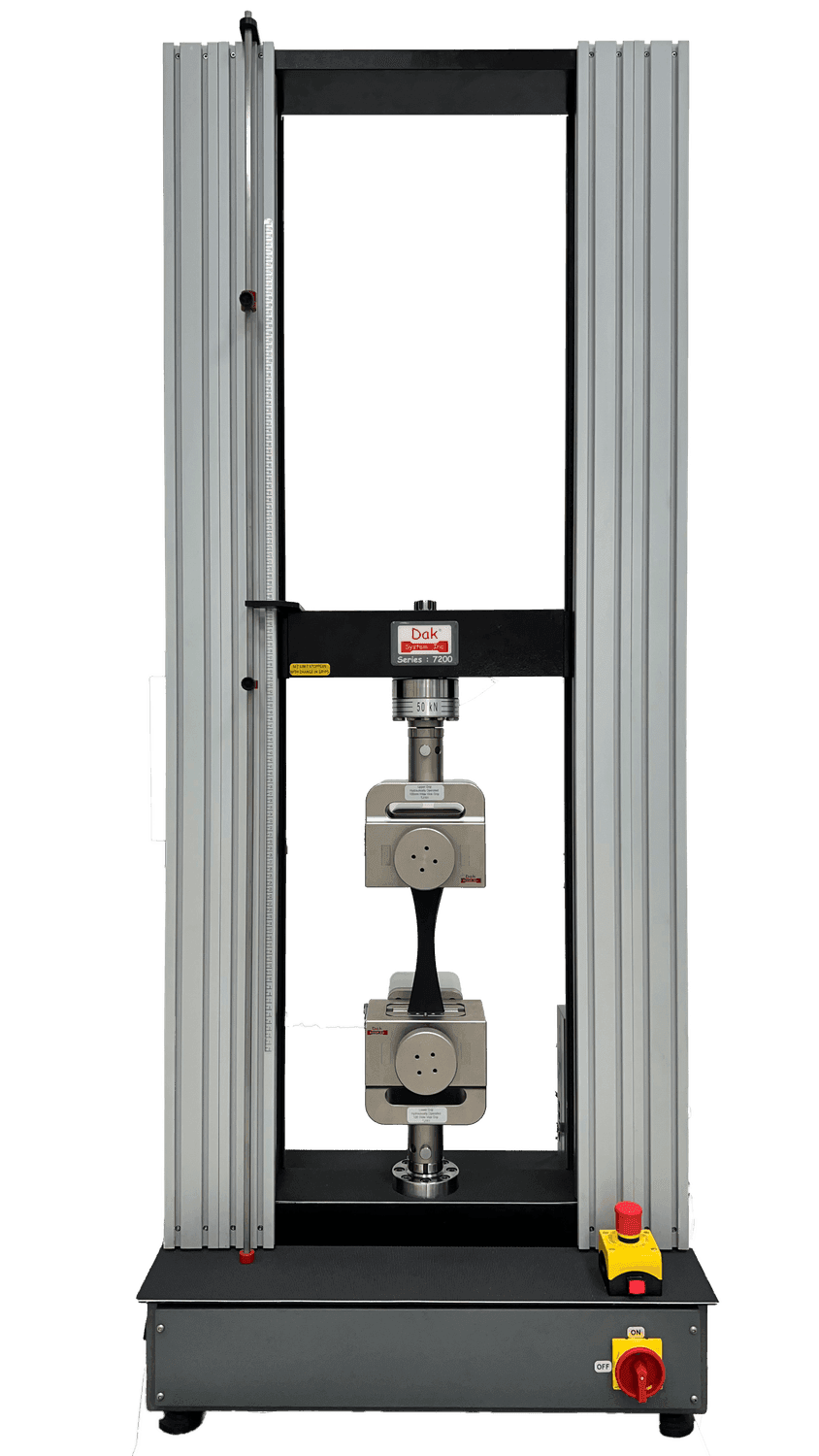 Universal Testing MachineSeries 7200Explore the machine →
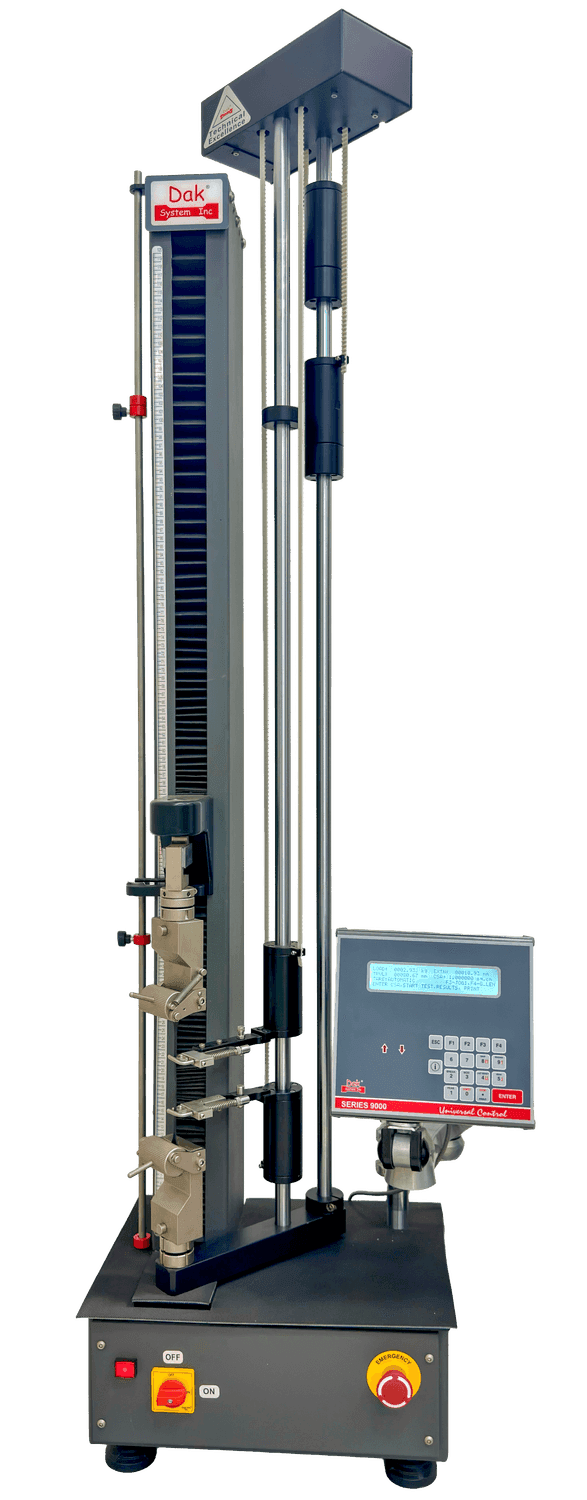 Universal Testing MachineSeries 9000Explore the machine →
01Understand the method
A conditioned foam specimen is cut with a sharp die into one of two shapes and pulled apart at a set jaw speed. The method permits any jaw speed from 50 mm/min to 500 mm/min (2.0 to 20 in./min), and then fixes the figure for referee purposes: 50 ± 5 mm/min (2.0 ± 0.2 in./min) for method A and 500 ± 50 mm/min (20 ± 2 in./min) for method B. The two are an order of magnitude apart because they are asking different questions, so the speed is not interchangeable between them and a governing material specification may name a different figure again. Method A uses a trouser test piece, whose two legs are gripped and separated. Method B uses an angle test piece with no nick, so the tear must start at the apex of the angle rather than from a prepared cut. The force is averaged according to the method's rule and divided by the specimen thickness, which is measured under a defined light load because foam compresses under any gauge.
How readily a foam tears — and, depending on the method chosen, whether that is about starting a tear or continuing one. The missing nick in method B is the substantive difference between them, and it is a real distinction rather than a procedural one: initiation and propagation are separate properties in a cellular material, and a foam can resist one while being poor at the other. A cushion that must survive a snag is asking about propagation; one that must resist being torn at all in handling is asking about initiation.
02Prepare the specimen and test settings
A trouser piece has the tear already started. An unnicked angle piece has to start it, which is a different property.
Method B's missing nick is the whole distinction. Initiation and propagation are separate properties in a cellular material, and a foam can resist one while being poor at the other.
03Build the test setup on a DAK machine
Very small forces, measured traceably — foam tear forces are commonly a few newtons, well below the range a frame's own load cell describes accurately. Grips must hold without crushing, which on a light open-cell foam means very little pressure indeed, less than feels reassuring: an over-tightened jaw creates a dense, stiff band along the clamp line and the tear runs to that band instead of through representative material. Long, steady travel is needed, as with any tear test.
Pneumatic vice action grips clamp the full specimen width at a constant, even pressure — which is what stops one side slipping or tearing before the other.
SpecificationsDak verifies against whichever standard the method names, and where a class applies our frames sit a class tighter than it asks.
| The method asks for | Dak supplies | |
|---|---|---|
| Capacity | Very low — foam tear forces are commonly a few newtons | Load cells from 1 kg to 60 ton on the Series 7200, and 0.5 to 100 kN on the Series 9000 |
| Force accuracy | Verified at the actual tear force, which is a very small fraction of most frames | ISO 7500-1 Class 0.5, verified to ASTM E4, DIN 51221 and BS 1610 |
| Gripping | Grips holding the two legs of a trouser piece, or the two ends of an angle piece | Wedge, vice-action, pneumatic and hydraulic grips, built to the specimen |
| Environment | 23 ± 2 °C standard laboratory atmosphere | 3009 series chambers, −150 °C to +400 °C — temperature only |
04Run the test
05Calculate, report and interpret
Force divided by the specimen thickness
Normalised by thickness, so the thickness measurement carries directly into the result — and foam thickness is measured under a defined light load because the material compresses.
No nick means initiation is included
Method A measures how easily an existing tear runs; method B measures how easily one starts and then runs. The two rank foams differently.
Reporting a value without the method letter, when A and B measure different properties and rank foams differently. Over-tightened grips crushing the cells. A blunt die. Measuring thickness by squeezing the foam, which shortens the divisor and inflates the tear strength. And reading a single peak off a trace that is jagged by nature — the tear advances cell wall by cell wall, which is exactly why the method specifies an averaging rule rather than leaving the reading to judgement.
06Compare methods and find answers
| Method A — trouser | Method B — angle, no nick | |
|---|---|---|
| Tear exists at the start | Yes | No |
| Measures | Propagation | Initiation and propagation together |
| Comparable with each other | No | No |
| Both report | Force per unit thickness | Force per unit thickness |
Choosing between them is choosing which question to ask. A cushion that must not tear once snagged wants method A; one that must resist being torn at all wants method B.
It is the ISO tear strength method for flexible cellular polymeric materials — foams used in upholstery, mattresses, packaging and vehicle seating. It specifies two methods: method A with a trouser test piece, and method B with an angle test piece that has no nick. The current edition is ISO 8067:2018, with a revision in the approval phase.
So that the specimen has to start its own tear. A trouser piece arrives with the tear already made, so it measures only how easily an existing one propagates. An unnicked angle piece concentrates stress at the apex and the foam must initiate a tear there before anything can run. Initiation and propagation are separate properties in a cellular material, and a foam can be good at resisting one and poor at the other.
Whichever the specification names, and the choice is a real one rather than a formality. A cushion that must survive being snagged is asking about propagation, which is method A. A foam that must resist being torn at all in handling is asking about initiation, which method B includes. The two rank materials differently, so a value reported without its method letter cannot be interpreted.
Because foam is compressible in a way solid rubber is not. A jaw tightened as it would be for a solid crushes the cells along the clamp line, creating a dense, stiff band, and the tear then runs to that band rather than through representative material. The pressure has to be just enough to hold — which on a light, open-cell foam is very little indeed.
To make foams of different thickness comparable, in the same way film tear is normalised. It means the thickness measurement carries directly into the answer, and foam thickness is not a simple measurement: the material compresses under any gauge, so it is measured under a defined light load rather than by closing callipers on it.
Because a tear in foam advances from cell wall to cell wall rather than through a continuous solid. Each wall resists and then ruptures, so the record is jagged by nature rather than by fault. That is why the method specifies how to average it — reading a single peak from such a trace would report whichever cell wall happened to be strongest.
Because almost every mechanical property of a foam tracks its density closely, tear strength included. Two samples of the same chemistry at different densities are effectively different materials, so a tear result without a density is hard to compare with anything and impossible to use in selecting a grade.
Discuss your specimen, test requirements and reporting needs with DAK engineering.
This page describes the method as practised. The governing text is the current edition from the issuing body. Tell us what you are testing and we will answer with the machine, the fixture and a quotation.