Written and technically reviewed by Dak System Inc. engineering·Last reviewed
ISO 6872 is the international specification for dental ceramic materials. It divides ceramics into five classes by intended clinical use and sets each class a minimum flexural strength, from 50 MPa for a single-unit anterior veneer to 800 MPa for prostheses of four or more units, together with chemical solubility limits. Strength may be measured by three-point bending, four-point bending or a biaxial piston-on-three-ball test, and the standard also fixes limits for radioactivity, thermal expansion, glass transition temperature and sintering shrinkage.
ISO 6872 is a product specification with test methods bound into it, not a pure test method. It sets what a dental ceramic must achieve — flexural strength, chemical solubility, thermal expansion, glass transition temperature and radioactivity — and supplies the procedures for measuring them. Flexural strength decides where a ceramic may be used, and there are three ways to measure it: three-point bending, four-point bending, and a biaxial piston-on-three-ball test on a disc. Materials are designated Type I, supplied as powders, pastes or aerosols, or Type II, every other form.
What it measures, and why it matters
The class table is what makes this standard unusual. Ceramics are divided into five classes by intended clinical use, each with a minimum flexural strength and a solubility limit. A ceramic is not simply strong or weak; it is qualified for single-unit anterior work, or for three-unit prostheses involving a molar, or for four units and more, and the minimum rises from 50 to 800 MPa.
Two details are easy to miss. The strength requirement is a minimum value for the mean, so it belongs to the set of specimens rather than to every one. And the solubility limit splits by sub-class: a monolithic ceramic is held under 100 µg/cm², while a covered substructure in classes 2, 3 and 4 is allowed under 2000, because it is not exposed in service.
Beyond strength, the specification caps activity concentration at 1.0 Bq/g of uranium-238, requires the thermal expansion coefficient within 0.5 × 10⁻⁶ K⁻¹ of the manufacturer's stated value and the glass transition temperature within 20 °C of it, and fixes the sintering shrinkage factor to ±0.002.
Specimen and sampling
Dental bend bars and discs are around a millimetre thick, which puts edge preparation among the leading sources of scatter — a point the committee itself acted on.
Uniaxial specimen
Bend barDimensions are in clause 7.3, which is not published openly, and are not reproduced here.
Biaxial specimen
Disc, loaded through a piston onto three ballsDisc diameter, thickness, ball diameter and support circle are all in clause 7.3. The published literature quotes disc diameters of 12, 14 and 15 mm and ball diameters from 3 to 4.5 mm — read yours from the standard.
Chamfer on thin bars
Reduced maximum, specifically for thin specimensA change made at the 2015 revision. On a bar this thin the chamfer is a meaningful fraction of the section.
Grinding direction
Grind lengthwiseAdded to the bar preparation clause at the 2015 revision.
Type I sampling
Retail packages from the same batch, all of one lotEnough material for the specified tests plus an allowance for repeats.
Shade
Test the shade most commonly usedWhere a class of ceramic is supplied in more than one shade.
Measure every specimen before test
Thickness especiallyDakThickness enters the strength calculation squared, so a 5 % thickness error is a 10 % strength error. On a 1.2 mm disc that is 60 µm.
Test rate
The crosshead rate is in clause 7.3 and clause 7.3 is paywalled. No figure is published here, and the reason is worth stating.
Crosshead rate
Not published hereRates of 0.5 mm/min and 1 mm/min both appear in peer-reviewed dental papers describing ISO 6872 biaxial testing. They cannot both be the standard's figure, so neither is reproduced. Read it from a purchased copy.
What governs
ISO 6872 clause 7.3
Why it matters here
Ceramic strength is rate-sensitive through slow crack growthPracticeA faster test gives a higher strength on the same material, which is why the standard fixes the rate rather than leaving it open.
Calculations
The uniaxial relationships are the ordinary ones. The biaxial expression is deliberately NOT reproduced — see the caution on the page.
Flexural strength, three-pointσ
σ = 3PL / (2bd²)
P
fracture load, N
L
span between supports, mm
b
specimen width, mm
d
specimen thickness, mm
Thickness enters squared, so thickness measurement dominates the uncertainty on a 1 mm bar.
Biaxial flexural strengthσmax
Take the expression from the standard, not from a paper
—
the constant and the grouping of the geometric terms both vary between published papers
Two different constants for the piston-on-three-ball expression are in print in peer-reviewed dental journals, about 19 % apart, along with differing groupings of the terms. Clause 7.3 is paywalled and neither constant is reproduced here, because publishing the wrong one would be worse than publishing none.
Weibull modulusm
fitted to the strength distribution
σ₀
characteristic strength — the value at which cumulative failure probability reaches 63.2 %
Weibull statistics sit in an INFORMATIVE annex of the 2015 edition, so they were guidance rather than a requirement there. Whether the 2024 edition makes them normative was not confirmed.
How acceptance runs
01Establish which of the five classes the product is being sold into — that sets the strength minimum and the solubility limit.
02Take material from one batch and one lot, in the shade most commonly used.
03Prepare bend bars or discs to the clause 7.3 geometry, grinding lengthwise and observing the reduced chamfer limit for thin specimens.
04Measure each specimen, thickness above all.
05Run three-point, four-point or biaxial piston-on-three-ball flexure at the clause 7.3 rate.
06Calculate strength using the expression in the standard.
07Compare the MEAN of the set against the class minimum, not each specimen individually.
08Run chemical solubility in 100 ml of 4 percent analytical grade acetic acid in grade 3 water to ISO 3696.
09Check the coefficient of thermal expansion against the manufacturer's stated value, and the glass transition temperature likewise.
10Check the activity concentration of uranium-238.
The flexural strength requirement is written as a minimum value for the mean. A set whose mean clears the class minimum conforms even if individual specimens fall below it — and conversely, a single strong specimen proves nothing.
Grips and fixtures for this method
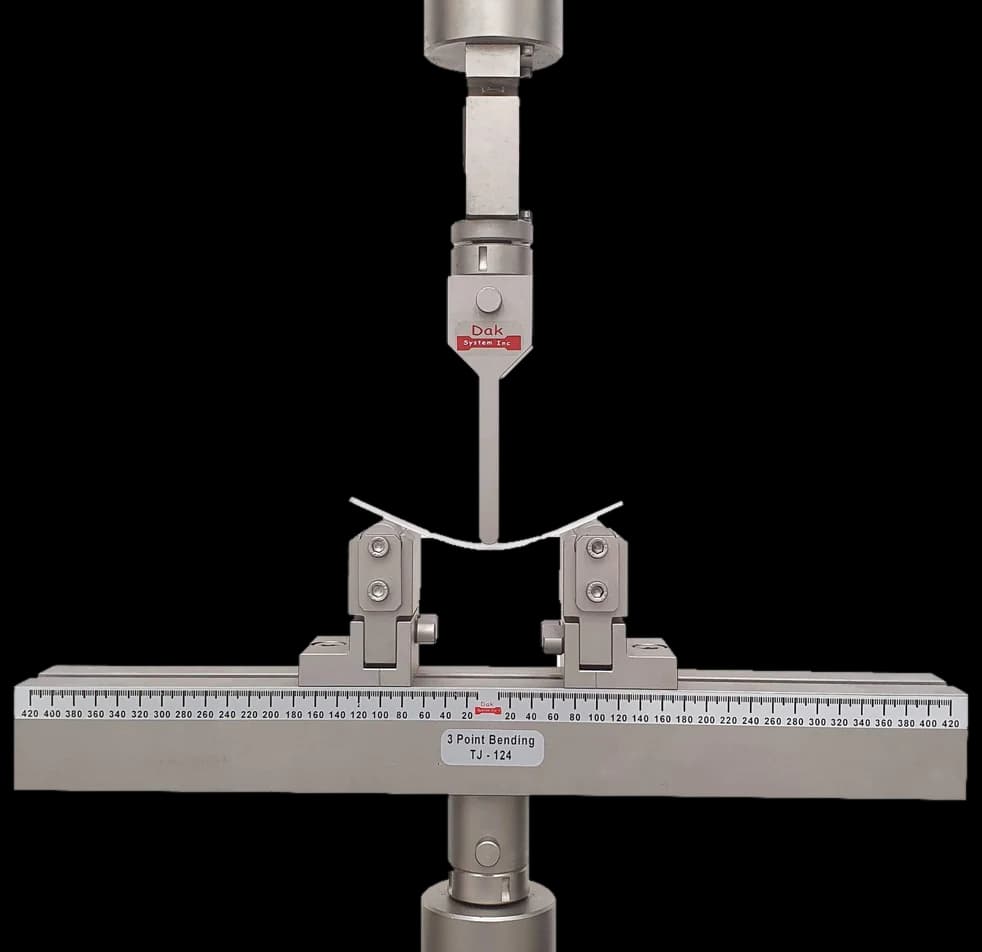
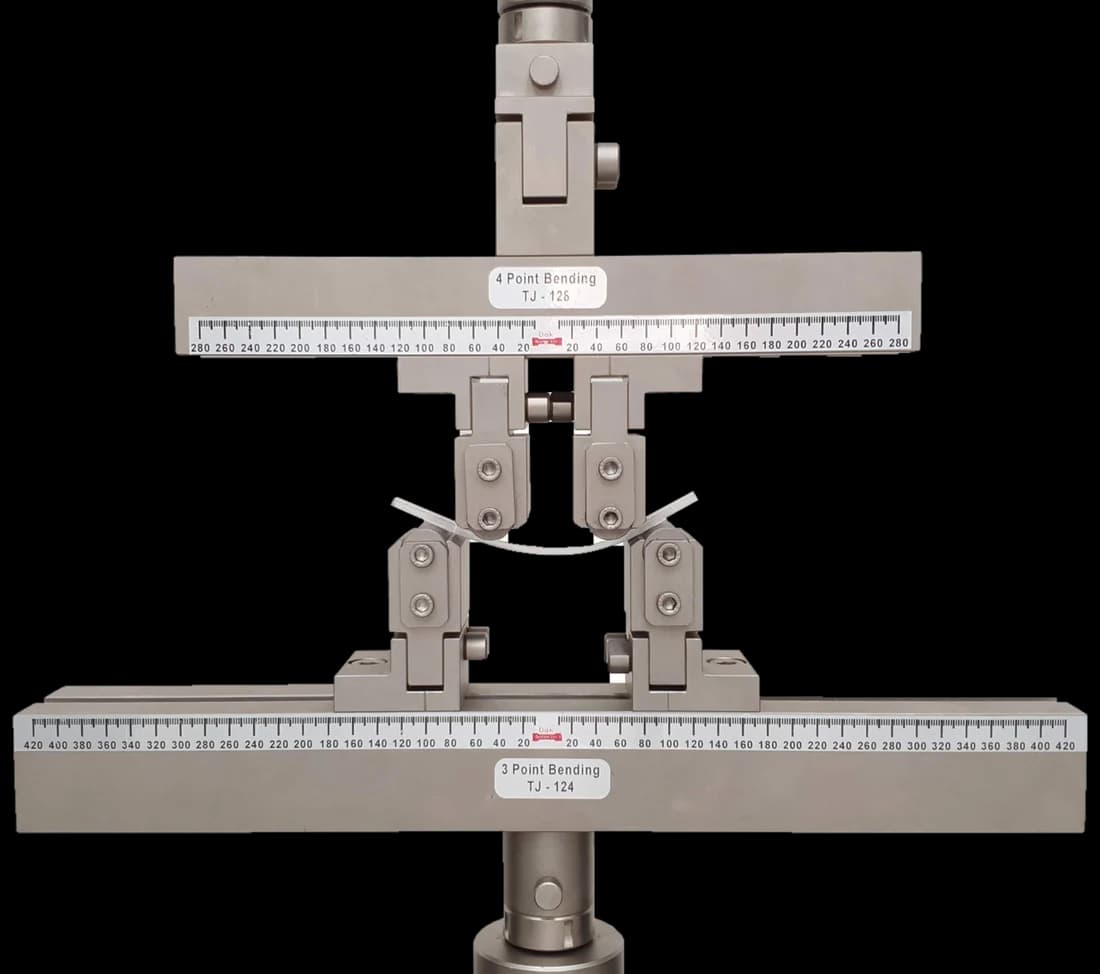
Adjustable spanTJ-124
Three Point Bend Fixture
Three-point flexure on a bend bar is one of the three strength routes ISO 6872 allows. The span sits in clause 7.3 and is not reproduced here, so the fixture must be set from your own copy rather than from a default.
Four-point loading puts a length of the bar under constant moment rather than concentrating it under one nose, which samples more of the surface and usually returns a lower, more conservative strength than three-point on the same material.
Flexure method used: three-point, four-point or biaxial
Specimen geometry and measured dimensions
Crosshead rate
Individual strengths and the mean of the set
Weibull modulus and characteristic strength where determined
Chemical solubility in µg/cm²
Coefficient of thermal expansion and glass transition temperature against the manufacturer's stated values
Activity concentration of uranium-238
Sintering shrinkage factor and its accuracy
What the machine must be capable of
ISO 6872 does not list ISO 7500-1 among its normative references, so it states no force accuracy class and none should be assumed.
What the test demands instead is resolution at the bottom of the range. A disc about 1.2 mm thick fails at loads in the tens to low hundreds of newtons, so the useful instrument is a low-capacity, high-resolution load cell rather than a large frame run near its floor.
Crosshead speed likewise sits in clause 7.3. Speeds of 0.5 and 1 mm/min both appear in the literature for the biaxial test and cannot both be the standard's figure, so no rate is published here.
Chemical solubility uses 100 ml of analytical grade 4 percent acetic acid in grade 3 water to ISO 3696 — the one numeric condition Amendment 1:2018 restated.
What goes wrong in practice
The biaxial formula is the trap worth naming. Two different constants for the piston-on-three-ball expression are in print in peer-reviewed dental journals, differing by about nineteen percent, along with differing groupings of the geometric terms. A laboratory that lifts the formula from a paper rather than the standard can be a fifth out on every strength it reports, and nothing in its own data will reveal it.
Specimen edges are the second recurring problem, and the committee's own chamfer and grinding revisions are the evidence for it.
The third is fracture toughness, which in the 2015 edition sits in an informative annex rather than the class table — and that annex records that the notched-beam method cannot be applied to 3Y-TZP, because the notch cannot be made sharp enough with a razor blade.
The five classes
Table 1, read from ISO 6872:2015 and independently corroborated by US FDA guidance on dental ceramics. The 2024 Table 1 could not be seen; its foreword lists only the addition of Annex C, which suggests no change, but that is not confirmation.
Class
Intended clinical use
Flexural strength, min for the mean (MPa)
Chemical solubility (µg/cm²)
1 a
Monolithic ceramic for single-unit anterior prostheses, veneers, inlays or onlays, adhesively cemented
50
<100
1 b
Ceramic for coverage of a metal framework or a ceramic substructure
50
<100
2 a
Monolithic ceramic for single-unit anterior or posterior prostheses, adhesively cemented
100
<100
2 b
Partially or fully covered substructure for single-unit anterior or posterior prostheses, adhesively cemented
100
<2000
3 a
Monolithic ceramic for single units and three-unit prostheses not involving a molar
300
<100
3 b
Partially or fully covered substructure for the same
300
<2000
4 a
Monolithic ceramic for three-unit prostheses involving molar restoration
500
<100
4 b
Partially or fully covered substructure for the same
500
<2000
5
Monolithic ceramic or fully covered substructure for prostheses of four or more units
800
<100
The solubility limit is twenty times looser for a covered substructure than for a monolithic ceramic in classes 2, 3 and 4, because a substructure is not exposed in service. Reading the 2000 figure across to a monolithic material would pass a ceramic that should fail. Fracture toughness criteria circulate attributed to ISO 6872, but in the 2015 edition toughness sits in an informative annex and not in this table — check the current text before treating any toughness figure as a pass criterion.
Other requirements ISO 6872 sets
Property
Requirement
Radioactivity
Not more than 1.0 Bq/g of uranium-238
Coefficient of thermal expansion
Within 0.5 × 10⁻⁶ K⁻¹ of the manufacturer's stated value
Glass transition temperature
Within 20 °C of the manufacturer's stated value
Sintering shrinkage factor
Absolute accuracy ±0.002
Chemical solubility reagent
100 ml of 4 % (V/V) analytical grade acetic acid in grade 3 water to ISO 3696
The thermal expansion and glass transition requirements are tolerances against what the manufacturer declares, not absolute values. A product with an unusual expansion coefficient conforms provided it matches its own declaration.
ISO 6872, ASTM C1161 and ASTM C1499
ISO 6872
ASTM C1161
ASTM C1499
What it is
Product specification with methods
Test method
Test method
Property minima
Yes, by clinical class
None
None
Geometry
Bend bars and discs, about 1 mm thick
Bars typically 3 × 4 × 45–50 mm
Discs or plates
Biaxial loading
Piston on three balls
—
Concentric ring on ring
Covers solubility, expansion, Tg
Yes
No
No
The biaxial pair is the one to be careful with. Piston-on-three-ball and ring-on-ring produce different stress fields and have different closed-form solutions, so an ISO 6872 result and a C1499 result are not interchangeable even on the same material. C1499 also explicitly accommodates as-fired specimens with limited warpage, which three-ball supports handle differently.
Questions we are asked about this test
What is ISO 6872?+
It is the international standard for dental ceramic materials, currently ISO 6872:2024 and adopted identically in Europe as EN ISO 6872:2024. It is a specification rather than a pure test method: it classifies ceramics by intended clinical use, sets each class a minimum flexural strength and a chemical solubility limit, and supplies the procedures for measuring those and several other properties.
What are the ISO 6872 classes?+
Five, by intended clinical use, with the flexural strength minimum rising with the demand: 50 MPa for class 1, covering single-unit anterior prostheses, veneers, inlays, onlays and coverage of a framework; 100 MPa for class 2, single-unit anterior or posterior; 300 MPa for class 3, single units and three-unit prostheses not involving a molar; 500 MPa for class 4, three-unit prostheses involving a molar; and 800 MPa for class 5, prostheses of four or more units.
Does every specimen have to meet the class strength?+
No. The requirement is written as a minimum value for the mean, so it applies to the set of specimens rather than to each one. A set whose mean clears the minimum conforms even where individual specimens fall below it. It also means a single strong result proves nothing on its own.
Which flexure method should I use?+
ISO 6872 allows three — three-point bending, four-point bending and a biaxial piston-on-three-ball test on a disc. The biaxial method is widely used for dental ceramics because it loads a central area rather than an edge, so it is less sensitive to the edge finish of a very thin specimen. Four-point puts a length of bar under constant moment and usually returns a lower, more conservative figure than three-point on the same material.
What is the biaxial flexural strength formula in ISO 6872?+
It is in clause 7.3, which is not published openly, and it is not reproduced here for a specific reason: two different constants for the piston-on-three-ball expression are in print in peer-reviewed dental journals, differing by about nineteen percent, along with differing groupings of the geometric terms. A laboratory that takes the formula from a paper rather than from the standard can be a fifth out on every result it reports, with nothing in its own data to reveal it. Take the expression from your purchased copy.
What specimen dimensions does ISO 6872 use?+
They are in clause 7.3 and are not published openly. We do not reproduce them, because the secondary literature disagrees: disc diameters of 12, 14 and 15 mm and ball diameters between 3 and 4.5 mm all appear in peer-reviewed papers describing ISO 6872 testing. Several sources agreeing with one another is not the same as one source that is the standard.
Is Weibull analysis required by ISO 6872?+
In the 2015 edition it sat in Annex B, marked informative, which makes it guidance rather than a requirement. Whether the 2024 edition changes that was not confirmed. What laboratories routinely report under it is the Weibull modulus and the characteristic strength, the latter being the strength at which cumulative failure probability reaches 63.2 percent. ISO 20501 covers Weibull statistics for strength data and appears in the ISO 6872 bibliography.
What force capacity do I need for ISO 6872?+
Far less than people expect, and resolution matters much more than capacity. A dental ceramic disc about 1.2 mm thick fails at loads in the tens to low hundreds of newtons, so the right instrument is a low-capacity, high-resolution load cell rather than a large frame working near the bottom of its range. The standard specifies no capacity, and it does not carry ISO 7500-1 as a normative reference, so it states no force accuracy class either.
Is ISO 6872:2024 the final word?+
It is the current published edition, but not a settled one. Its ISO catalogue stage already reads "International Standard to be revised" and a committee draft, ISO/CD 6872, is in development. The 2024 edition itself added Annex C on the hydrothermal stability of Y-TZP. Anyone building a long-lived procedure around it should expect to revisit it.
Related and equivalent standards
EN ISO 6872:2024 is the identical European adoption. ASTM C1161 measures flexural strength of advanced ceramics on much larger bend bars, with no material classification and no property minima — a method where ISO 6872 is a specification. ASTM C1499 is the American equibiaxial method but loads ring-on-ring rather than piston-on-three-ball, a different stress field with a different closed-form solution, so the two are not interchangeable. ISO 23146 is the notched-beam fracture toughness method ISO 6872 cites; ISO 20501 covers Weibull statistics.
Dak verifies against whichever standard the method names, and where a class applies our frames sit a class tighter than it asks.
The method asks for
Dak supplies
Capacity
Low. A dental ceramic disc about 1.2 mm thick fails at loads in the tens to low hundreds of newtons, so resolution matters far more than capacity. The standard specifies no capacity.
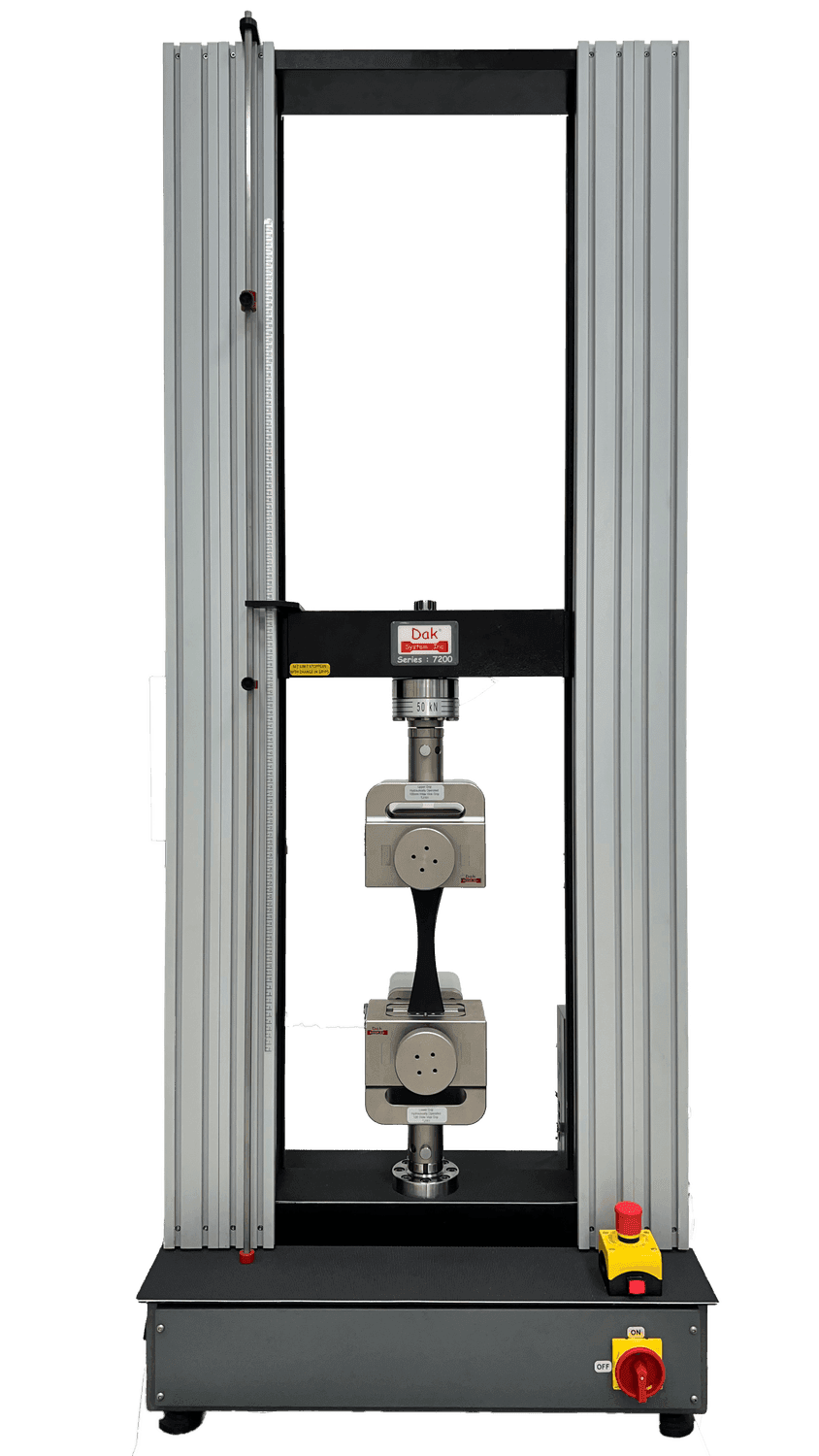
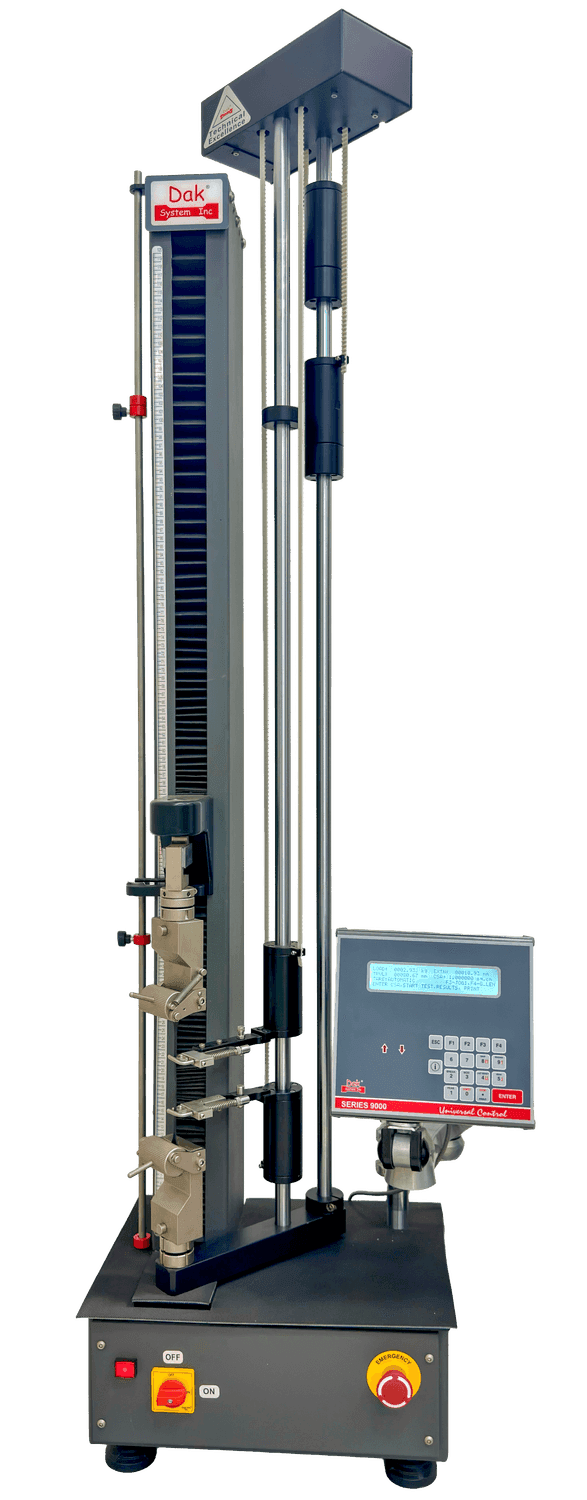
Load cells from 1 kg to 60 ton on the Series 7200, and 0.5 to 100 kN on the Series 9000
Force accuracy
none stated — ISO 6872 does not carry ISO 7500-1 as a normative reference and no accuracy class should be assumed for it
ISO 7500-1 Class 0.5 — the method sets no class of its own
Gripping
Three-point and four-point bend fixtures for bars, and a piston-on-three-ball rig for discs. The geometry of each sits in clause 7.3, which is not published openly, and no dimension is reproduced.
Chemical solubility uses 100 ml of analytical grade 4 percent acetic acid in water of grade 3 to ISO 3696, in Pyrex glass or plastic bottles. The bath temperature and duration were not confirmed and no figure is given.
This page describes the method as practised. The governing text is the current edition from the issuing body. Tell us what you are testing and we will answer with the machine, the fixture and a quotation.