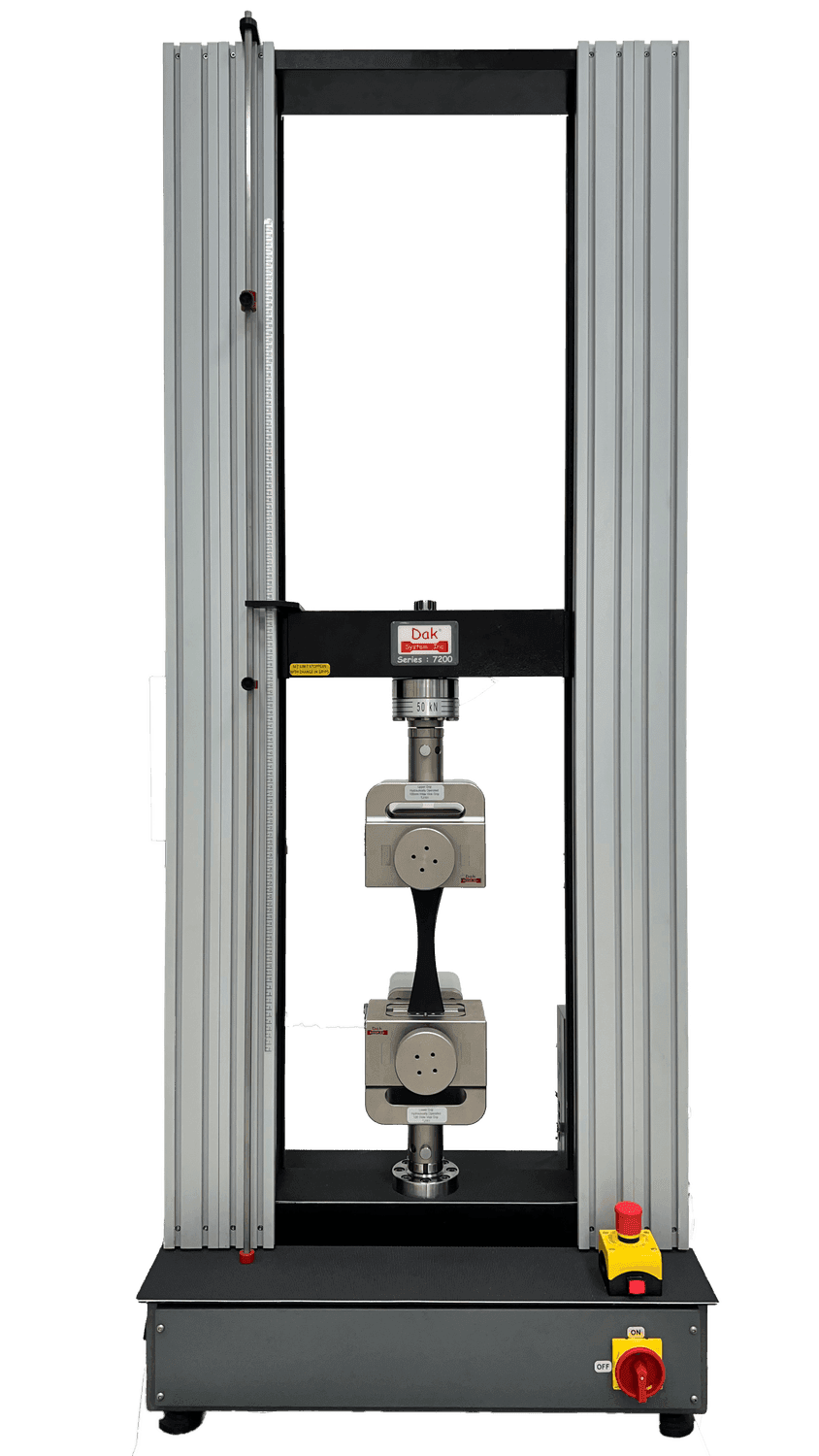
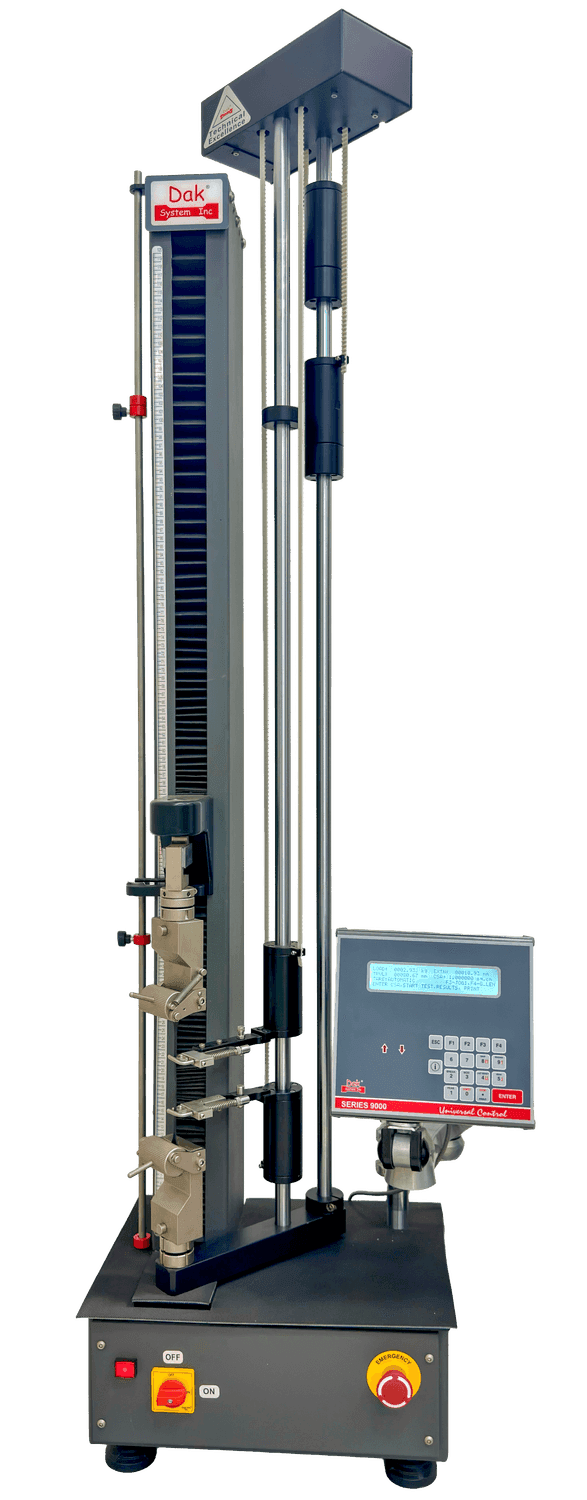
Load Cells
Short span strengths are tens to a few hundred newtons over a displacement of well under a millimetre. Resolution and instrument stiffness decide whether this test works at all; a cell sized for the frame does not.
SpecificationsTesting standard
Short span compressive strength of containerboard
Written and technically reviewed by Dak System Inc. engineeringLast reviewed
TAPPI T826 clamps a 15 mm wide strip of containerboard between two clamps set 0.70 mm apart and drives them together until the paper crushes. The very short free span removes the possibility of buckling, so the result is a genuine in-plane compressive strength. The current revision is TAPPI/ANSI T 826 om-21.
A strip of containerboard 15 mm wide is clamped between two clamps set 0.70 mm apart. The clamps are driven together until the paper between them fails in compression, and the maximum force is recorded.
That 0.70 mm gap is the entire design of the test. Paper loaded on its edge over any useful length buckles as a slender column and never reaches its compressive strength. Reducing the free span to less than a millimetre removes the possibility of buckling, so the sheet is genuinely crushed and the number that comes out is a material property rather than a structural accident.
Short span compressive strength — usually written SCT — is the cleanest available measure of a paper's in-plane compressive strength, and in-plane compression is what holds a stacked box up. Every other method in this area, ring crush included, restrains buckling by geometry and accepts some contamination of the result; the short-span test removes the buckling instead of restraining it.
The method is defined for a span-to-thickness ratio of five or less, which corresponds to grammages between about 100 g/m² and 440 g/m² — the containerboard range. Outside it the geometry no longer guarantees a compression failure.
For a mill it is a process measure: SCT responds to refining, to wet pressing and to drying restraint, and it moves before edge crush does. For a converter it is a predictor: SCT of the components feeds the edge crush of the combined board, which feeds the compression resistance of the box. It is the first link in that chain and the one measured on the smallest sample.
The method is defined by a geometry, and the geometry only works over a defined range of board.
Maximum force divided by specimen width
Reported per unit width, and divided again by grammage where a compression index is required.
A free span under a millimetre cannot buckle as a column
Every other in-plane compression method for paper restrains buckling by geometry and accepts some contamination of the result. This one removes the possibility.
Component SCT → board edge crush → box compression
SCT is the first link, measured on the smallest sample, and it moves before edge crush does — which is why mills watch it as a process signal.
Any slip in the clamps lengthens the effective free span. The specimen then buckles rather than crushing, the result falls, and it stays repeatable — so the number looks like a property of the paper rather than a fault in the fixture.
Short span strengths are tens to a few hundred newtons over a displacement of well under a millimetre. Resolution and instrument stiffness decide whether this test works at all; a cell sized for the frame does not.
SpecificationsShort span compressive strengths are low — tens to a few hundred newtons — and the displacement is tiny, so this is a test where instrument stiffness and resolution matter far more than capacity. The load cell is chosen for the specimen, and force accuracy to ASTM E4 over the working range is the requirement.
The clamping fixture is the test. Two clamps grip almost the entire strip, leaving a free span of 0.70 mm between them, and that span has to be held accurately while the clamps close under load. A fixture that flexes, or clamps that let the paper slip even slightly, adds span and lets the specimen buckle after all. Dedicated short-span testers exist for this reason; where the work is done on a universal frame, the fixture has to be built to the geometry rather than adapted from something else.
No extensometer is used; the reported quantity is a maximum force, normally expressed per unit width.
Slip in the clamps is the failure that matters, because it does not look like slip — it looks like a slightly lower result. Any slip lengthens the effective free span, and the specimen buckles instead of crushing, so the number falls and stays repeatable. Span set wrong, or drifting as the fixture wears, does the same thing. Testing a grade outside the 100 to 440 g/m² window puts the specimen outside the geometry the method assumes. And an unconditioned specimen in a humid plant reads low for a reason nobody in the room will guess.
Four documents, four scales, one chain. Each is measured on a different thing and none substitutes for the next.
| Short span (T826) | Ring crush (T822) | Edge crush (T 811) | Box compression (ASTM D642) | |
|---|---|---|---|---|
| Sample | A 15 mm strip | A strip formed into a ring | A piece of combined board | The finished box |
| Buckling | Removed by a 0.70 mm span | Restrained by a groove | Restrained by the flutes | Part of what is measured |
| Measures | Paper in compression | Paper in compression | Board on edge | The whole container |
| ISO counterpart | ISO 9895 | ISO 12192 | ISO 3037 | ISO 12048 |
| Moves first when the process drifts | Yes | Later | Later | Last |
The chain runs one way. Good SCT does not guarantee a good box, because the corrugating, the converting and the closures all sit between them. What a poor SCT does guarantee is that the box will not be better than its papers.
TAPPI T826 is the North American method for the short span compressive strength of containerboard, usually written SCT. A 15 mm wide strip is held between two clamps 0.70 mm apart and the clamps are driven together until the paper fails in compression. The maximum force is recorded, normally per unit width. The current revision is TAPPI/ANSI T 826 om-21.
Because paper loaded on edge over any useful length buckles as a slender column and never reaches its compressive strength. Reducing the unsupported span to less than a millimetre removes the possibility of buckling entirely, so the sheet is genuinely crushed. The span is not a convenience of the fixture; it is the method.
Both are trying to measure the same property and they deal with buckling differently. Ring crush restrains it, by curving the strip into a ring and supporting it in a groove, and accepts that some residual buckling contaminates the result. The short span test eliminates it. That is why SCT is generally regarded as the cleaner measurement, and why both remain in use — ring crush carries decades of specification history behind it.
The method is defined for a span-to-thickness ratio of five or less, which corresponds to grammages of roughly 100 to 440 g/m² — the containerboard range. Outside that window the geometry no longer guarantees a compression failure, so a figure obtained on a lighter or heavier grade is not what the method claims to produce.
Because it responds first. SCT is sensitive to refining, wet pressing and drying restraint, and it moves before the edge crush of the board made from that paper does. It is also measured on a small strip taken straight from the reel rather than on combined board that has to be corrugated first. For process control that combination — early signal, small sample — is worth more than the closer relationship edge crush has to the finished box.
Slip in the clamps, and it is difficult to spot because it does not look like slip. Any movement of the strip lengthens the effective free span, the specimen buckles instead of crushing, and the force falls. The result stays repeatable, so it reads as a property of the paper rather than a fault in the fixture. Verifying the span and checking the clamp faces are the first two things to do when a grade suddenly reads low.
Stiffness and resolution rather than capacity. Forces are tens to a few hundred newtons over a very small displacement, so the load cell is chosen for the specimen and force accuracy to ASTM E4 over the working range is the requirement. The clamping fixture is the critical part: it has to hold the 0.70 mm span accurately while closing under load. Dedicated short-span testers exist for this reason, and where the work is done on a universal frame the fixture is built to the geometry rather than adapted from something else.
Dak verifies against whichever standard the method names, and where a class applies our frames sit a class tighter than it asks.
| The method asks for | Dak supplies | |
|---|---|---|
| Capacity | Low — tens to a few hundred newtons, over a displacement of well under a millimetre | Load cells from 1 kg to 60 ton on the Series 7200, and 0.5 to 100 kN on the Series 9000 |
| Force accuracy | ASTM E4 over the working range | Verified to ASTM E4, and to ISO 7500-1 Class 0.5 |
| Gripping | Two clamps holding a 15 mm strip with a free span of 0.70 mm between them | Our a fixture built for this method, built to the specimen |
| Environment | Standard atmosphere for testing paper and board; compressive strength is more moisture-sensitive than tensile strength | 3009 series chambers, −150 °C to +400 °C — temperature only |
This page describes the method as practised. The governing text is the current edition from the issuing body. Tell us what you are testing and we will answer with the machine, the fixture and a quotation.