
Testing standard
ASTM A931 Tension Testing of Wire Ropes and Strand
Standard Test Method for Tension Testing of Wire Ropes and Strand
Written and technically reviewed by Dak System Inc. engineeringLast reviewed
ASTM A931 covers the tension testing of wire ropes and strand at room temperature, determining the measured breaking force, yield strength, elongation and modulus of elasticity. It goes further than a breaking-force-only method, which matters when the rope is a structural element rather than only a lifting medium.
At a glance
- Test type
- Tensile — the specimen is pulled apart
- Published by
- ASTM
- Edition
- A931-18
- Material
- Metals, alloys & welds
- Runs on
- Series 7200 and Series 9000
From the test method to your testing system
Explore DAK equipment for ASTM A931, then review the specimen and setup requirements below.
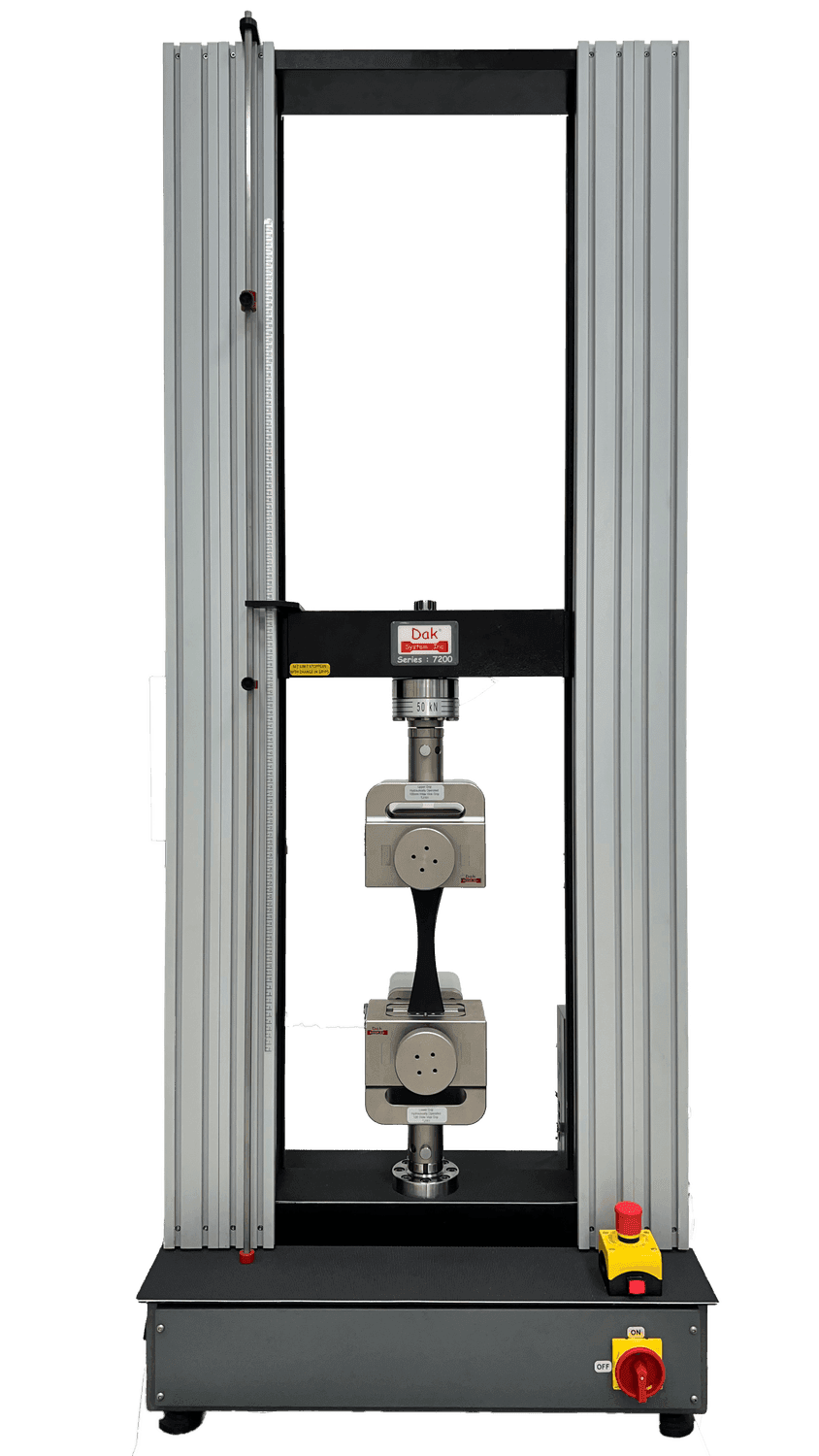 Universal Testing MachineSeries 7200Explore the machine →
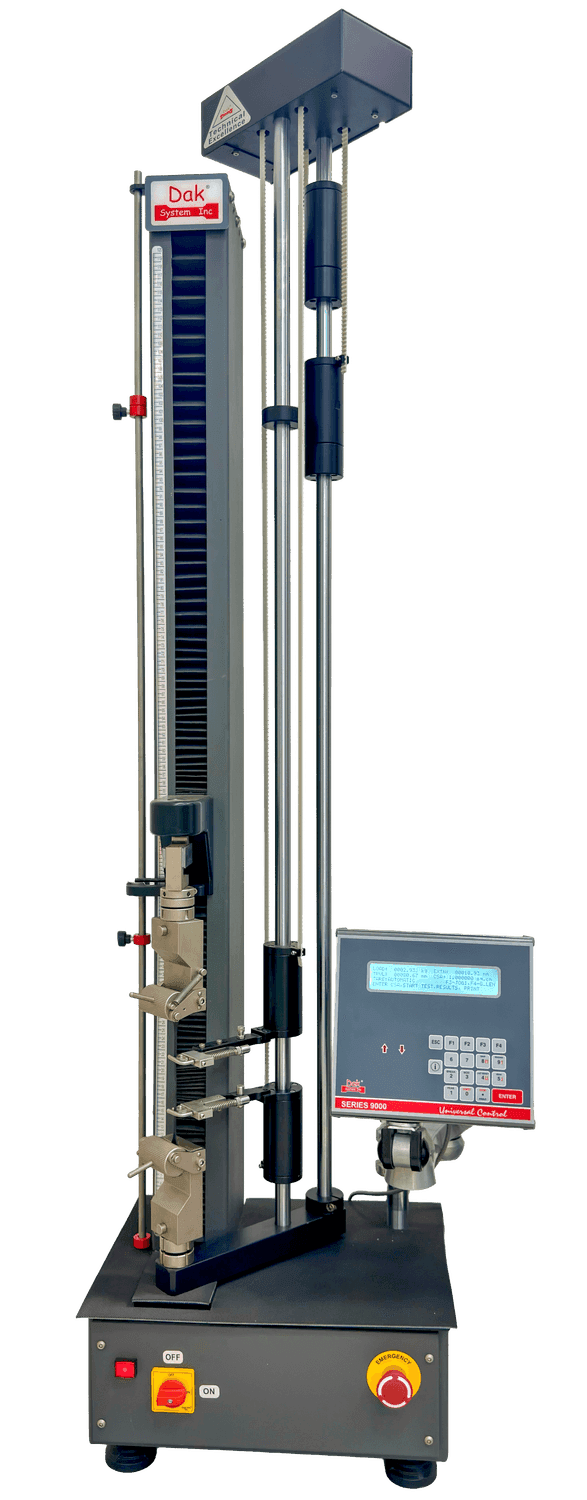 Universal Testing MachineSeries 9000Explore the machine →
Jump to a specific section
01Understand the method
What the test does
A sample of specified length is seized so it cannot unlay, terminated at both ends — normally in poured sockets — and left until the socketing medium has fully cured. It is mounted to hang axially, pre-stressed to remove construction stretch, and fitted with an extensometer on its free length well clear of the terminations. It is then loaded at room temperature while force and extension are recorded, giving yield strength, elongation and modulus of elasticity from the curve, and finally the measured breaking force at failure. The loading is governed by force rather than by a crosshead rate, and the rate that applies to a given rope is set against its minimum breaking force rather than fixed in millimetres per minute. The ISO counterpart states it explicitly and is the figure to work to where a contract names none: ISO 3108 lets the force rise quickly until it passes 80 % of the minimum breaking force, and caps it thereafter at 0.5 % of that minimum breaking force per second. On a rope specified to a 200 kN minimum breaking force that is 1 kN/s, so the last 40 kN of the pull takes a minimum of 40 s. The pre-stress is bounded on the same basis: the general-purpose rope specification, ASTM A1023, caps a prestretch load at 55 % of the minimum breaking force and gives three cycles to 40 % of it as its worked example of static practice, which on the same rope is 110 kN and 80 kN.
What it measures, and why it matters
How a rope or strand behaves under load, not merely when it parts. That is the distinction from a breaking-force-only method and the reason to choose this one. A rope used as a lifting medium is specified on breaking force; a rope used as a structural element — a bridge hanger, a guy, a mast stay, a stay cable — is designed around how much it stretches at working load and how stiff it is, and those quantities come from the stress-strain curve. A rope's strength is also never simply the sum of its wires', because lay angle, core compression and load sharing between strands all intervene.
02Prepare the specimen and test settings
More than a breaking force
Yield, elongation and modulus are reported too, which is what a designer needs when a strand is carrying a structure rather than a load.
- Measured breaking force
- The force at which the sample failed
- Yield strength
- Determined on the assembly, not on a single wireA rope's yield is a property of the assembly bedding in and the wires yielding together.
- Elongation
- Over a defined length of the free rope
- Modulus of elasticity
- After pre-stressingA new rope has construction stretch. Measuring modulus through it reports the geometry settling, not the steel.
- Temperature
- Room temperature
- Keep the extensometer off the sockets
- On the free length onlyDakSocket pull-in and the transition region are not part of the rope's elastic behaviour.
Structural strand in a bridge or a mast is designed on modulus and elongation, not on breaking force alone. That is the case for using this method rather than a breaking-force-only one.
Test speed
Rope is loaded against its minimum breaking force, not against a crosshead rate in millimetres per minute. A931 keeps its own clause behind the purchased text; the ISO counterpart states the rule outright, and it is the one to work to where a contract names none.
- Up to 80 % of minimum breaking force
- May be applied quicklyISO 3108 clause 7.6. Only the approach to failure is rate-controlled.
- Above 80 % of minimum breaking force
- Not more than 0.5 % of the minimum breaking force per secondISO 3108 clause 7.6, the corroborated counterpart figure.
- Worked through
- 1 kN/s on a rope specified to 200 kN minimum breaking forceDak0.5 % of 200 kN. The last 40 kN, from 160 kN to failure, then takes at least 40 s. Re-do it against your own rope's specified minimum.
- Pre-stress load
- Not above 55 % of the minimum breaking forceASTM A1023 clause 7.5, for the prestretching of the rope itself. 110 kN on the same rope.
- Pre-stress cycles
- Three cycles to 40 % of the minimum breaking forceA1023 Note 4, its worked example of static practice. 80 kN on the same rope.
- Temperature
- Room temperature; 10 to 35 °C on the ISO counterpart, 23 ± 5 °C where controlled
- Record the break position
- Free length, or at a terminationDak
03Build the test setup on a DAK machine
What the machine must be capable of
Force set entirely by the product, and the range is very wide — strand and rope breaking forces span orders of magnitude, and large structural strand goes well beyond what a general-purpose laboratory frame reaches. The frame needs length for the sample plus terminations, pinned connections that let the assembly hang axially without imposing bending, extensometry that can be fitted to the free length, and guarding proportionate to the energy released when a rope parts.
Running ASTM A931 on the Series 7200 and Series 9000
Dak verifies against whichever standard the method names, and where a class applies our frames sit a class tighter than it asks.
| The method asks for | Dak supplies | |
|---|---|---|
| Capacity | Very high and set by the product — strand and rope breaking forces span orders of magnitude | Load cells from 1 kg to 60 ton on the Series 7200, and 0.5 to 100 kN on the Series 9000 |
| Force accuracy | ASTM E4 over the working range | Verified to ASTM E4, and to ISO 7500-1 Class 0.5 |
| Strain measurement | An extensometer of the class the method specifies | Certified to ISO 9513 Class 1 and ASTM E83 — non-contact video, clip-on and high-elongation |
| Gripping | Poured sockets, or a termination appropriate to the product; never a plain jaw on a rope | Our a fixture built for this method, built to the specimen |
| Environment | 23 ± 2 °C standard laboratory atmosphere | 3009 series chambers, −150 °C to +400 °C — temperature only |
04Run the test
How the test runs
- Select a sample of the specified length, allowing for terminations.
- Seize the ends so the rope cannot unlay.
- Fit terminations appropriate to the product — normally poured sockets.
- Allow the socketing medium to cure fully.
- Mount the sample so it hangs axially, free of bending.
- Pre-stress as specified to remove construction stretch.
- Fit an extensometer on the free length, clear of the terminations.
- Load slowly at room temperature, recording force and extension.
- Determine yield strength, elongation and modulus from the curve.
- Continue to failure and record the measured breaking force.
- Note the break position, and repeat if it failed at a termination.
05Calculate, report and interpret
Calculations
The maximum force reached before failure
Compared against the minimum breaking force in the relevant product specification, which is where the acceptance criterion lives.
Δ force per unit area over Δ strain, after pre-stressing
- area
- the metallic area of the wires, not the area of the enclosing circle
Two areas are available and they differ substantially. Which one was used has to be stated or the modulus cannot be interpreted.
The non-elastic extension as wires bed into their helical seats
Removed by pre-stressing before the elastic measurements are taken.
What the report has to contain
- Reference to ASTM A931 and the edition
- Product identification: rope or strand, diameter, construction, grade, core and finish
- The product specification it is supplied to
- Termination method and medium
- Sample and gauge lengths
- Pre-stressing applied
- Which cross-sectional area was used for stress and modulus
- Breaking force, yield strength, elongation and modulus
- Break position
- Any sample rejected and why
What goes wrong in practice
Reporting a modulus without saying which area it was computed on. Skipping the pre-stress, so construction stretch enters the elastic measurement. Fitting the extensometer across a termination, where wires pull in and the potting stiffens the transition. Testing before the socketing medium has cured, which fails at the socket and reads low. And treating a rope's breaking force as the sum of its wires' strengths, which it never is — lay angle, core compression and the way load shares between strands all reduce it, which is exactly why the assembly is tested rather than calculated.
06Compare methods and find answers
ASTM A931 or ISO 3108
| ASTM A931 | ISO 3108 | |
|---|---|---|
| Reports | Breaking force, yield, elongation, modulus | Measured breaking force |
| Covers | Wire ropes and strand | Steel wire ropes |
| Temperature | Room temperature, stated | Ambient |
| Use | Structural and lifting | Principally lifting and general purpose |
Where the question is only whether the rope reaches its minimum breaking force, either serves. Where the rope is a structural member and its stiffness enters a calculation, A931's additional quantities are the reason to choose it.
Questions we are asked about this test
What is ASTM A931?
It is the ASTM tension test for wire ropes and strand at room temperature. It determines the measured breaking force, the yield strength, the elongation and the modulus of elasticity. The current designation is ASTM A931-18, approved in September 2018, with a revision in progress under work item WK92568.
How does it differ from a breaking-force-only method?
It reports the stress-strain behaviour as well as the failure point. That matters when the rope is a structural element rather than a lifting medium — a bridge hanger, a guy, a mast stay or a stay cable is designed around stiffness and elongation under working load, not around the force at which it eventually parts. A breaking-force-only test cannot supply those numbers.
Why is the rope pre-stressed before the modulus is measured?
Because a new rope beds in. On first loading the wires settle into their helical seats and the strands compact against the core, producing an extension that is geometric rather than elastic. That is construction stretch, and a modulus measured through it describes the rope tightening up rather than the steel deforming. Pre-stressing removes it so the subsequent measurement is elastic.
Which cross-sectional area is used?
It has to be stated, because two are available and they are very different. The metallic area is the sum of the individual wire areas; the area of the enclosing circle includes the gaps between wires and the core. A modulus or a stress computed on one is not comparable with the same quantity computed on the other, and the omission is a common source of confusion in strand data.
Why can't the extensometer sit across the sockets?
Because the region around a termination is not behaving like free rope. Wires pull into the socket slightly as load rises and the transition zone is stiffened by the potting medium, so extension measured across it mixes rope behaviour with termination behaviour. Fitting the extensometer well inside the free length keeps the measurement to the rope.
What if the sample breaks at the termination?
It is not a valid rope result and the test should be repeated. A break at or in a socket reflects the brooming, cleanliness and cure of the termination rather than the strength of the rope, and it reads low. Recording the break position is part of validating the result, which is why it belongs in the report.
Does this replace testing the individual wires?
No — they answer different questions. Testing individual wires establishes the grade of the material going into the rope. Testing the assembly establishes what the finished rope does, including the effects of lay, core compression and how load shares between strands. A rope's breaking force is never simply the sum of its wires' strengths, which is precisely why the assembly is tested.
Related
Materials tested to it
The test it standardises
Industries that test to it
Other standards explained
Planning ASTM A931 testing?
Discuss your specimen, test requirements and reporting needs with DAK engineering.
This page describes the method as practised. The governing text is the current edition from the issuing body. Tell us what you are testing and we will answer with the machine, the fixture and a quotation.