
Testing standard
ISO 1974 Elmendorf Tear Testing of Paper
Paper — Determination of tearing resistance — Elmendorf method
Written and technically reviewed by Dak System Inc. engineeringLast reviewed
ISO 1974 measures the out-of-plane tearing resistance of paper by the Elmendorf method. Four superimposed 63 mm by 76 mm sheets are slit 20 mm in the centre and torn by a falling pendulum; the energy the pendulum loses is the result. Readings are taken in machine and cross direction, and the pendulum capacity is chosen so they land between 20 % and 80 % of scale.
At a glance
- Test type
- Tear — a cut or nick is forced to grow
- Published by
- ISO
- Edition
- ISO 1974:2012
- Material
- Paper, board & corrugated
- Runs on
- Series 7200 and Series 9000
From the test method to your testing system
Explore DAK equipment for ISO 1974, then review the specimen and setup requirements below.
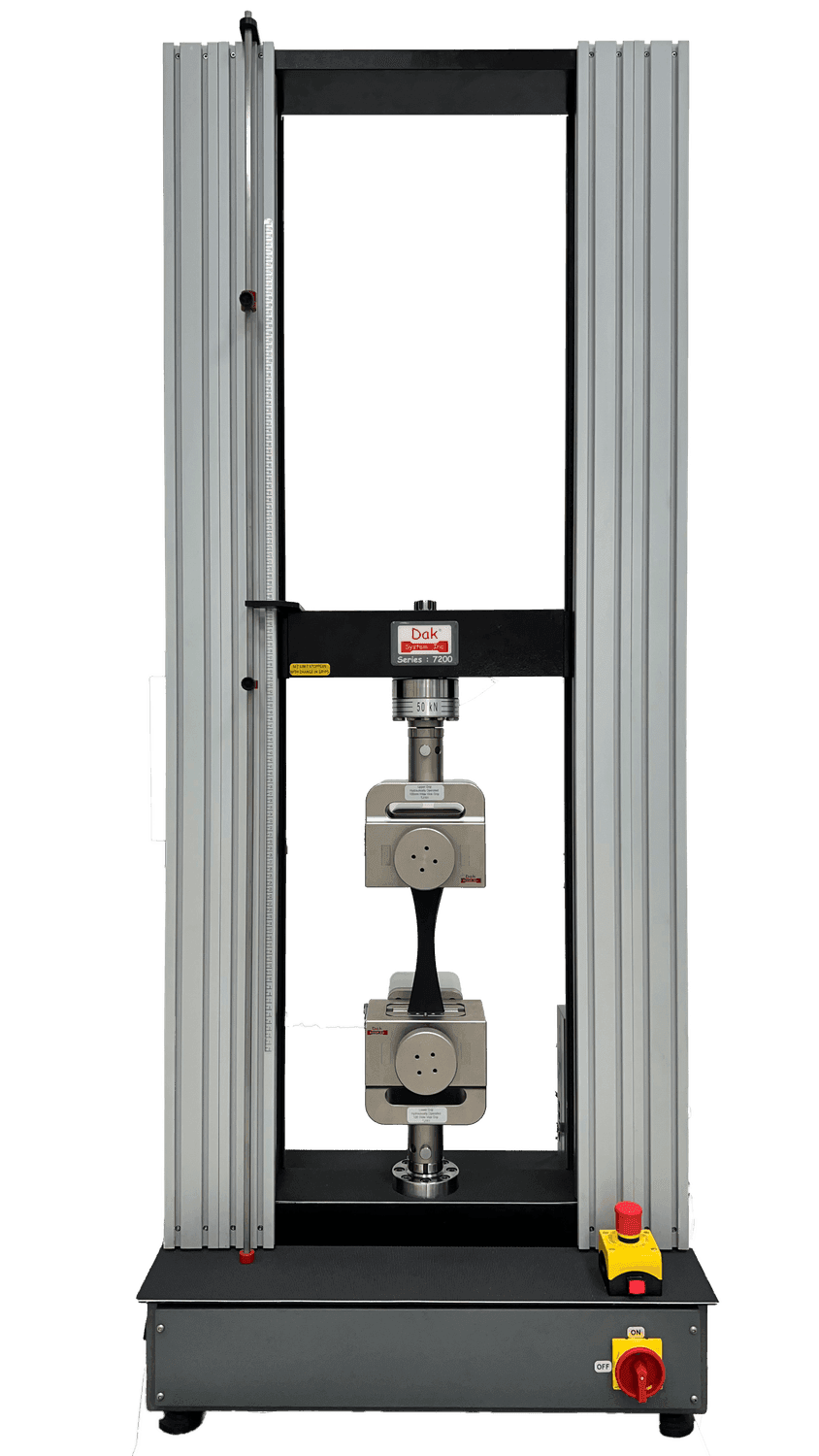 Universal Testing MachineSeries 7200Explore the machine →
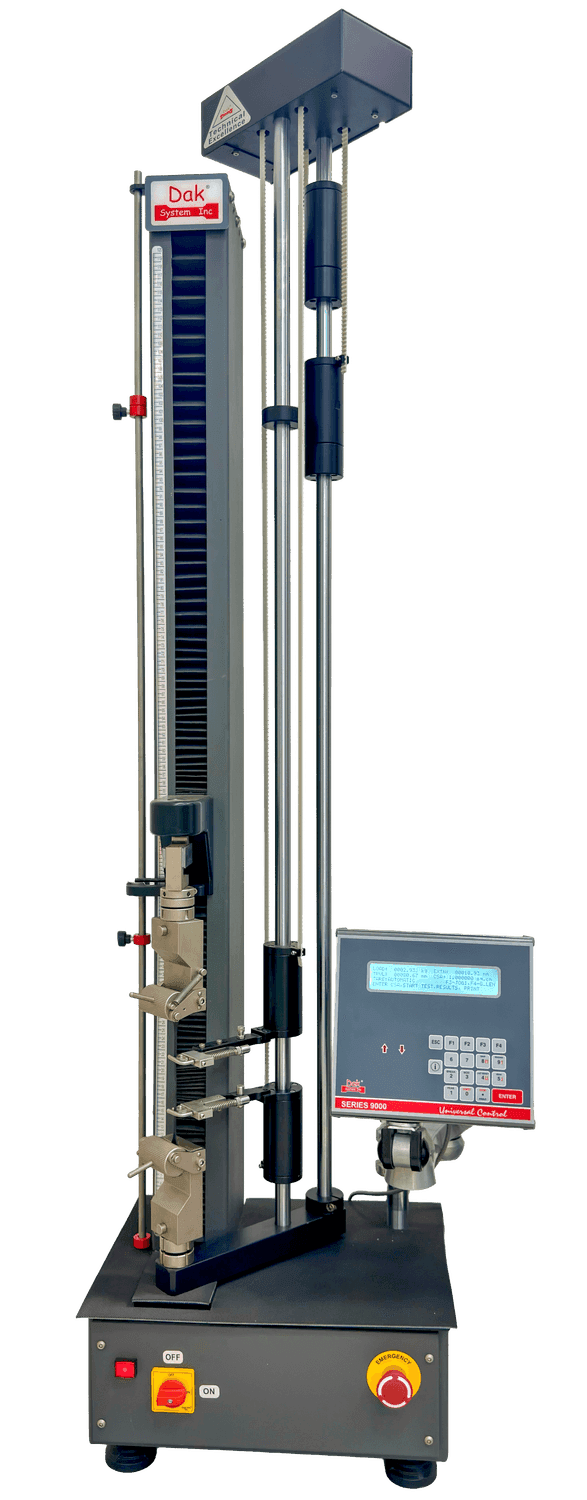 Universal Testing MachineSeries 9000Explore the machine →
Jump to a specific section
01Understand the method
What the test does
A stack of paper is cut, slit and torn by a falling pendulum, and the energy the pendulum loses is the result. It is among the fastest tests in a paper laboratory and one of the oldest; the apparatus has barely changed in principle since Elmendorf designed it.
Specimens are cut 63 mm × 76 mm and a 20 mm slit is made in the centre of each with a clean blade, which starts the tear rather than leaving the paper to find its own starting point. Four superimposed sheets are torn together as one specimen. Fewer or more may be used where the paper demands it, provided the deviation is stated in the report — the number of plies changes the reading, so it is part of the result rather than a detail of how it was obtained.
The pendulum is released, tears through the remaining width, and swings on. What it measures is out-of-plane tearing resistance: the sheet is torn apart through its thickness, not pulled along its plane. The pendulum capacity is chosen so the reading falls between 20 % and 80 % of the scale, which is where the instrument is linear.
What it measures, and why it matters
Tearing resistance decides whether a web survives a machine. Tensile strength tells you what a sheet withstands pulled evenly; tear tells you what happens once a flaw exists, which on a running machine it eventually always does. A nick at the edge of a web under tension is the start of either nothing or a break, and tear decides which.
The measurement is always made in both machine and cross directions, and the ratio between them is as informative as either figure. Paper is anisotropic because the fibres align with the flow on the wire, so a sheet tears far more readily along the machine direction than across it. A ratio that has drifted from its usual value says the forming section has changed even when both absolute figures still sit inside specification.
Two exclusions matter. The method does not apply to corrugated fibreboard, though it may be used on its components. And it is not suitable for cross-direction tearing resistance of highly directional paper or board, where the tear runs away along the fibres and the number returned is not a property of the material.
02Prepare the specimen and test settings
Specimen
Cut in both directions, stacked, and slit — the slit is what starts the tear rather than leaving the paper to find its own beginning.
- Size
- 63 mm × 76 mmCut in both machine and cross direction so both can be reported. A single figure without its direction is not a measurement.
- Plies
- Four superimposed sheetsFewer or more may be used where the paper demands it, provided the deviation is stated in the report. A two-ply and a four-ply result are different numbers for the same paper.
- Slit
- 20 mm, central, clean bladeA ragged or crushed slit end gives the tear a head start nobody has recorded, and biases the result low with nothing on the instrument to show why.
- Conditioning
- Standard atmosphere for paper testingTear resistance moves with moisture content, so an unconditioned sheet is not comparable with anything.
Test speed
There is no crosshead and no rate to set: the pendulum is released and falls under gravity, and the result is the potential energy it loses tearing the stack. What the operator controls instead is the tear length, the pendulum capacity and where the reading lands on the scale.
- Rate
- None to set — gravity-driven pendulumUnlike a trouser-tear test on a crosshead, the tearing speed is a consequence of the pendulum rather than a parameter. Two laboratories running the same instrument tear at the same rate because the apparatus is specified, not because a rate was dialled in.
- Tear length
- 43 mmDakThe distance the tear actually runs: 63 mm of specimen in the direction tested, less the 20 mm starting slit. It is fixed by the specimen geometry rather than chosen.
- Pendulum capacity
- Interchangeable weights, commonly 8 000 mN to 64 000 mNDakThis is the operator's real control over the measurement. Instrument makers supply the range; the standard requires only that the capacity chosen puts the reading in the linear part of the scale.
- Target reading
- Between 20 % and 80 % of scaleWhere the instrument is linear. A pendulum too heavy gives a small deflection where resolution is worst; too light and it stalls before completing the tear.
03Build the test setup on a DAK machine
What the machine must be capable of
An Elmendorf pendulum tear tester with interchangeable weights, so a capacity can be chosen that puts the reading in the 20 % to 80 % band. A clamp holding all four plies square and flat without crushing them, a blade producing a clean 20 mm slit, and a calibrated scale or transducer.
The instrument must be level and its pendulum free. Friction in the pivot subtracts from the energy the paper absorbed and adds it to the recorded tear resistance — an error that is systematic, always in the same direction, and invisible without a routine zero check.
Running ISO 1974 on the Series 7200 and Series 9000
Dak verifies against whichever standard the method names, and where a class applies our frames sit a class tighter than it asks.
| The method asks for | Dak supplies | |
|---|---|---|
| Capacity | Low: the pendulum capacity is chosen so the reading falls between 20 % and 80 % of scale | Load cells from 1 kg to 60 ton on the Series 7200, and 0.5 to 100 kN on the Series 9000 |
| Force accuracy | unknown — the method specifies the operating band rather than a machine accuracy class | ISO 7500-1 Class 0.5 — the method sets no class of its own |
| Gripping | Elmendorf pendulum tear tester with interchangeable weights, clamp and slitting blade | Our a fixture built for this method, built to the specimen |
| Environment | yes — conditioned in the standard atmosphere for paper testing, because tear resistance moves with moisture content | 3009 series chambers, −150 °C to +400 °C — temperature only |
04Run the test
How the test runs
- Condition the paper in the standard atmosphere for paper testing.
- Cut specimens 63 mm × 76 mm in both machine and cross direction.
- Stack four sheets and clamp them square and flat without crushing.
- Cut a clean 20 mm slit centrally through the stack.
- Select a pendulum capacity that will put the reading between 20 % and 80 % of scale.
- Release the pendulum and read the tearing resistance.
- Report machine and cross direction separately, with the ply count used.
05Report and interpret
What travels with an ISO 1974 result
Two of these change the number, so a result without them cannot be compared.
- The direction — machine or cross. Values for one sheet can differ severalfold.
- The number of plies, if it was not four.
- The pendulum capacity used, and that the reading fell inside the 20 % to 80 % band.
- The conditioning atmosphere.
- The MD to CD ratio, which tracks fibre alignment and often moves before either figure leaves specification.
What goes wrong in practice
Reading outside the 20 % to 80 % band is the most common. A pendulum too heavy for the paper gives a small deflection at the bottom of a scale where resolution is worst; too light and it stalls.
A blunt or dirty slitting blade is the second, and it always biases low.
Testing the wrong number of plies without saying so is the third. Four is the default and the report has to state any departure, because a two-ply and a four-ply result are different numbers for the same paper.
Finally, quoting a single tear figure without its direction. Machine and cross direction values for the same sheet can differ severalfold, so a figure without a direction beside it is not a measurement.
06Compare methods and find answers
What ISO 1974 does not cover
Two exclusions, and both are the kind that produce a plausible number rather than an obvious error.
| Material | Position |
|---|---|
| Corrugated fibreboard | Out of scope — but the method may be used on the components the board is made from |
| Highly directional paper or board, cross direction | Not suitable — the tear runs away along the fibres and the number is not a property of the material |
| Low grammage board | In scope, provided the tearing resistance falls within the instrument's range |
Both exclusions still return a reading. Nothing on the instrument tells you the number is meaningless.
Related and equivalent standards
TAPPI T 414 is the closest counterpart and uses the same Elmendorf principle, so results are comparable in trend but not automatically interchangeable in figure. ISO 1974 sits beside the other paper strength methods — tensile to ISO 1924-2 and burst to ISO 2758 — which together describe how a sheet fails in the three ways a converting line can break it.
Questions we are asked about this test
What is ISO 1974?
It is the ISO method for determining the out-of-plane tearing resistance of paper by the Elmendorf pendulum method, current as ISO 1974:2012, which replaced the 1990 edition.
What size are the specimens?
63 mm by 76 mm, cut in both machine and cross direction, with a 20 mm slit made centrally with a clean blade. Four sheets are superimposed and torn together as one specimen.
Can I test a different number of sheets?
Yes, where the paper demands it — but the deviation must be stated in the report. The ply count changes the reading, so it is part of the result rather than a detail of how it was obtained.
Why does the reading have to fall between 20 % and 80 % of scale?
Because that is where the instrument is linear. A pendulum too heavy for the paper gives a small deflection at the bottom of the scale where resolution is worst, and one too light stalls before completing the tear.
Why are machine and cross direction both measured?
Because paper is anisotropic — the fibres align with the flow on the wire, so a sheet tears far more readily along the machine direction than across it. The ratio between the two is often more informative than either figure, and it moves when the forming section changes even while both absolute values remain in specification.
Can ISO 1974 be used on corrugated board?
No. The method does not apply to corrugated fibreboard, although it may be used on the components that board is made from. It is also unsuitable for cross-direction measurement on highly directional paper or board.
How does it compare with TAPPI T 414?
TAPPI T 414 uses the same Elmendorf principle and is the closest counterpart, so results are comparable in trend. They are not automatically interchangeable in figure, and a specification that names one should be tested to that one.
Can Dak supply an Elmendorf tear tester?
Tell us the grammage range and whether you need machine and cross direction routinely, and we will answer with the instrument, the pendulum set and a quotation.
Related
Materials tested to it
The test it standardises
Industries that test to it
Other standards explained
Planning ISO 1974 testing?
Discuss your specimen, test requirements and reporting needs with DAK engineering.
This page describes the method as practised. The governing text is the current edition from the issuing body. Tell us what you are testing and we will answer with the machine, the fixture and a quotation.