TJ-144
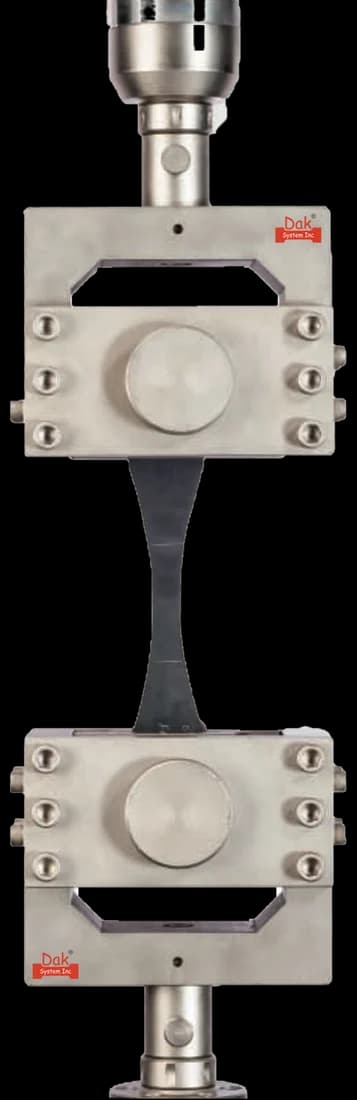
Heavy Duty Hydraulic Grips
Heavy duty hydraulic wedge grips hold a constant clamping force on a thick welded coupon as it necks, which a mechanical wedge does not always manage at these loads.
Specifications
Testing standard
Destructive tests on welds in metallic materials — Tensile test on cruciform and lapped joints
Written and technically reviewed by Dak System Inc. engineeringLast reviewed
ISO 9018 specifies test pieces and the procedure for tensile tests on welded cruciform and lapped joints with transverse stressed fillet welds, determining the tensile strength and the location of the fracture. It states that evaluation of the results is not included in the standard.
From the test method to your testing system
Explore the DAK machines already listed for ISO 9018, then review the grips, measurement and setup requirements below.
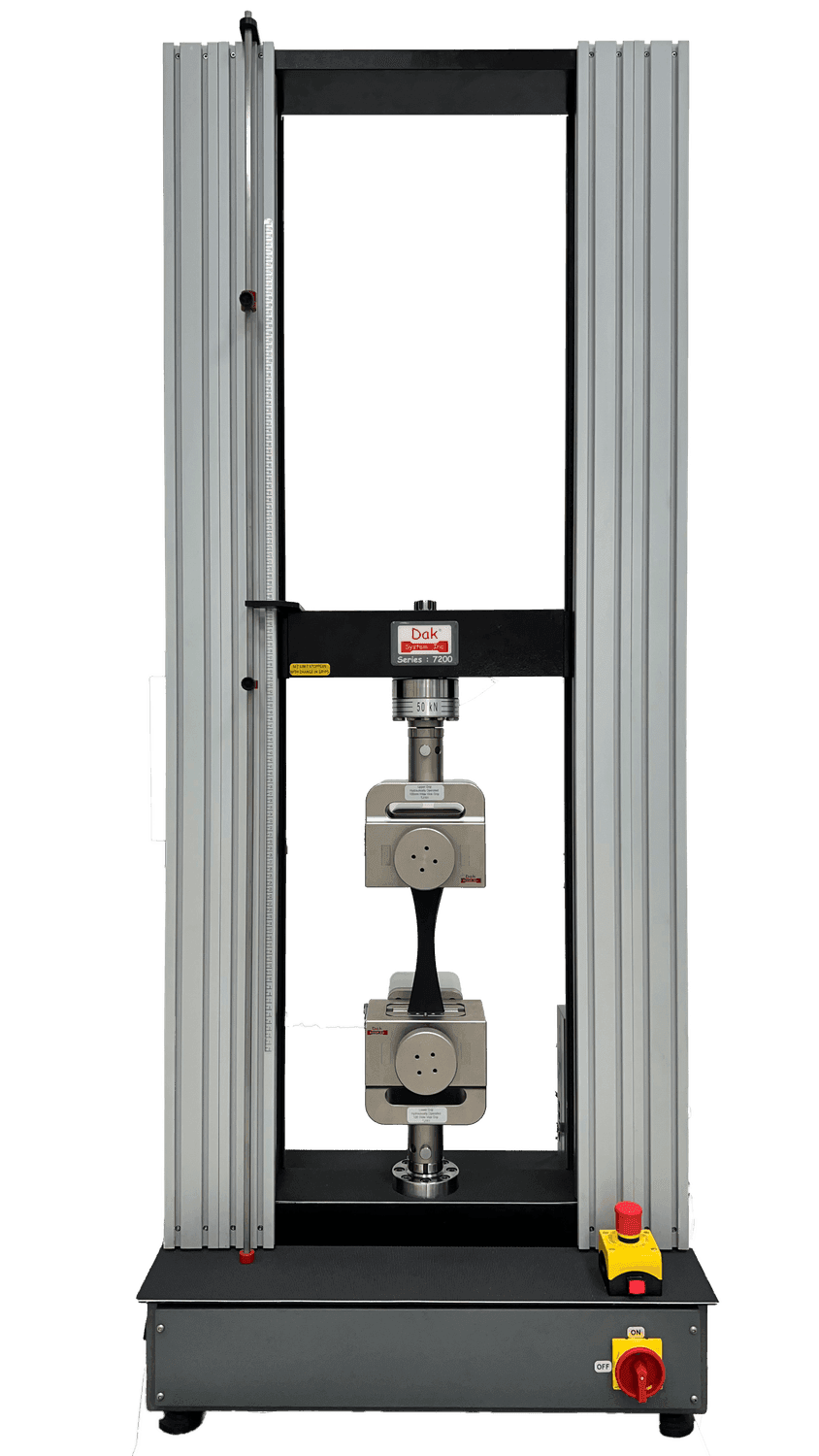 Universal Testing MachineSeries 7200Explore the machine →
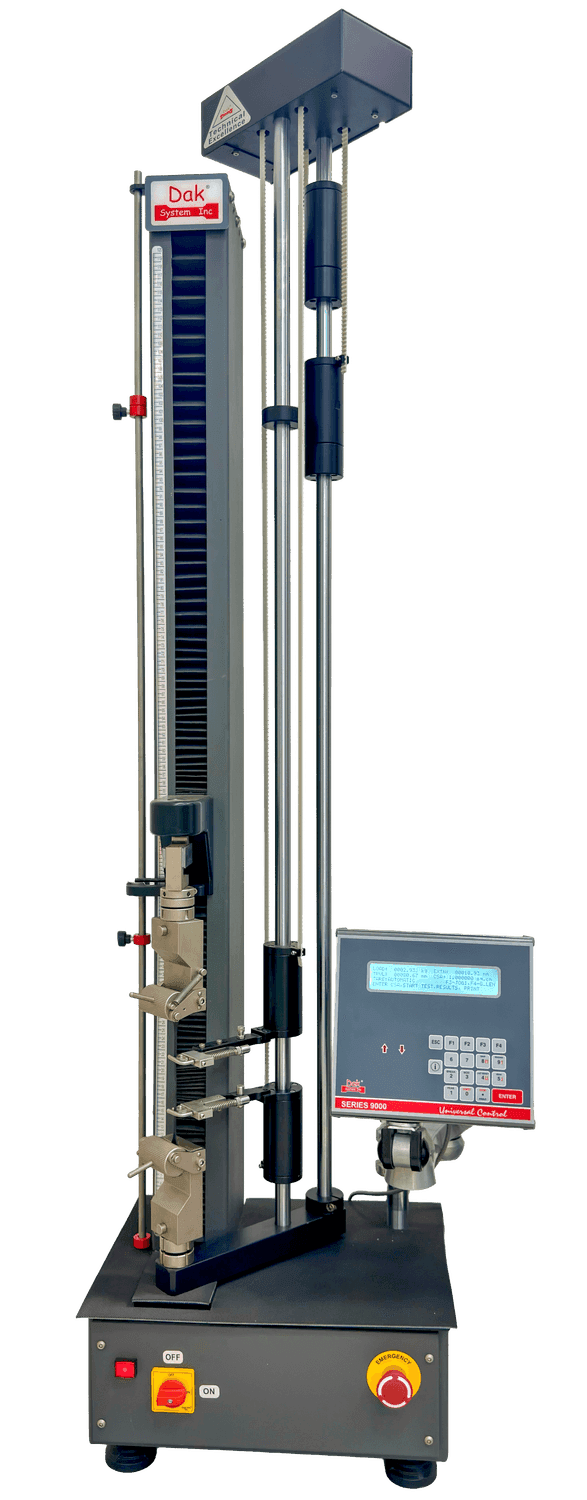 Universal Testing MachineSeries 9000Explore the machine →
01Understand the method
Cruciform or lapped test pieces are welded using the procedure being qualified, the fillet weld throats achieved are measured, and specimens of the required width are cut. The specimen is gripped so the load path crosses the transverse fillet welds and pulled to failure at 23 °C ± 5 °C unless something else is specified. ISO 9018 sets no rate of its own: it says the general principles of ISO 6892-1 apply, so the figure is read from there. Because only tensile strength and fracture location are wanted, ISO 6892-1 permits a single strain rate for the whole test, not above 0,008 s⁻¹ — on a 200 mm free length between the grips, up to 96 mm/min, its recommended 0,4 min⁻¹ working out at 80 mm/min. Where the elastic range is controlled by stress rate instead, the bands are 6 to 60 MPa/s for steel and 2 to 20 MPa/s below 150 000 MPa modulus: on a cruciform specimen 40 mm wide in 10 mm plate, 400 mm² of loaded section, 2,4 to 24 kN/s and 0,8 to 8 kN/s. Recalculate for your own section and free length. Two things are reported: the tensile strength, calculated on the area appropriate to the joint geometry, and the location of the fracture — through the weld throat, along the fusion boundary, or through the plate.
Whether transversely loaded fillet welds carry the load, and where they give way. The interpretive difficulty, and the reason this method deserves its own standard, is that a fillet weld's load-carrying section cannot be seen once the joint is made. A full-penetration butt weld transfers load through the full plate section, which is measurable at any time. A fillet weld transfers it across a throat — the altitude of the weld triangle rather than a leg length — and a weld that looks generous can have a modest throat if it is concave. The strength depends on what was achieved, not on what was drawn.
02Prepare the specimen and test settings
A butt weld carries load through its full section. A fillet weld carries it through a throat that nobody can see once the joint is made.
Fracture location matters as much as in a butt joint. Failure through the throat is a weld result; failure through the plate means the welds were stronger than the material they joined.
03Build the test setup on a DAK machine
Substantial force — a cruciform coupon in structural plate commonly needs a hundred kilonewtons or more — with wedge grips sized for the plate thickness and enough daylight for the assembled joint. Alignment good enough that the load is genuinely axial matters here more than on a plain coupon, because the geometry already carries an offset and a bending component added by the fixture will move the failure to whichever weld happens to be on the tension side.
Heavy duty hydraulic wedge grips hold a constant clamping force on a thick welded coupon as it necks, which a mechanical wedge does not always manage at these loads.
Specifications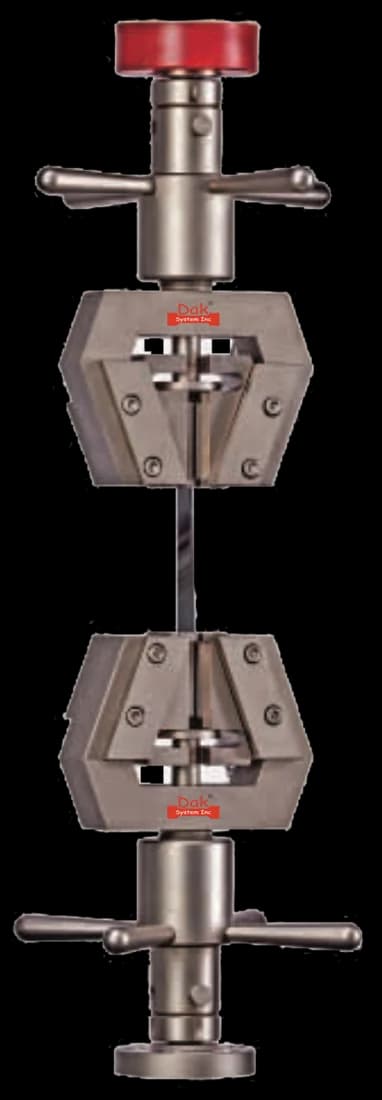
Universal parallel wedge grips with flat inserts, where the plate thickness and failure load sit within their range.
SpecificationsDak verifies against whichever standard the method names, and where a class applies our frames sit a class tighter than it asks.
| The method asks for | Dak supplies | |
|---|---|---|
| Capacity | High — a cruciform coupon in structural plate commonly needs 100 kN or more | Load cells from 1 kg to 60 ton on the Series 7200, and 0.5 to 100 kN on the Series 9000 |
| Force accuracy | ISO 7500-1 Class 1 over the working range | ISO 7500-1 Class 0.5 — a class tighter than the method asks |
| Gripping | Wedge grips sized for the plate thickness, holding the two loaded arms of the joint | Our self-tightening serrated wedge grips, with V-jaws for round specimens, built to the specimen |
| Environment | 23 ± 2 °C standard laboratory atmosphere | 3009 series chambers, −150 °C to +400 °C — temperature only |
04Run the test
05Calculate, report and interpret
Maximum force divided by the relevant cross-sectional area
Which area applies depends on the joint type, so the basis has to be stated with the value.
A fillet weld transfers load across its throat, not across the plate thickness
The throat is a triangle's altitude, not a leg length, so a weld that looks generous can have a modest throat if it is concave.
Not defined in ISO 9018
Stated in the standard's own scope. A report that implies a pass or fail without naming its source is overreaching.
Reporting a pass or fail as though the standard supplied one, when it explicitly does not — the acceptance criteria come from the application standard or the contract and their source belongs in the report. Reporting a strength without the fracture location, which discards the diagnostic half of the result. Assuming the specified throat is the throat achieved. And failing to section a low-failing joint, which is usually where an unfused root — invisible from outside — turns out to explain everything.
06Compare methods and find answers
| ISO 9018 | ISO 4136 | |
|---|---|---|
| Joint | Cruciform and lapped, fillet welded | Butt joint, full penetration |
| Load path | Across the fillet throats | Through the full weld section |
| Acceptance criteria | Not given in the standard | Usually the parent minimum |
| Both report | Strength and fracture location | Strength and fracture location |
Two joint families with the same reporting discipline. The fillet case is the harder one to interpret, because the load-carrying section is a throat that cannot be seen after welding and often differs from what was specified.
It is the ISO tensile test for welded cruciform and lapped joints with transverse stressed fillet welds. It specifies the test pieces, the specimens and the procedure, and it determines the tensile strength and the location of the fracture. It applies to plates, sheets, extruded bars and other solid sections. The current edition is ISO 9018:2015.
Because the standard says so in its own scope: information concerning the evaluation of test results is not included. It is a method, not a specification. The pass or fail comes from the application standard, the design code or the contract, and a test report that implies a verdict without naming where the criterion came from is claiming more authority than the method has.
Because the load-carrying section cannot be seen. A full-penetration butt weld transfers load through the full plate section, which is measurable. A fillet weld transfers it across its throat — the altitude of the weld triangle, not a leg length — and once the joint is made that dimension is hidden. A weld that looks generous can have a modest throat if it is concave, and a specified throat is not necessarily the throat achieved.
The same thing it does in a butt joint. Failure through the throat means the welds were the limiting element. Failure through the plate means they were stronger than the material they joined, which is generally the outcome a procedure is qualified to produce. Failure along the fusion boundary points at penetration or technique rather than at weld metal strength.
To see the root. Lack of penetration at the root of a fillet weld is entirely invisible from outside — the weld looks complete, the profile looks correct — and it reduces the effective throat directly. A joint that failed at a low load through the throat, sectioned, will often show an unfused root that explains the result and points at fit-up or technique rather than at the consumable.
Two plates welded to opposite faces of a third, forming a cross, with fillet welds at the four corners. Load is applied to the pair of arms in line with each other, so it must cross the fillet welds twice to get from one arm to the other. It is a common structural detail and it concentrates the whole load path into welds whose section nobody measured after the fact.
Yes, before the joint is closed up or on a sectioned sample afterwards. The strength depends on the throat achieved rather than the throat specified, and fillet throats vary substantially with fit-up, gap and technique. Reporting the measured throat alongside the strength is what allows a low result to be attributed to the weld size rather than to the weld metal.
Discuss your specimen, test requirements and reporting needs with DAK engineering.
This page describes the method as practised. The governing text is the current edition from the issuing body. Tell us what you are testing and we will answer with the machine, the fixture and a quotation.