Packaging for terminally sterilized medical devices — Part 1: Requirements for materials, sterile barrier systems and packaging systems
Written and technically reviewed by Dak System Inc. engineering·Last reviewed
ISO 11607-1 is a requirements standard for packaging that keeps a terminally sterilised medical device sterile until use. It is not itself a test method. The mechanical requirement that reaches a testing machine is seal strength — the capacity of the seal to withstand force — normally demonstrated by a peel test. The current edition is ISO 11607-1:2019.
ISO 11607-1 is not itself a test method — it is a requirements standard, and that distinction is the most useful thing to know about it. It specifies what a sterile barrier system must achieve and points to test methods that demonstrate it.
The mechanical requirement that reaches a testing machine is seal strength. Where a sterile barrier system is formed by sealing, the standard requires that specified requirements for seal width and seal strength are met, seal strength being the mechanical capacity of the seal to withstand force. In practice that is demonstrated by a peel test on the two bonded materials, measuring the force required to separate them — which is also the force a nurse feels when opening the pack.
What it measures, and why it matters
A sterile barrier system has two jobs that pull against each other. It must maintain sterility until the point of use, which argues for the strongest possible seal, and it must open cleanly at the bedside without shedding fibres or tearing the web, which argues for the weakest seal that will hold. Seal strength is where those two requirements are reconciled, and both an upper and a lower limit are normally specified.
Failure mode matters as much as the force. An adhesive peel, where the two webs separate cleanly at the interface, is what a peelable pouch should do. Delamination of the paper, or fibre tear, means the seal is stronger than the substrate — the pack will open by ripping rather than peeling, and it may shed particles into a sterile field.
The regulatory weight behind this is considerable. ISO 11607 is the primary reference for medical packaging validation and is required for both FDA submissions and CE marking, so a seal strength result is part of a regulatory file rather than a production statistic.
Specimen, and where on the pouch it came from
A pouch seal is made by different parts of the sealing tooling on each edge. Which edge the specimen came from is part of the result.
What is tested
A strip cut across the seal of the pouch or tray lidPractice
Strip width
Fixed by the referenced test method, normally ASTM F88Practice
Source of the specimens
Pouches made on the equipment and at the settings being validatedISO 11607-2 qualifies the forming, sealing and assembly process; these specimens are its output.
Sampling
Across the whole seal perimeterDakThe weakest edge determines whether the pack holds. Specimens taken from one convenient side describe that side.
Ageing
After accelerated or real-time ageing, and after the sterilisation process the pack will seeThe as-made figure alone does not support a shelf-life claim.
Peel rate and how the result is read
Loading
The two bonded webs are drawn apart, peeling the sealPractice
Rate
Fixed by the referenced test methodPractice
Result read as
An average force over a length of peel, not a peakPracticeA peak overstates the seal, and a seal that is uniform along its length is the whole objective.
Log the whole separation
DakContinuous logging and enough crosshead travel to complete the peel in one pass.
Two limits, not one
Seal strength—
Average peel force divided by specimen width
average peel force
over the peel length, N
width
the specimen width, mm
Reported per unit width so specimens of different widths compare.
Why there is an upper limit as well as a lower one—
Sterility argues for a strong seal; clean opening argues for a weak one
The pack has to hold until use and then open at the bedside without shedding fibres. Both limits are normally specified.
Failure mode—
Adhesive peel, or fibre tear and delamination
adhesive peel
the two webs separate cleanly at the interface — what a peelable pouch should do
fibre tear
the paper delaminates, meaning the seal is stronger than the substrate
A pack that tears rather than peels can shed particles into a sterile field. Force without failure mode is half a result.
How the seal strength work runs
01Make pouches on the equipment and at the settings being qualified.
02Subject a set to the sterilisation process the product will see.
03Age a further set, accelerated or real time, to support the shelf-life claim.
04Cut strips across the seal from every edge of the pouch.
05Record which edge each specimen came from.
06Clamp the two webs in the grips without cutting either.
07Peel at the rate the referenced method sets, logging continuously.
08Take the average force over the peel length.
09Classify the failure mode on every specimen.
10Report seal strength per unit width against both the upper and lower limits.
Grips and fixtures for this method
HJ-42
Light Duty Pneumatic Grip
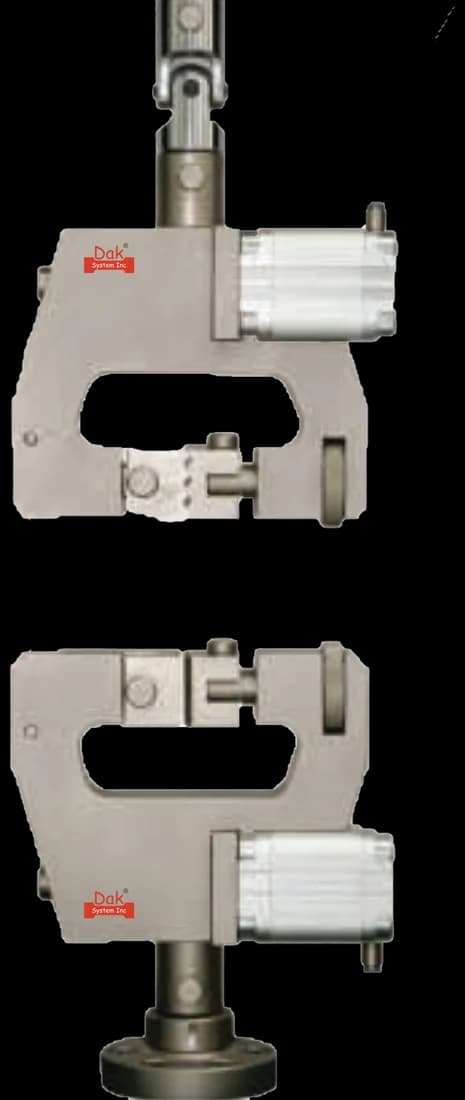
Light jaws with a soft or rubber-coated face, holding a thin film and a coated paper without cutting either. Jaw alignment matters: a peel that starts crookedly never straightens, and the trace shows it as a slow rise rather than a fault.
Seal peel forces are typically a few newtons and sometimes under one. A cell sized in newtons rather than kilonewtons is what makes the difference between a readable trace and a flat line — this is a resolution problem, not a capacity one.
Reference to ISO 11607-1 and the edition, and to the test method used
Materials of both webs and the sterile barrier system design
Sealing equipment and the settings being qualified
Which seal edge each specimen came from
Sterilisation process applied, if any
Ageing condition, accelerated or real time
Specimen width and peel rate
Average seal strength per specimen, per unit width
Failure mode per specimen
Comparison against the specified upper and lower seal strength limits
What the machine must be capable of
Peel forces are very low: typically a few newtons, sometimes under one. This is the least demanding test in the batch in terms of force and among the most demanding in terms of resolution, so a low-capacity frame with a load cell sized in newtons rather than kilonewtons is essential. Force accuracy to ISO 7500-1 Class 1 over that working range is the requirement.
Grips must hold a thin film and a coated paper without cutting either. Light-duty pneumatic jaws with a soft or rubber-coated face are the usual answer, and jaw alignment matters because a peel that starts crookedly never straightens.
The result is taken from an average force over a length of peel rather than from a peak, so continuous logging over the whole separation and enough crosshead travel to complete it are both required.
What goes wrong in practice
Reporting a peak instead of an average is the commonest analysis error and it overstates the seal. Specimens taken from one edge of the pouch miss the weak edge. A load cell sized for the frame rather than the seal turns a two-newton trace into noise. And reporting a force without the failure mode leaves out the half of the result that says whether the pack will peel or tear.
The medical packaging test set
Seal strength is one of four questions asked of a sterile barrier system, and it is the only one that needs a tensile frame.
Seal strength (ASTM F88)
Burst (ASTM F1140)
Dye penetration (ASTM F1929)
Bubble leak (ASTM F2096)
Tests
A strip of seal
The whole pack
The seal for channels
The whole pack for leaks
Equipment
A tensile frame
A pressurising rig
Dye and a light box
A vacuum tank
Result
A force per unit width
A burst pressure
Pass or fail
Pass or fail
Finds
Weak or over-strong seals
The weakest point of the whole pack
Channel defects in the seal
Pinholes anywhere
A strip test can pass while the pack fails, because a strip does not sample the corners where sealing tooling is least consistent. Burst and leak testing challenge the whole system and are not optional extras alongside seal strength.
Questions we are asked about this test
What is ISO 11607-1?+
ISO 11607-1 specifies requirements and test methods for materials, preformed sterile barrier systems, sterile barrier systems and packaging systems intended to keep terminally sterilised medical devices sterile until the point of use. The current edition is ISO 11607-1:2019, the second edition, adopted in the United States as ANSI/AAMI/ISO 11607-1:2019 and amended in 2023. Part 2 covers validation of the forming, sealing and assembly processes.
Is it a test method?+
No, and this is the most useful thing to know about it. It is a requirements standard: it says what a sterile barrier system must achieve and points to test methods that demonstrate it. Where the system is formed by sealing, it requires that specified requirements for seal width and seal strength are met, and seal strength is then measured by a referenced method — ASTM F88/F88M in most laboratories.
Why is there an upper limit on seal strength as well as a lower one?+
Because the pack has two jobs that conflict. It must maintain sterility until use, which argues for the strongest seal possible, and it must open cleanly at the bedside without tearing the web or shedding fibres into a sterile field, which argues for the weakest seal that will hold. Seal strength is where those two are reconciled, so a specification normally sets both limits and a value above the upper one is a failure just as a value below the lower one is.
Why does the failure mode matter?+
Because it tells you how the pack will open. An adhesive peel, where the two webs separate cleanly at the interface, is what a peelable pouch is designed to do. Delamination of the paper or fibre tear means the seal is stronger than the substrate: the pack opens by ripping rather than peeling and can shed particles at exactly the wrong moment. Two packs with the same peel force and different failure modes are not equivalent.
Where should specimens be taken from?+
From every edge of the seal. A pouch seal is formed by different parts of the sealing tooling on each side, and consistency between them is one of the things being validated. Cutting all the specimens from one convenient edge produces a tight, reassuring set of numbers about that edge, and the pack will fail at whichever edge nobody sampled.
Why is ageing part of the requirement?+
Because the shelf-life claim is. A sterile barrier system is labelled with an expiry date, and the evidence for that date has to include seal strength after real-time or accelerated ageing and after whatever sterilisation process the product goes through. Ethylene oxide, gamma and steam all change the materials to different degrees. The as-made figure says only that the pack was sealed correctly today.
What machine does it need?+
A small frame with a load cell sized in newtons. Seal peel forces are typically a few newtons and can be under one, so force accuracy to ISO 7500-1 Class 1 over that low range is the requirement and capacity is irrelevant. Grips must hold a thin film and a coated paper without cutting either, and the result is taken as an average over the peel length, so continuous logging and enough travel to complete the peel in one pass are both needed.
This page describes the method as practised. The governing text is the current edition from the issuing body. Tell us what you are testing and we will answer with the machine, the fixture and a quotation.